Can Dogs Eat Chocolate? No — Why It Is Bad and What to Do If Your Dog Eats Some

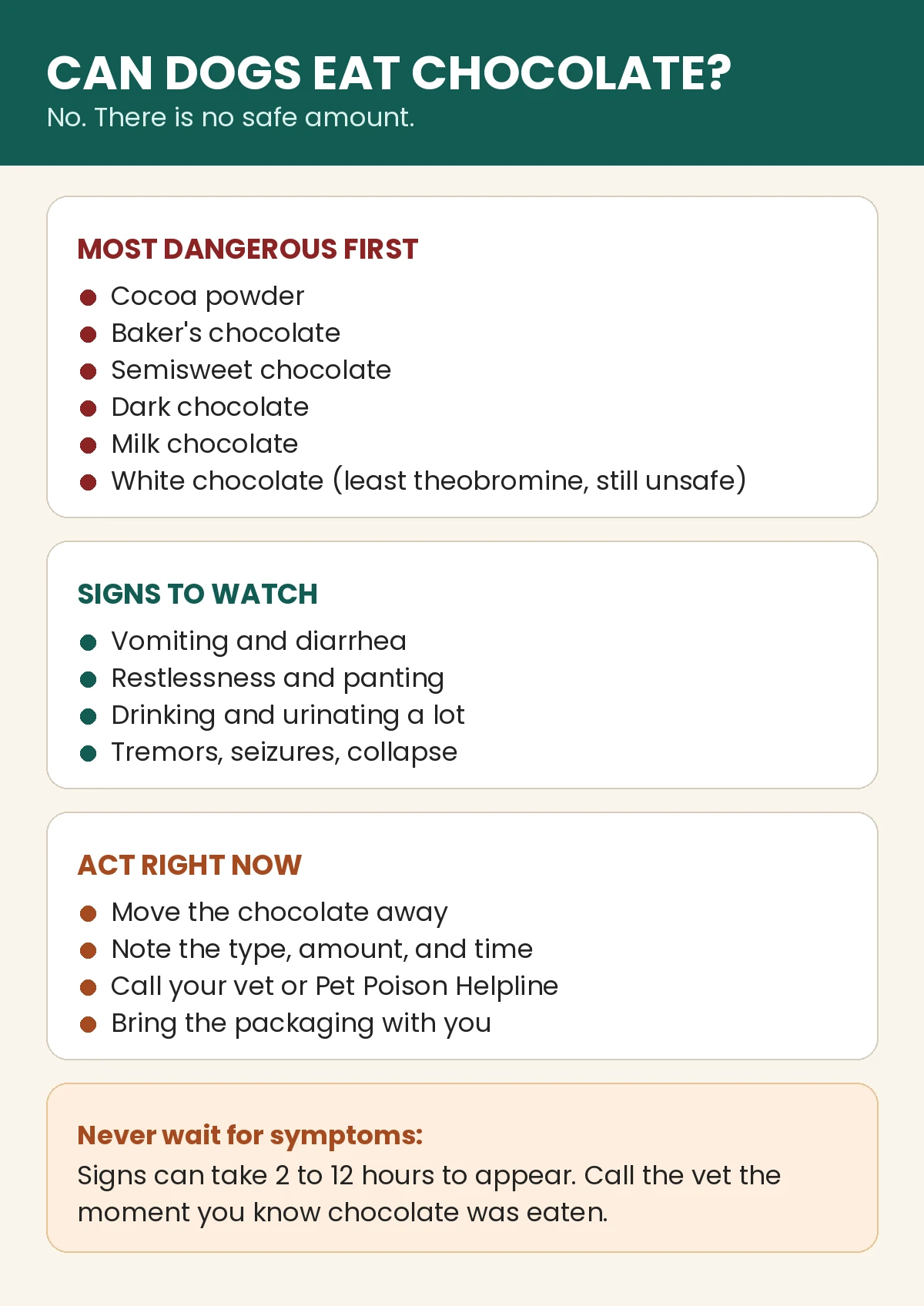
No. Dogs must never eat chocolate. There is no safe amount, no safe type, and no safe way to prepare it. Chocolate contains theobromine and caffeine, two stimulants that dogs clear from their bodies far more slowly than people do. Even a small piece can poison a small dog, and a large amount can kill any dog. If your dog eats chocolate, call your vet or a pet poison helpline right away. Do not wait for symptoms to appear.
Why Chocolate Is Toxic to Dogs
Chocolate comes from the roasted seeds of the cacao tree. Those seeds carry two toxic compounds for dogs: theobromine and caffeine. Vets group them as methylxanthines. Theobromine does most of the damage, and it sits in chocolate at roughly 3 to 10 times the concentration of caffeine.
These compounds overstimulate a dog’s nervous system and heart. They block adenosine receptors in the cells, which speeds up the heart, raises blood pressure, and excites the nervous system. They also act as diuretics, so a poisoned dog drinks and urinates far more than usual. The Merck Veterinary Manual puts the half-life of theobromine in dogs at about 17.5 hours, against roughly 4.5 hours for caffeine. That slow clearance explains why a dose that barely affects a person can build up and harm a dog for a day or more.
People handle theobromine easily because the human liver breaks it down fast. Dogs lack that speed. Size, age, and individual sensitivity also shape the outcome, but no dog digests chocolate safely. Puppies and small dogs face the highest risk because the same piece of chocolate delivers a bigger dose per pound of body weight.
Chocolate also carries fat and sugar. The fat can upset the stomach and, in some dogs, trigger pancreatitis — inflammation of the pancreas — 24 to 72 hours after eating. That risk sits apart from the theobromine poisoning itself, so a dog can face two problems from one piece of chocolate.
Which Types of Chocolate Are Most Dangerous?
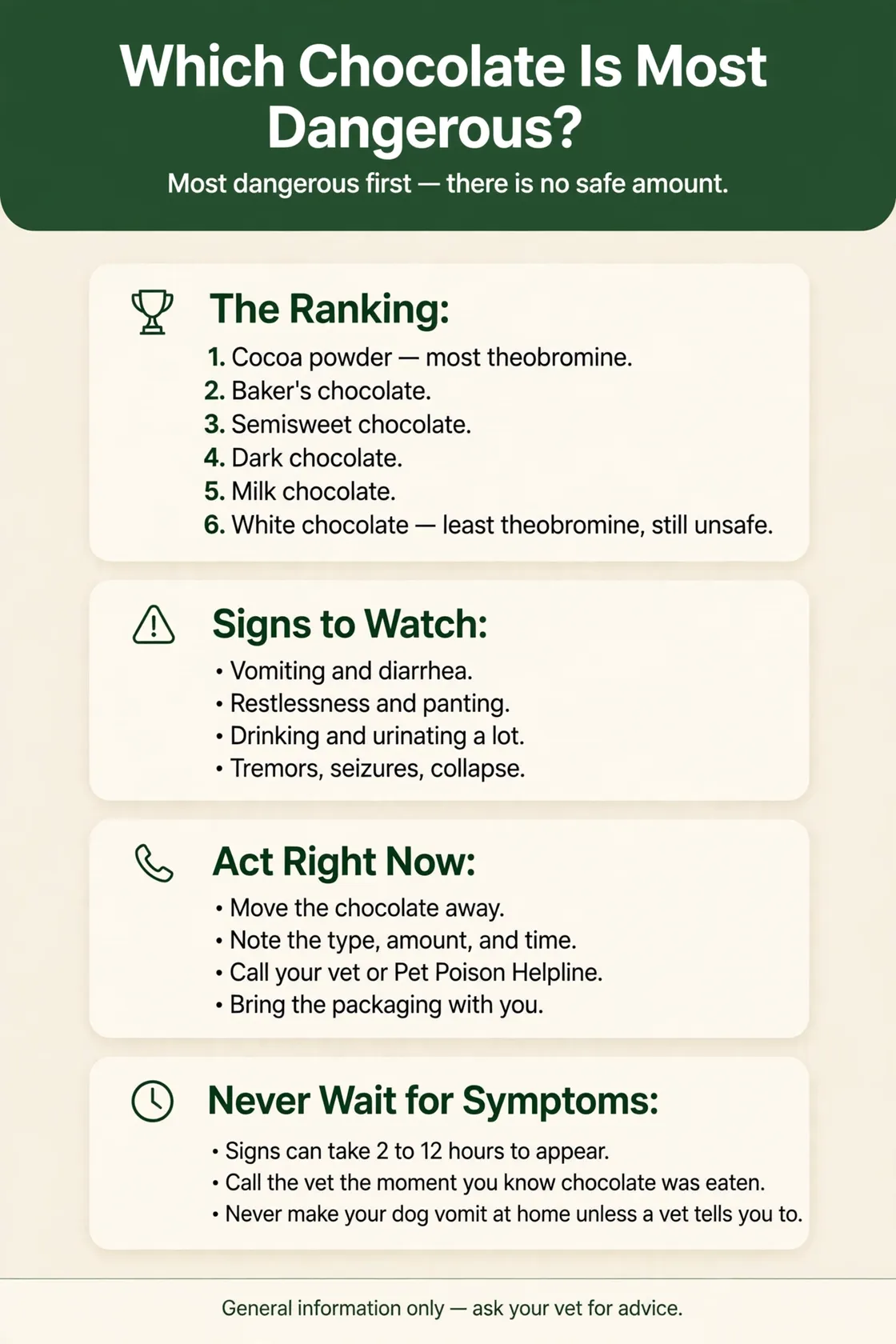
The darker and more bitter the chocolate, the more theobromine it holds. Cocoa powder and unsweetened baking chocolate top the list. Milk chocolate holds far less, and white chocolate holds almost none. Banfield Pet Hospital ranks the types from most harmful to least harmful like this: cocoa powder, baker’s chocolate, semisweet chocolate, dark chocolate, instant cocoa powder mix, milk chocolate, and white chocolate.
The theobromine content per ounce differs by type and by product, and sources disagree on exact figures. The FDA’s archived guidance lists milk chocolate at 44 mg of theobromine per ounce, semisweet chocolate chips at 150 mg per ounce, and baking chocolate at 390 mg per ounce.
MasterClass lists white chocolate at about 1.1 mg per ounce, milk chocolate at about 64 mg per ounce, and baker’s chocolate at up to 450 mg per ounce. The milk chocolate figures conflict (44 vs 64 mg per ounce), so treat every number here as an approximate range, not an exact value.
The ranking itself does not conflict: every source agrees that cocoa powder and baking chocolate are the most concentrated and white chocolate the least.
White chocolate deserves a clear warning of its own. It holds hardly any theobromine, so theobromine poisoning is unlikely from white chocolate alone. But its fat and sugar can still cause vomiting, diarrhea, and pancreatitis. White chocolate also often hides other dangers, such as raisins and macadamia nuts, which are toxic to dogs in their own right.
How Much Chocolate Is Toxic?
No amount is safe to feed on purpose. The figures below exist only so a vet can judge an accident. Never use them as permission to give chocolate.
Vets measure toxicity in milligrams of methylxanthines per kilogram of body weight (mg/kg). The American Kennel Club and the ASPCA Animal Poison Control Center agree on the thresholds: mild signs such as vomiting and diarrhea begin at about 20 mg/kg, heart effects appear at about 40 to 50 mg/kg, and seizures occur at about 60 mg/kg and above. The LD50 — the dose that kills half of animals in tests — sits at 100 to 200 mg/kg, but severe and life-threatening signs can appear well below that dose.
The FDA’s archived guidance translates the risk into amounts of chocolate: about 1 ounce of milk chocolate per 1 pound of body weight is potentially lethal, 1 ounce of semisweet chocolate per 3 pounds of body weight is potentially lethal, and 1 ounce of baking chocolate per 9 pounds of body weight is potentially lethal. The ASPCA puts it the same way: less than 1 ounce of milk chocolate per pound of body weight, and less than 0.1 ounces of baking chocolate per pound, can kill a dog.
A worked example shows how little it takes. A 10-pound dog needs only about 17 grams of dark chocolate — two squares — to reach the mild-toxicity threshold, and about 6 grams of baking chocolate. Individual dogs vary, and severe signs have shown up at doses below the published figures. Treat every threshold as a reason to call the vet, not as a reason to relax.
Three factors decide the risk: the type of chocolate, the amount eaten, and the dog’s weight. A large dog that eats one milk chocolate drop faces far less risk than a small dog that eats a baking chocolate bar. But the vet makes that call, not the owner. Always call, even if the amount looks small.
Signs of Chocolate Poisoning
Signs range from mild stomach upset to death. Watch for them in this order of severity:
Cornell University’s veterinary school lists the same progression, adding increased thirst and urination, hyperexcitability, incoordination, and coma. The ASPCA adds bloating, excessive drooling, and low blood pressure in some cases. If your dog vomits up chocolate on its own, treat that as a clear warning sign, not as proof that the danger has passed.
How Soon Do Symptoms Appear and How Long Do They Last?
Timing varies, so here is the range. The American Kennel Club says signs typically develop within 6 to 12 hours and can last up to 72 hours. Cornell says signs may occur within 2 to 12 hours and last 12 to 36 hours, sometimes longer in severe cases. Dogster says signs start within a few hours but can take 12 to 24 hours to appear. The ASPCA says signs usually occur within 6 to 12 hours.
Put together, expect signs within 2 to 12 hours in most cases, occasionally up to 24 hours, and expect them to last from half a day to three days. The theobromine’s long half-life explains the slow tail. Do not wait for signs to appear. By the time a dog looks very sick, treatment has already become harder. Call the vet the moment you know chocolate was eaten.
My Dog Ate Chocolate — What to Do Right Now
Act fast. Every source agrees that early action decides the outcome. Follow these steps in order.
- Move the chocolate away. Stop your dog from eating any more. Pick up dropped pieces and close the packet.
- Work out what your dog ate. Note the type of chocolate, the cocoa percentage if the wrapper shows it, roughly how much is missing, and the time your dog ate it. Weigh what is left in the packet if you can — a kitchen scale beats a guess.
- Call your vet or a poison helpline immediately. Call your vet first. If the office is closed, call the Pet Poison Helpline at 855-764-7661 or the ASPCA Animal Poison Control Center at 888-426-4435. Tell them your dog’s weight, the type of chocolate, the estimated amount, and the time it was eaten.
- Bring the packaging. The wrapper carries the cocoa percentage, which is the single most useful number for the vet. Bring it to the clinic if the vet asks you to come in.
- Follow the vet’s instructions. The vet may tell you to monitor your dog at home or to bring the dog in at once. If the vet asks you to come in, go. Do not try to treat the poisoning yourself.
What NOT to Do
Do not wait to see if symptoms appear. Chocolate absorbs slowly, so a dog can look fine for hours while the theobromine builds up. Do not induce vomiting yourself. Only a vet should decide that, and only within the right time window. Home vomiting attempts can cause choking, aspiration, or more harm. Do not give your dog activated charcoal, milk, food, or home remedies unless the vet tells you to. Do not give your dog any human medicine. And do not assume a small amount is safe — the vet judges the dose, not the owner.
How Vets Treat Chocolate Poisoning
Treatment depends on how much chocolate the dog ate, when it was eaten, and how sick the dog looks. The vet handles life-threatening signs first, then works to remove the toxin.
If the dog ate the chocolate within the last few hours, the vet may induce vomiting with medication, even if a few hours have passed, because chocolate absorbs slowly. The vet may then give activated charcoal by mouth, which binds the remaining toxin so it passes through the body instead of entering the bloodstream. Cornell notes that most patients need hospitalization.
For more serious cases, treatment can include IV fluids, antinausea medication, stomach protectants, medicine to stop tremors, medicine to steady an irregular heart rhythm, and medicine to stop seizures. The vet may use a urinary catheter or frequent walks to encourage urination, which helps clear the toxin. Dogs with seizures may need hospitalization and overnight observation, with cardiac monitoring. The vet decides each step from the dog’s condition. No home treatment replaces this care.
Chocolate in Other Foods

Chocolate hides in many foods, and every one of them counts. Chocolate cake, brownies, chocolate chip cookies, chocolate ice cream, hot chocolate, chocolate cereal, and chocolate-covered fruit or nuts all carry theobromine. Baking supplies — chocolate chips, cocoa powder, and prepackaged mixes — are especially dangerous because they are concentrated and easy for a dog to reach in a pantry.
Cocoa bean hull mulch poses a garden risk that many owners miss. The ASPCA warns that dogs dig in it and eat it because it smells attractive. It carries the same methylxanthines as cocoa powder. Keep it out of gardens where dogs roam.
Chocolate-flavoured foods and “dog chocolate” treats need a clear distinction. Real chocolate in any form is unsafe. Some dog treats use carob, a chocolate lookalike made from the carob tree, which contains no theobromine. The American Kennel Club suggests carob treats as a safe alternative. Check the label: if it lists cocoa, chocolate, or theobromine, do not give it to your dog.
Other Toxic Ingredients Often Found With Chocolate
Chocolate rarely travels alone. Raisins and macadamia nuts often sit inside chocolate bars, cookies, and trail mixes, and both are toxic to dogs on their own. Xylitol, a sugar substitute, appears in sugar-free chocolate and gum and is extremely toxic to dogs. A chocolate product that contains any of these adds a second poisoning risk on top of the theobromine. Tell the vet about every ingredient on the wrapper, not just the chocolate.
Safe Alternatives to Chocolate

Dogs do not need chocolate, and no nutrient in chocolate justifies the risk. Offer treats made for dogs instead. Carob treats give a dog the chocolate-like flavour without theobromine. Plain dog biscuits, small pieces of cooked chicken, banana slices, and sliced carrots all work as safe rewards. Keep the treat small and count it toward the dog’s daily food so the dog does not gain weight.
How to Prevent It
Prevention beats treatment every time. Store all chocolate products — bars, baking chocolate, cocoa powder, hot chocolate mix, and chocolate baked goods — on a high shelf in a closed pantry, where a dog cannot reach them. Keep chocolate out of bags, coat pockets, and low tables. Watch for chocolate during holidays such as Halloween, Valentine’s Day, and Easter, when chocolate fills the house and dogs find it easily. Teach a reliable “leave it” cue so your dog drops food on command instead of swallowing it. Crate training adds another layer of protection when you cannot supervise your dog. Dispose of chocolate wrappers in a closed bin, because dogs dig through open trash.
One more group deserves a note. The ASPCA reports that methylxanthines can cross the placenta and pass into a mother’s milk, so unborn or nursing puppies can suffer if the mother eats chocolate. Keep chocolate away from pregnant and nursing dogs with the same care.