How Often Should You Bathe Your Dog? A Schedule by Coat Type

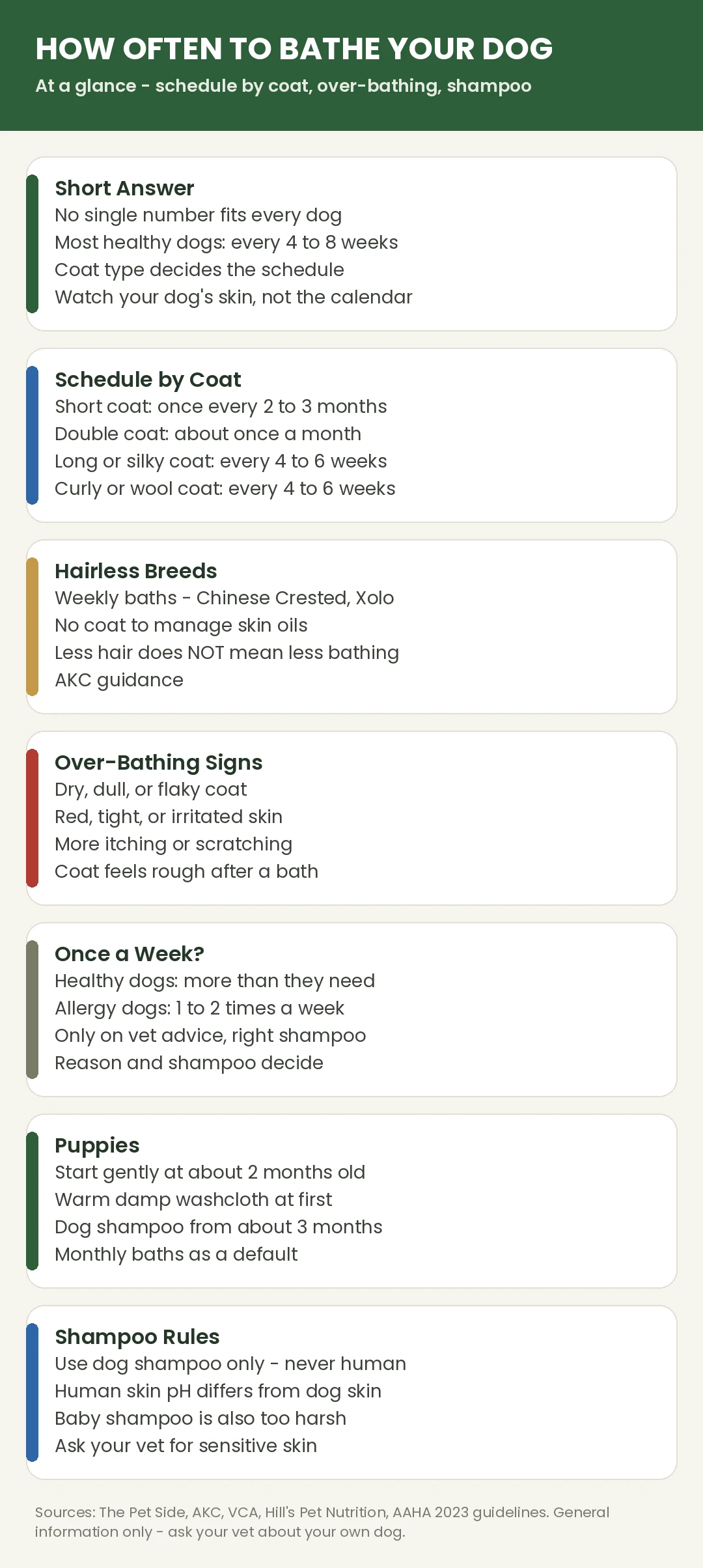
How often should you bathe your dog? There is no single number that works for every dog. Most healthy adult dogs do well with a bath somewhere between every four weeks and every three months, and four to eight weeks is a sensible starting point. Coat type drives the answer more than anything else: hairless breeds need weekly baths, while short-coated dogs can go two to three months. Skin health, activity, and age shift the schedule further. This guide gives you a schedule by coat type and breed, explains what over-bathing does to skin, covers puppies and dogs with skin problems, and answers the practical questions owners ask most.
Key Takeaways — Short Answer
What Decides How Often Your Dog Needs a Bath?
Four factors do most of the work: coat type, skin condition, activity level, and age.
Coat type is the single biggest variable. A short-haired dog with no undercoat sheds dirt and oil differently than a double-coated dog built for insulation, and both differ again from a wool-coated dog whose hair never stops growing. The AKC’s grooming experts put it bluntly: the amount of hair a dog has ties directly to how much bathing and brushing it needs. Less hair does not mean less bathing — some hairless breeds need more frequent baths than many long-haired ones.
Skin condition comes next. A dog with healthy, intact skin can go longer between baths than a dog managing allergies, a chronic skin condition, or a history of skin infections. For dogs with diagnosed allergic skin disease, vet guidelines actually recommend more frequent bathing, because washing physically removes allergens such as pollen, dust, and dander from the coat before they can sink into the skin. That only works with dog-appropriate products and, ideally, your vet’s input.
Activity level and environment matter too. A dog that spends its days in a fenced yard smells and looks different after a week than a dog that swims in ponds, works outdoors, or rolls in whatever it finds on a walk. Dogs that get muddy, wet, or into something smelly need spot baths or full baths as needed, separate from their regular schedule.
Age changes the picture as well. Puppies have different skin and temperature needs than adult dogs, and very young or very senior dogs may need gentler, less frequent bathing because their skin barrier is more fragile or their tolerance for the process is lower.
Bathing Schedule by Coat Type
Use this table as a starting point, not a deadline. Always adjust for your dog’s skin, lifestyle, and any vet guidance you have received.
Short-haired breeds. Beagles, Boxers, Weimaraners, Dalmatians, and Greyhounds have a single, short coat and need the least frequent bathing of any coat type. Hill’s Pet Nutrition notes that a healthy short-coated dog without skin problems often does fine with a bath once every two to three months, and that baths for these dogs are often more about the owner’s comfort than a real hygiene need.
Between baths, a damp washcloth wipe-down after a walk or a good brushing session usually covers routine cleanliness. Genghis Collar gives a shorter interval — every 4 to 6 weeks for short, smooth single coats — so treat the honest range as every 4 weeks to every 3 months, with most short-coated dogs landing toward the longer end.
Double-coated breeds. Labrador Retrievers, Golden Retrievers, Siberian Huskies, and German Shepherds carry a coarse outer coat and a soft, insulating undercoat. This double-coat system does seasonal work insulating against cold and heat, and over-bathing can strip the natural oils that keep it working. These dogs generally do well with monthly bathing, with extra baths around their heavy shedding seasons, typically spring and fall, when a bath can help loosen and remove the blown undercoat.
Long or silky-coated breeds. Maltese, Yorkshire Terriers, Afghan Hounds, and toy breeds with continuously growing coats tend to need bathing more often than short-haired dogs — generally every four to six weeks, paired with frequent brushing in between to prevent mats and tangles. Pomeranians sit in a related category: their thick double coat sheds seasonally like other spitz-type breeds, so the same general monthly-to-six-week guidance applies, with regular brushing between baths just as important as the bath itself.
Curly or wool-coated breeds. Poodles and poodle mixes have hair that grows continuously rather than shedding on a cycle. Loose hair and dander get trapped in the coat instead of falling out, so these dogs often need bathing on a schedule closer to every four to six weeks, generally paired with professional grooming for haircuts and de-matting.
Hairless breeds. This is the one category where the “less hair means less bathing” instinct breaks down completely. Chinese Cresteds and Xoloitzcuintlis lack the coat that would normally help regulate oil production and protect the skin, so the AKC notes these breeds typically need weekly baths to manage oil buildup and keep the exposed skin healthy.
Bathing Schedule by Breed
Breed examples sharpen the picture, but remember that individual dogs vary. Forever Vets gives these breed-specific answers: Labradors usually need a bath at most monthly, or as little as once every three months — too much bathing can strip important natural oils and irritate their skin.
Golden Retrievers have a much thicker coat than Labradors, so experts recommend a bath at least every six weeks. Shih Tzus need a bath about every three weeks to keep skin and hair healthy and prevent bad smells. Poodles do best with a bath every three weeks. Bichon Frises may need a bath every two weeks, plus regular trims to prevent matting.
Dachshunds, long-haired and short-haired alike, need a bath only about every three months, assuming they stay out of messes.
The sources conflict on a few breeds, and this guide shows the conflicts. Genghis Collar puts Labradors and other short, dense double coats at every 3 to 6 weeks, while Forever Vets says monthly to once every three months for Labradors. The Pet Side puts curly coats at every 4 to 6 weeks, while Forever Vets says every two weeks for Bichon Frises. Use the range, watch your dog’s skin, and ask your vet if you are unsure.
Can You Bathe a Dog Too Often?
Yes. More bathing is not automatically better hygiene. Past a certain point, it actively works against skin health. Dog skin carries a thin protective layer called the acid mantle, which helps block bacteria and viruses and helps the skin hold moisture. Every bath temporarily washes away that layer. Dog shampoos are formulated to help that barrier rebuild rather than strip it further.
Dog skin also differs from human skin in two concrete ways. Human skin runs more acidic, roughly pH 5.2 to 6.2, while dog and cat skin sits at a more neutral pH of about 6.2 to 7.5. Dogs also have only about three to five layers of skin cells, compared with a human’s ten to fifteen. That thinner barrier breaks down more easily under harsh products or excessive washing.
Research backs the caution, with limits. A 2023 study in Frontiers in Veterinary Science bathed 16 Labrador Retrievers daily with a dilute dish detergent solution over 14 days and tracked changes in their skin bacterial communities. Repeated daily bathing significantly altered the dogs’ normal skin bacteria, reducing several bacteria groups typically found in healthy skin.
The conditions were extreme by pet-owner standards — daily bathing with dish detergent, a degreasing product, is a decontamination protocol for working dogs, not a home routine. The study supports the general principle that repeated harsh washing disrupts the skin’s microbial balance, but it does not tell us exactly where the line sits for a dog bathed weekly or monthly with a gentle dog shampoo.
That threshold has not been clearly established.
Signs You Bathe Your Dog Too Often
Watch for a dry, dull, or flaky coat; skin that looks red, tight, or irritated after bathing; increased itching or scratching; or a coat that feels rough instead of soft a day or two after a bath. Hill’s notes that over-bathing strips the natural oils dogs need for healthy skin and coat. If more frequent bathing is necessary for any reason, switching to a moisturizing shampoo or following up with a conditioner can help offset that effect. If you notice flaking, redness, or itching after baths, change the product, rinse more thoroughly, or adjust how often you bathe — and ask your vet if the signs persist.
Can I Bathe My Dog Once a Week?
For most healthy dogs with no skin conditions, weekly bathing is more than they need and can tip into over-bathing territory, particularly for double-coated or short-haired breeds whose skin does better with natural oils left in place between baths. That said, weekly or even twice-weekly bathing is not inherently harmful in every situation. It is part of standard vet management for some dogs.
The 2023 AAHA Management of Allergic Skin Diseases in Dogs and Cats guidelines identify routine bathing as one of the most effective tools for allergen avoidance in dogs with atopic dermatitis, and their treatment algorithm includes bathing once to twice weekly as part of managing environmental allergies. The Merck Veterinary Manual similarly notes that bathing decreases allergen load and is often the most effective way to implement allergen avoidance, with weekly to biweekly baths recommended for dogs managing atopic dermatitis. In active bacterial skin infection (pyoderma), vet dermatology guidance sometimes calls for even more frequent bathing during the initial treatment phase, tapering to a weekly maintenance schedule.
The difference between harmful weekly bathing and helpful weekly bathing comes down to two things: the reason, and the shampoo. Allergy-management bathing uses non-stripping, moisturizing, or medicated shampoos chosen to support the skin barrier, and it usually runs under a vet’s guidance. Bathing a healthy dog weekly with a generic shampoo “just because” is a different scenario, and one more likely to lead to dry, irritated skin. If you wonder whether once-a-week bathing fits your dog, bring the question to your vet — the right answer depends on your dog’s skin and health history.
Signs Your Dog Needs a Bath Sooner Than Scheduled
Regardless of the official schedule, some situations call for an out-of-cycle bath. Noticeable odor that does not improve with brushing, visible dirt, oily or greasy-feeling fur, rolling in something unpleasant, mud or debris after outdoor activity, or a recent flea or tick treatment that calls for bathing are all reasonable triggers for an unscheduled bath. None of these requires waiting for the next scheduled bath. Spot-cleaning or a full bath as needed is completely appropriate and does not count against your dog’s regular routine.
Puppies: When to Start and How Often
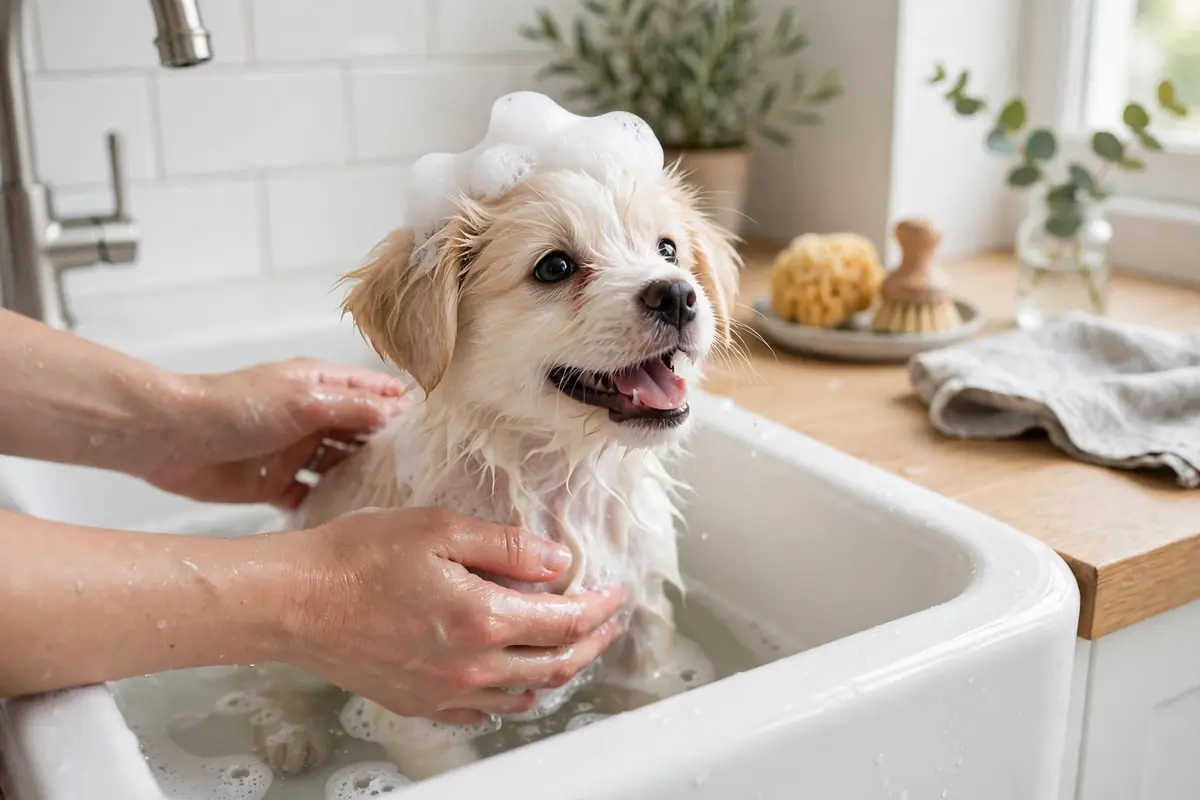
A puppy’s first baths are short, warm, and gentle.
Puppy skin and coat care starts more gently and gradually than adult dog bathing. According to grooming experts consulted by the AKC, you can reasonably begin a bathing routine at around two months old to help puppies get comfortable with the process.
In the early months, keep it very gentle — use a warm, damp washcloth rather than full submersion or shampoo until the puppy is closer to three to four months old. Shampoos and conditioners formulated for dogs typically come in once a puppy is at least three months old.
Even then, stay gentle: soft water pressure, no scrubbing, and careful attention around the eyes, ears, and face, since a puppy’s ear canals can trap water and lead to ear infections.
Once a puppy is old enough for a full, regular routine, monthly bathing is a reasonable default to start with, adjusted from there based on coat type and mess-related exceptions, the same way it would be for an adult dog. Use the monthly default and your vet’s advice.
Dogs With Skin Problems
If your dog has diagnosed allergies, atopic dermatitis, or a history of recurrent skin or ear infections, general bathing guidelines do not really apply. Your dog’s bathing schedule should come from your vet, not from a blog post. Vet guidelines support bathing as an active part of allergy management, sometimes as often as once or twice weekly, often paired with a specific shampoo: moisturizing shampoos with fatty acids, oatmeal, ceramides, or lipids for skin barrier support, or antimicrobial shampoos with chlorhexidine for dogs prone to recurrent bacterial or yeast infections.
If you notice new or worsening skin issues — redness, hair loss, scabbing, a strong odor even shortly after a bath, or excessive scratching — that is worth a vet visit rather than experimenting with more frequent home bathing. A dull or dry coat can also signal an issue unrelated to bathing frequency, including nutritional gaps or underlying joint or endocrine problems.
Do not invent one. Follow your vet’s instructions for your dog’s condition and shampoo.
Choosing the Right Shampoo
The shampoo matters as much as the frequency. Because dog skin sits at a different, more neutral pH than human skin, vet sources agree that human shampoo, including baby shampoo, is not a suitable substitute for dog shampoo, even in a pinch. A plain, hypoallergenic, dog-formulated shampoo without added fragrance is a reasonable default for routine bathing. Ask your vet for a specific recommendation if your dog has sensitive skin. Dish detergent such as Dawn is a degreasing decontamination product, not a routine shampoo.
Oatmeal shampoo suits many dogs with itchy skin, and flea shampoo serves a specific purpose when fleas are present.
Do not bathe your dog in dish soap on a regular schedule. If your vet prescribes a medicated shampoo, follow their instructions on how often to use it and how long to leave it on the skin before rinsing. Medicated bathing schedules can differ considerably from routine bathing. Do not add extra products without checking with your vet first.
How to Bathe Your Dog Safely, Step by Step
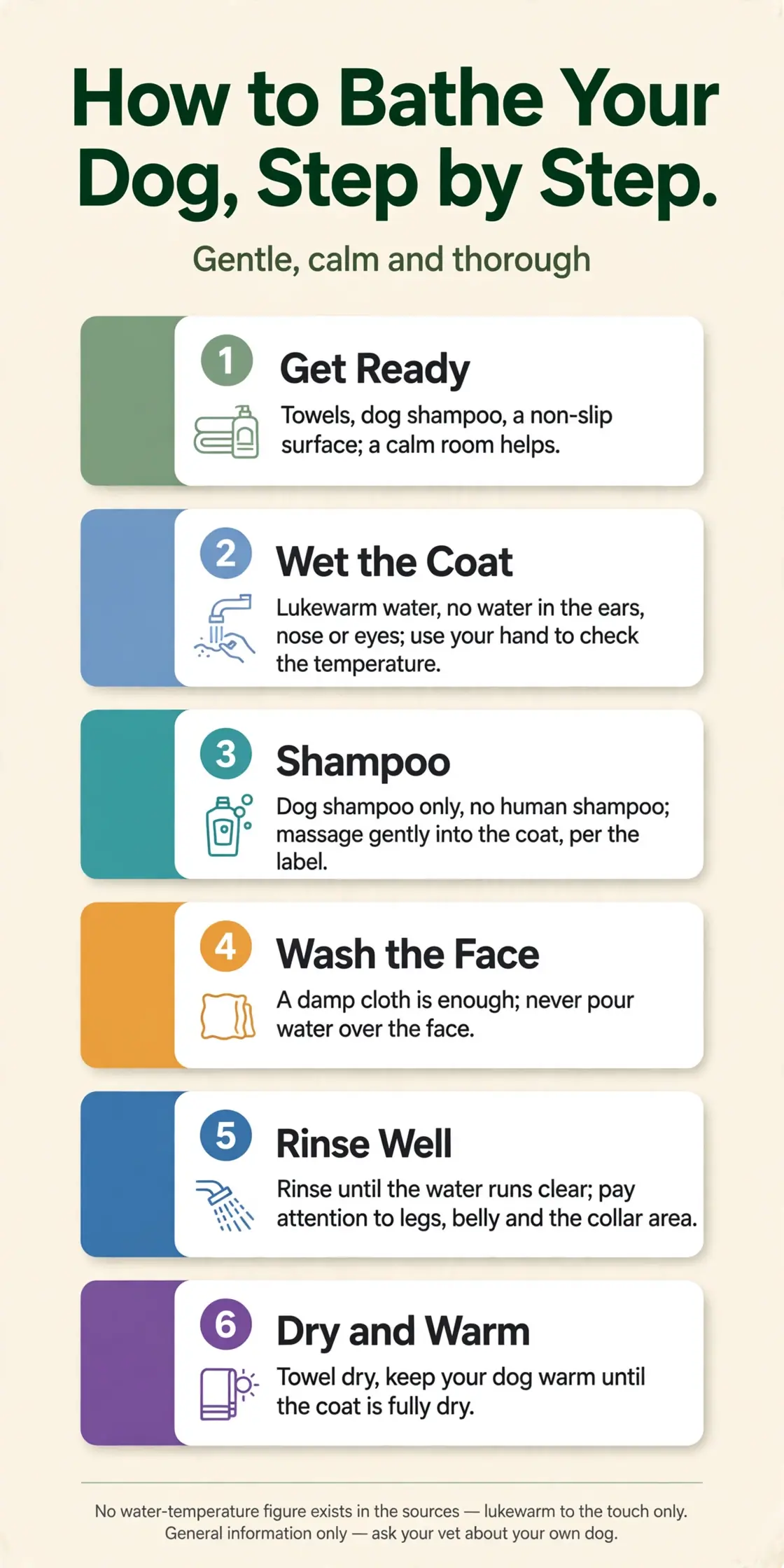
How to bathe your dog safely, step by step.
Prepare towels, dog shampoo, and a non-slip surface before you begin. Wet the coat with lukewarm water, keeping water out of the ears and away from the nose and eyes. Apply a dog-specific shampoo according to its label, including any dilution instructions. Avoid human shampoo and household cleaning products. Massage gently without scrubbing sore areas.
Use a damp cloth for the face rather than pouring water over the head. Rinse thoroughly, including under the legs, along the belly, and around the collar area, until no shampoo remains. Dry your dog well, and keep the dog warm until the coat dries. Use water that feels lukewarm to the touch.
Brushing and Professional Grooming Alongside Bathing
Bathing is only part of coat care. Brush often enough to remove loose hair and prevent tangles from tightening against the skin. The ASPCA recommends regular brushing to remove dirt, spread natural oils, and keep the coat clean and tangle-free.
Short, smooth coats need brushing about once a week with a soft brush or rubber grooming mitt, more often if loose hair builds up. Medium or long coats need brushing several times a week, checking behind the ears, under the legs, and around the collar daily for tangles.
Curly or continuously growing coats need combing daily or every other day, working gently down to the skin rather than brushing only the surface. Double coats need brushing several times a week, and more often during heavy shedding.
If your dog has a continuously growing or easily tangled coat, book professional grooming about every four to eight weeks, depending on coat length and how you care for it at home. Brush your dog’s teeth daily with dog toothpaste and a suitable toothbrush, and check nails and ears regularly.
FAQs: How Often Should You Bathe Your Dog?
Questions Without a Clear Answer
Ask your vet for a bathing schedule if your dog has mange, ringworm, a yeast infection, hot spots, or giardia. For anything not covered here, ask your vet.