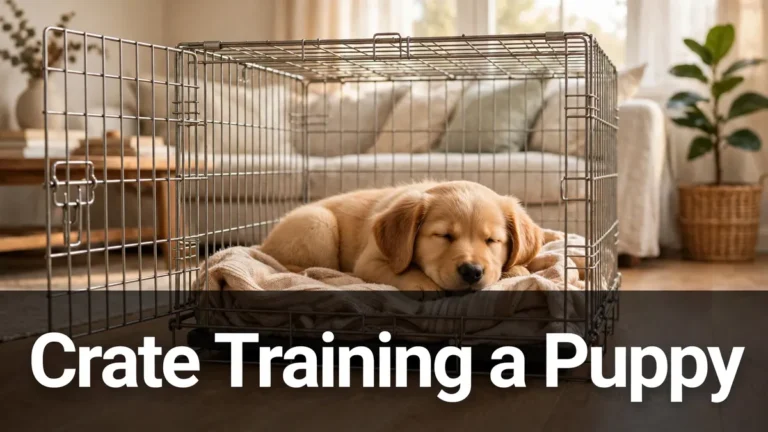
Potty Training a Puppy: Schedule, Crate Training, and How Long It Takes
Potty training a puppy is messy, repetitive, and — with the right routine — much simpler than it looks. There is no single magic method. Every approach that works shares the same three ingredients: a predictable schedule, close supervision, and an immediate reward every time the puppy goes in the right place. This guide gives you the age-by-age schedule, the crate method, the puppy-pad trade-off, and the honest answer to how long it takes.
1. Quick Answer — Start Day One, Keep a Schedule, Reward Every Success
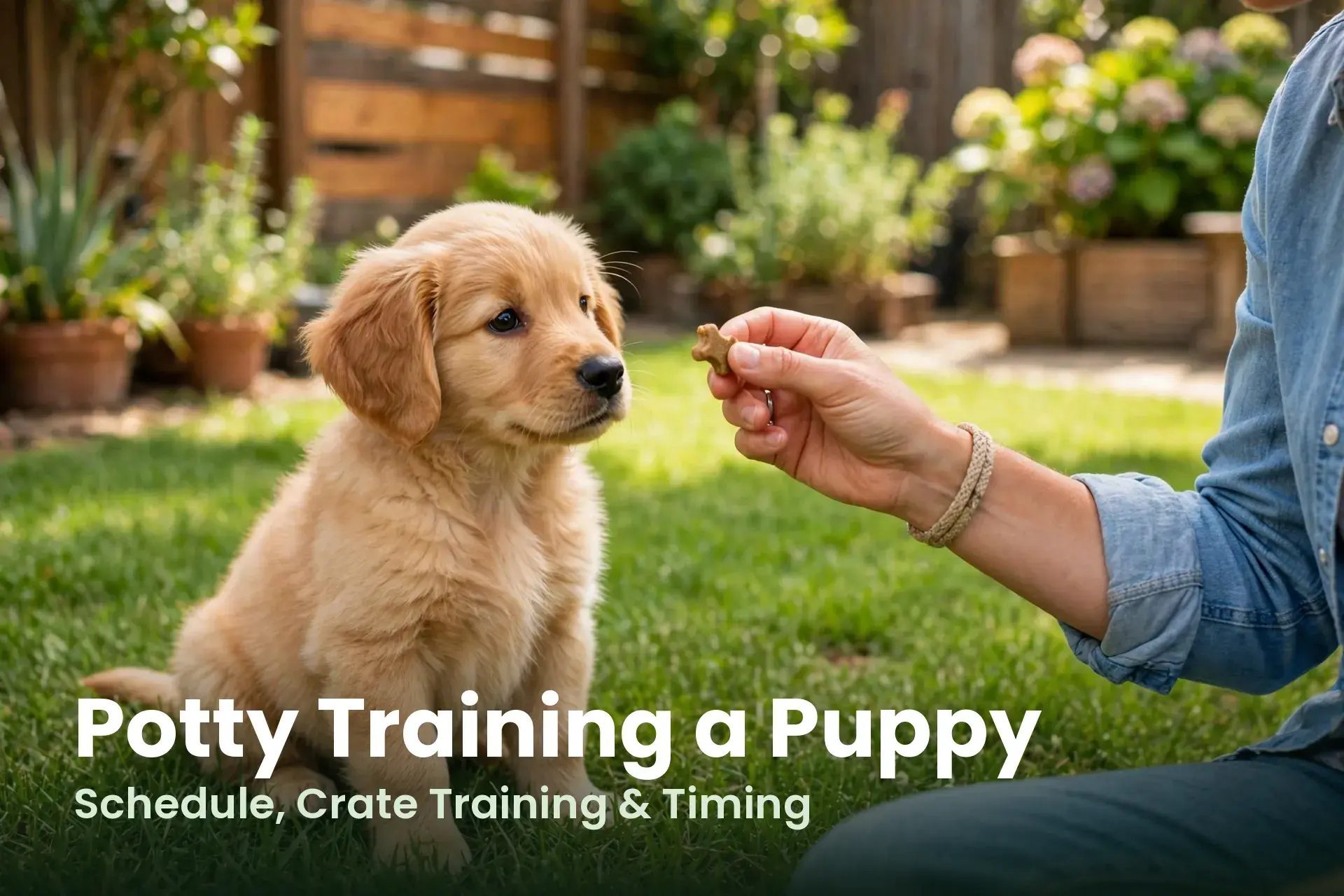
Start potty training the day your puppy comes home. Take the puppy out on a fixed schedule — first thing in the morning, last thing at night, and after every nap, meal, play session, and crate stay. Use a crate when you cannot supervise. Reward with a treat and praise the second the puppy finishes outside. Never punish an accident. Most puppies become reliably clean by 3 to 4 months with a tight schedule, according to PupWiki — but only if you keep the routine without exceptions.
2. When to Start Potty Training
Start the day the puppy comes home. The AKC says puppies start learning household routines immediately, and consistent expectations from the start prevent bad habits from forming. Most puppies arrive at their new homes at around 8 weeks old, which is also when their bladder control is at its weakest — so the first weeks need the most trips outside, not the fewest. The same rule applies whatever the dog’s age: starting housetraining right away helps any puppy understand where to go.
3. Before You Start — Supplies and Setup
Get three things ready before the puppy arrives, as PrepScholar puts it: containment, a designated bathroom area, and a reward. Containment means a crate, a baby gate blocking off one room, or a puppy playpen — somewhere small enough that the puppy treats it as a den and will not soil it. The bathroom area is one spot outside you use every time, or a wee mat kept in the same place indoors. The reward is small, tasty treats plus praise and gentle pats. Adopt-a-Pet adds a “go bag” by the door with treats, poop bags, and a leash, plus an enzymatic cleaner for accidents. Stock up before day one, not after the first accident.
4. The Bladder Rule — 1 Hour per Month of Age
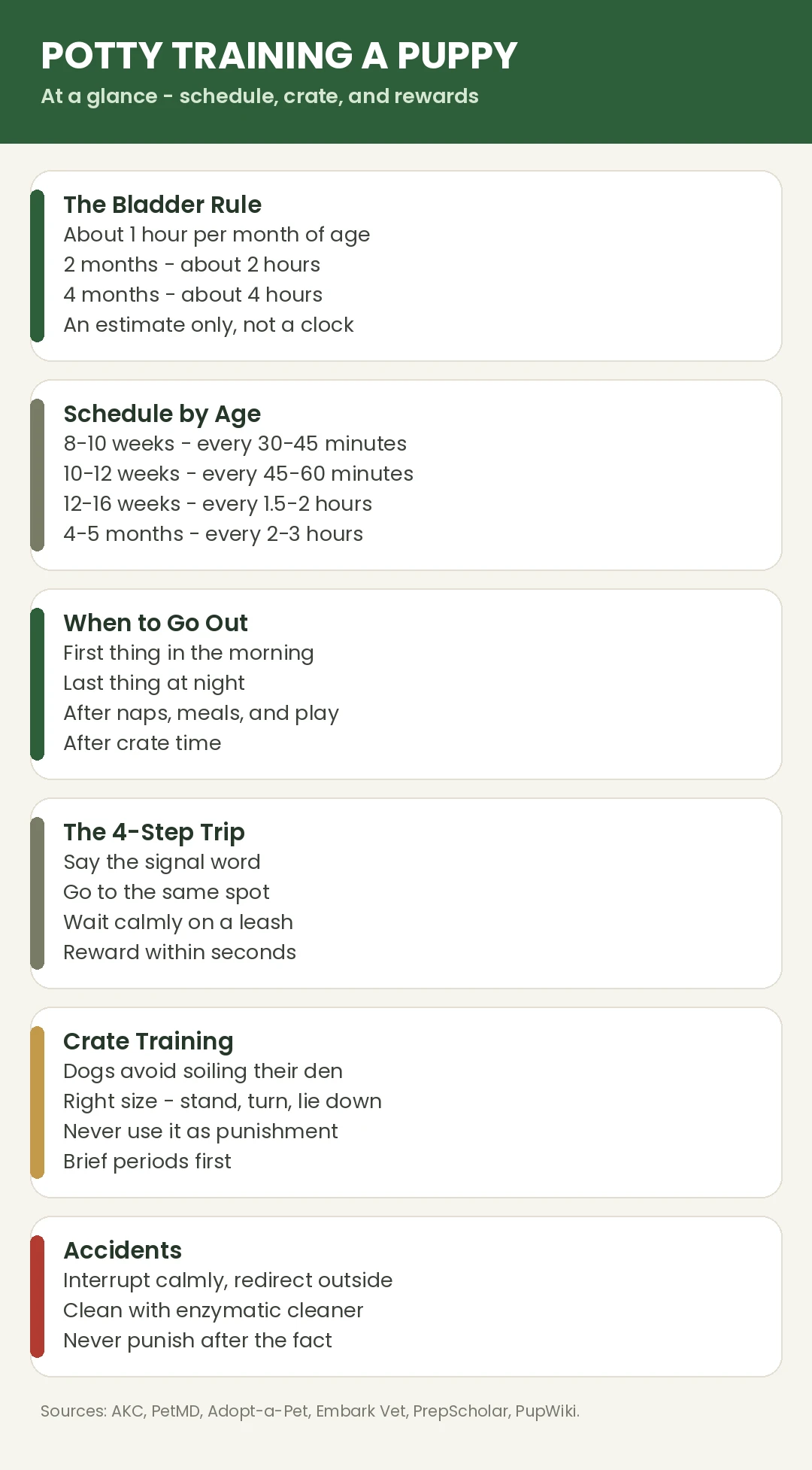
A commonly used guideline says a puppy can hold its bladder for roughly one hour for each month of age. PetMD calls this only an estimate, and it is. The AKC puts the ceiling at about 9 months to 1 year of age, while PupWiki puts the adult maximum at 8 to 10 hours — two different ceilings from two sources, so treat the rule as a rough guide, not a clock. A 2-month-old puppy holds for about 2 hours at most. A 4-month-old manages about 4 hours. Size matters too: toy breeds need more frequent trips throughout, and giant breeds develop bladder control faster than toy breeds relative to their age.
5. Potty Training Schedule by Age
This table comes from PupWiki. Other sources agree on the pattern but give less detail.
| Puppy age | Daytime frequency | Overnight trips | Signal word stage |
|---|---|---|---|
| 8–10 weeks | Every 30–45 minutes when awake; right after waking, eating, drinking, playing | 1–2 trips (typically 1–3 am and 4–5 am) | Introduce the signal word every time |
| 10–12 weeks | Every 45–60 minutes when awake; after all meals and activity | 1 trip (most nights) | Puppy begins to respond to the cue |
| 12–16 weeks | Every 1.5–2 hours when awake | 0–1 trips (some nights solid through) | Puppy uses the signal word reliably |
| 4–5 months | Every 2–3 hours; before and after longer absences | 0 trips (most puppies) | Puppy begins signaling to go out (scratching door, sitting by exit) |
| 5–6 months | Every 3–4 hours; can extend during quiet periods | 0 trips | Reliable signaling in place; accidents should be rare |
Other sources frame the same load differently: Embark says a new puppy needs a trip at least every couple of hours and 10 or more trips a day, and the AKC says a dozen or more times a day for a very young puppy. The PupWiki table is the most specific. Update the schedule as the puppy grows — what works at 8 weeks needs changing at 12 weeks, and again at 4 months.
6. The Daily Routine — When to Take Your Puppy Out
Take the puppy out at the same moments every day: first thing in the morning, last thing at night, after every nap, after every meal, after crate time, after drinking water, after chewing toys or bones, and after indoor play sessions. PetMD adds short training sessions to the list — teach “sit” and “come” in a brief session, then end with a potty break. Young puppies eat three meals a day, which means plenty of trips outside, and play itself increases the need to eliminate, so schedule a potty trip with every play session. Keep the routine identical every day — the repetition is what teaches the puppy.
7. The 4-Step Potty Trip
Every trip to the bathroom spot follows the same sequence. First, say the signal word — the same word or phrase every time, such as “go potty” — as you walk toward the door. Second, go to the same spot every time: the same patch of grass, the same quiet corner. The scent of past trips helps the puppy understand what the spot is for. Third, wait calmly on a leash. If nothing happens after about 15 minutes, bring the puppy back inside and watch closely — the need often arrives minutes later. Fourth, reward the second the puppy finishes: a treat and praise immediately, while you are still outside. A reward given indoors, minutes later, teaches nothing.
8. Crate Training
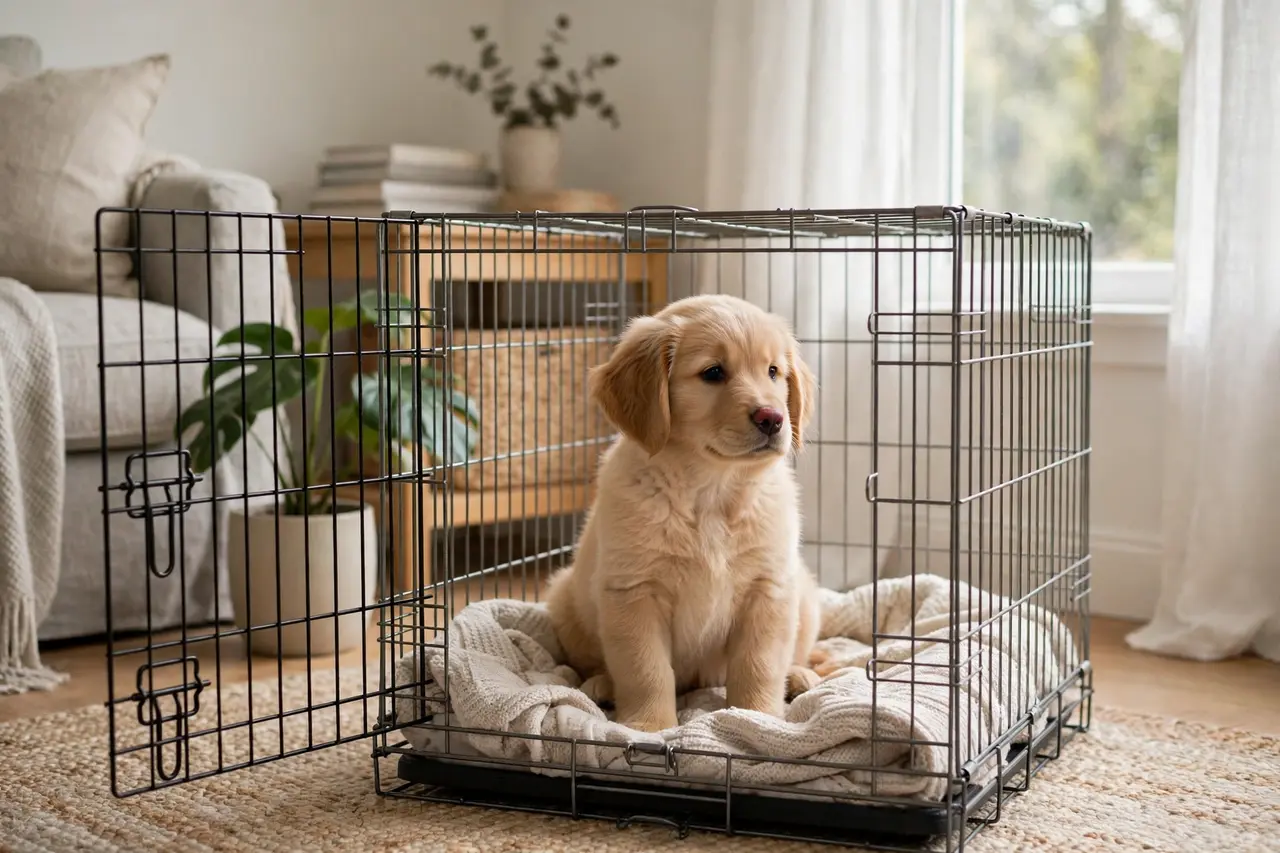
A crate is the most effective housetraining tool the AKC names, and the principle is simple: dogs prefer not to soil their sleeping area. Pick a crate big enough for the puppy to stand, turn around, and lie down comfortably — but not so big that the puppy can go potty in one corner and rest in another. Many crates have adjustable partitions so you can resize as the puppy grows.
Introduce the crate gradually: let the puppy explore it with the door open, feed meals inside, close the door for brief periods, then practice short absences while you stay nearby. PetMD’s crate guide says to work toward about 30 minutes of calm crate time while you are home before leaving the puppy alone. Never use the crate as punishment — that destroys the den feeling that makes it work. Do not crate a young puppy for more than a couple of hours during the day, and expect to give night breaks too.
Crate training takes days or weeks depending on the puppy’s age, temperament, and experience. If the puppy shows distress, stop and return to an easier step.
9. Puppy Pads and Indoor Potty Areas
Puppy pads give the dog an approved indoor spot, and they help owners who cannot return home often or who have very small dogs in severe winter weather. The trade-off is real: the AKC’s Dr. Burch says pad training is tricky because “you’re reinforcing two different options for the puppy” — indoors and outdoors at once.
In an ideal setup, the puppy learns to hold it indoors and only eliminate outdoors. Adopt-a-Pet and Embark treat pads as a valid indoor option, while the AKC treats them as a compromise. If you use pads, keep them in one place, use them inside a playpen to protect the floor, and plan the switch to outdoors early — the longer pads stay, the harder the switch gets.
10. How to Recognize the Signs
Watch for the signals and act fast. Embark lists pacing, panting, circling, sniffing the ground, and going to the door. The AKC adds whining, scratching, and becoming restless. When you see any of these, get the puppy outside as quickly as possible. The “umbilical cord” approach — keeping the puppy tethered to you with a six-foot leash when you move around the home, and using baby gates to block unsupervised rooms — catches these signals before they become accidents. A puppy that suddenly stops playing and starts sniffing in circles is telling you it needs to go right now.
11. Rewards That Work
Reward every success, every time, immediately. Embark says never go out for a potty break without the most delicious food rewards in your pocket. PetMD says to give treats immediately after the puppy pees or poops in the correct location. The AKC and Adopt-a-Pet agree: the same cue, then praise and a treat the second the puppy finishes outside. In the first few weeks, celebrate every single success big — the puppy connects the treat to the place only if the reward follows within seconds. As the habit firms up, you can fade the treats slowly, but keep the praise.
12. How to Handle Accidents
Accidents will happen — plan for them instead of fearing them. If you catch the puppy in the act, interrupt calmly and redirect outside at once; PrepScholar’s rule is to guide the right behavior and interrupt the wrong one, every time. If you find an accident after the fact, say nothing — the puppy cannot connect a punishment to something it did minutes ago.
Clean the spot with an enzymatic cleaner, which breaks down the scent that would draw the puppy back to the same place. Never punish: never rub the puppy’s nose in it, and never scold after the fact.
Punishment teaches the puppy to hide from you, not to hold it in.
13. Nighttime Potty Training
Young puppies cannot hold it all night, so plan overnight trips by age from the PupWiki table: 1 to 2 trips at 8 to 10 weeks, typically around 1 to 3 am and again at 4 to 5 am; 1 trip at 10 to 12 weeks; 0 to 1 trips at 12 to 16 weeks; and none by 4 to 5 months for most puppies.
Give a final potty break before crating for the night, and keep the night trip boring — no play, no long walk, straight out and straight back to the crate. Embark agrees that young puppies may need potty breaks during the night. If the puppy cries at night, take it out first and assume it needs the bathroom before assuming it wants attention.
14. Bell Training
Bell training teaches the puppy to ring a bell hung by the door when it needs to go out. Adopt-a-Pet lists it as “advanced bell training.” The basic idea is simple: hang a bell at nose height by the exit, help the puppy touch it with its nose or paw every time you go out, and reward the ring followed by the outdoor trip. Because only one source names it and none gives the steps, this article keeps it brief: it is a real option, it works best once the puppy already understands the outdoor routine, and it is not a starting method for week one.
15. Common Mistakes That Slow Training Down
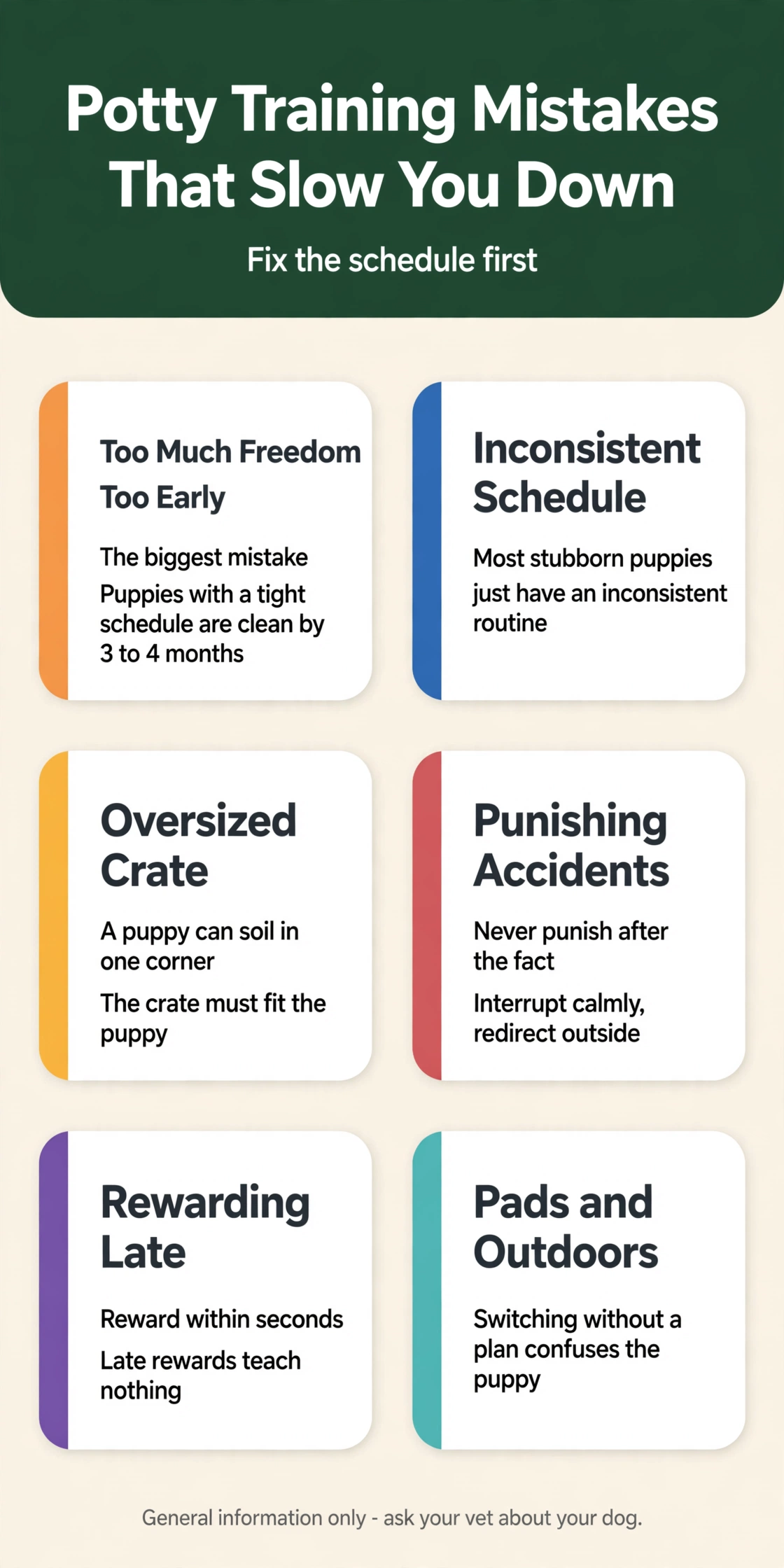
The biggest mistake is too much freedom too early. PupWiki says it plainly: the puppies that take six months to house train almost always live with owners who gave them too much freedom too early, while the puppies reliably clean by 3 to 4 months have owners who followed a tight schedule with no exceptions. Other mistakes: an inconsistent schedule; an oversized crate the puppy can soil in one corner; punishing accidents; switching between pads and outdoors without a plan; and rewarding late, after the puppy is already back inside. Fix the schedule first — most “stubborn” puppies are really puppies with an inconsistent routine.
16. Special Cases
Toy breeds need more frequent trips than the age table suggests, and giant breeds develop bladder control faster relative to their age — both points come from PupWiki. For apartment living, no top-seven source gives a full high-rise protocol; the AKC’s only related note is that pads help very small dogs in severe winter weather.
For older or rescue puppies, no top-seven source gives a separate method — the same schedule, crate, and reward system applies, but an older dog may need a vet check first, since medical problems such as urinary tract infections can cause accidents.
If a trained puppy starts having accidents again, see your vet to rule out a medical cause such as a urinary infection.
17. How Long Does Potty Training Take?
PupWiki gives the clearest answer: puppies reliably clean by 3 to 4 months with a tight schedule and no exceptions, while puppies given too much freedom too early can take six months. The AKC has a section on how long it takes but gives no firm timeline in the material returned. Age, breed size, consistency, and how quickly you catch and reward successes all move the timeline. Do not compare your puppy to a neighbor’s — compare this week to last week. Fewer accidents each week means the training is working.
18. Potty Training a Puppy FAQs
19. The Bottom Line
Potty training is a schedule, not a talent. Take the puppy out often, use the same spot and the same word every time, reward within seconds, supervise the rest of the time, and never punish. Keep the freedom small until the habit is solid, and update the schedule as the puppy grows. Do that without exceptions, and most puppies are reliably clean by 3 to 4 months.