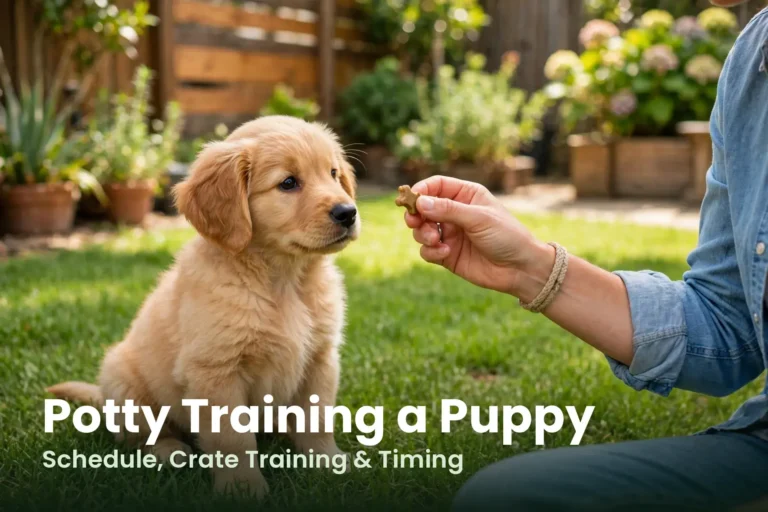
Crate Training a Puppy: A Step-by-Step Guide That Actually Works
Crate training means teaching your puppy that its crate is a good place to be — a safe den, not a cage. Done right, it keeps your puppy safe when you cannot watch it, speeds up housetraining, and gives your puppy a quiet place to rest. Done wrong, it scares the puppy and slows everything down. This guide walks you through the steps in order, with a schedule by age, a night plan, and what to do when things go wrong.
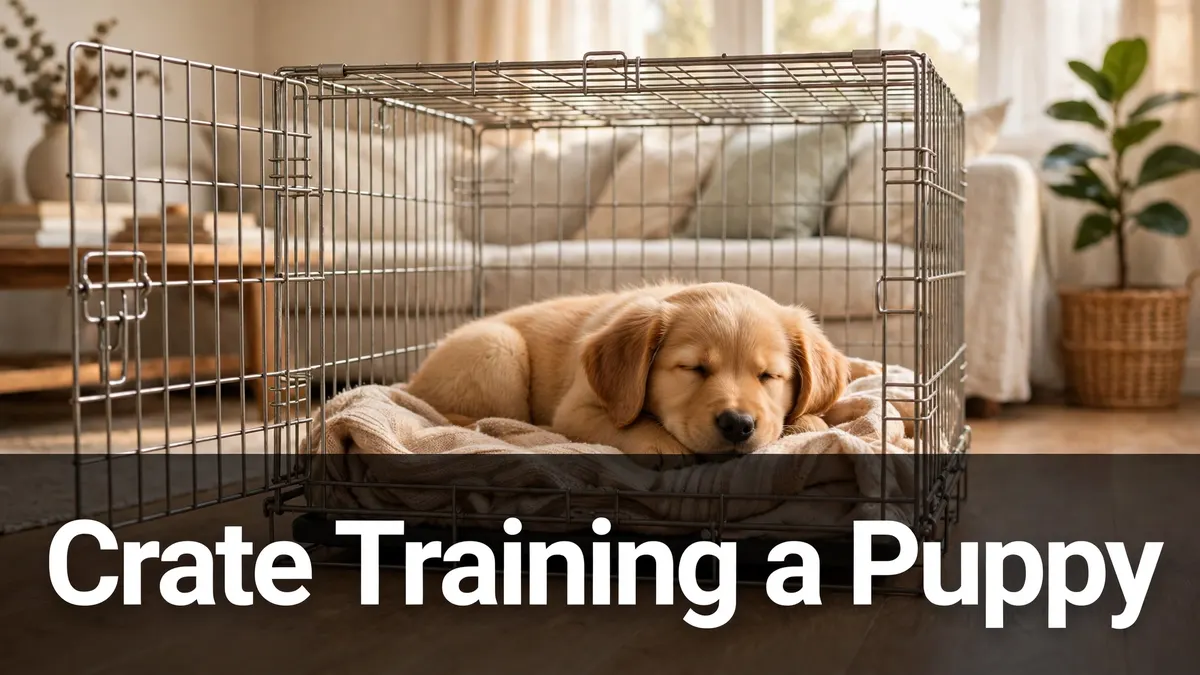
What Is Crate Training, and Why Do It?
Crate training is the process of getting your puppy used to spending time in its crate. Dogs are den animals: they like a small, enclosed space of their own where they can rest when things get busy. A crate gives your puppy that den.
It brings real benefits. It keeps your puppy safe from chewing wires, swallowing things, or getting into danger when you cannot supervise. It helps housetraining, because dogs do not like to soil the place where they sleep, so a crate teaches a puppy to hold its bladder for longer. It helps with travel, since crates are generally required when flying. It helps in emergencies: many shelters accept pets during evacuations only if they are crate trained. It helps at the vet, since a crate-trained dog relaxes more during an overnight stay. And it helps after an injury or surgery, when a dog needs strict rest and the crate keeps it from hurting itself further.
Is Crate Training Cruel?
No — when you use it right. A crate becomes cruel only when you misuse it. Short, positive sessions in a comfortable crate are not cruel. Locking a puppy in a crate all day and all night is. Humane World for Animals warns that a dog crated all day and night does not get enough exercise or human contact and can become depressed or anxious. A crate is not a magic fix, and it is not a substitute for company, training, or exercise.
Do not crate a puppy that panics. If your dog pants heavily, drools, claws frantically at the door, or howls or barks without letup when crated — even while you are home — stop and use a different setup, such as one room behind a baby gate, and ask your vet or a certified behaviorist for help. The ASPCA‘s separation anxiety guidance is clear: a crate can help some dogs feel safe when left alone, but for others it adds stress.
Choosing the Right Crate
Size matters more than anything else. The crate should be just big enough for your puppy to stand up, turn around, and lie down comfortably — but not much larger. A crate that is too small is uncomfortable, and your puppy will hate it. A crate that is too big lets your puppy sleep at one end and toilet at the other, which defeats the housetraining benefit.
For a growing puppy, buy a crate that will fit the adult dog and use a divider panel to block off the extra space now. Expand the space as your puppy grows. If you are not sure how big your puppy will get, your vet can help estimate its adult size.
What size crate should I get for my puppy?
Buy for the adult size and block off the extra space with a divider. The puppy’s space should let it stand without crouching, turn around without contorting, and lie down fully stretched — and no bigger.
Where should I put my puppy’s crate?
Put it where your family spends time, such as the family room, because dogs are social and a puppy settles better near people. Do not put it in a back bedroom, a utility room, or somewhere quiet and isolated. At night, put the crate in your bedroom or just outside it, so you can hear night cries and your puppy can smell you and feel less alone. As your puppy gets more comfortable overnight, you can gradually move the crate to its preferred spot in your home.
What should I put in my puppy’s crate?
Sources disagree on bedding. PetMD says a crate mat, soft blankets, or a dog bed inside can help the crate feel comfortable, and to use comfortable bedding only if your puppy does not chew or shred it. Lionheart K9 says the opposite: no bedding at all, because bedding encourages the puppy to soil it, while a bare floor motivates the puppy to hold it. The one exception both sides allow is a comfort item with a familiar scent, such as a Snuggle Puppy or a piece of fabric from the breeder that carries the scent of the mother and littermates, for the first few nights.
What every source agrees on: put small treats or part of your puppy’s regular meal in the crate, and a safe, age-appropriate chew or food-stuffed toy that you have already tested under supervision. Remove your dog’s collar, tag, and harness before leaving it unsupervised in the crate, because these can catch on crate parts. Take bedding away from a puppy that chews it, because swallowed fabric can cause choking or a blockage.
Wire, plastic, or airline-style? UC Davis and PetMD say both wire and plastic crates work well, and the choice depends on your preference — plastic crates can be used for airline travel, while wire crates may collapse for storage. Lionheart K9 disagrees and says to use an airline-style crate only, because wire crates carry injury risks: feet, jaws, and collars can catch in the bars.
Crate Training a Puppy Step by Step
Crate training is a gradual behavior-building process. Work through the stages in order, and stay at each stage for as long as your puppy stays relaxed. If your puppy shows escalating distress, shorten the session and return to the previous successful step. Most puppies take days to a few weeks. Some fly through in three days; others need three weeks. Patience is the key.
Step 1: Set up a safe crate
Put the crate where your family spends time. Put a mat or bedding inside if your puppy does not chew it. Prop the door open so it cannot accidentally hit your puppy and frighten it.
Step 2: Introduce your puppy to the crate
Bring your puppy over and talk in a positive, happy voice. Put small treats near or just inside the door to tempt your puppy to explore. Reward calm behavior such as standing, sitting, or lying down inside. If your puppy refuses to go in, do not force it. Never push, drag, or physically place your puppy in against its resistance — going in must always feel positive. As your puppy gets more comfortable, put treats farther inside so it walks all the way in. Repeat this until your puppy walks in and out comfortably. This can take a few minutes or several days.
Step 3: Feed your puppy’s meals in the crate
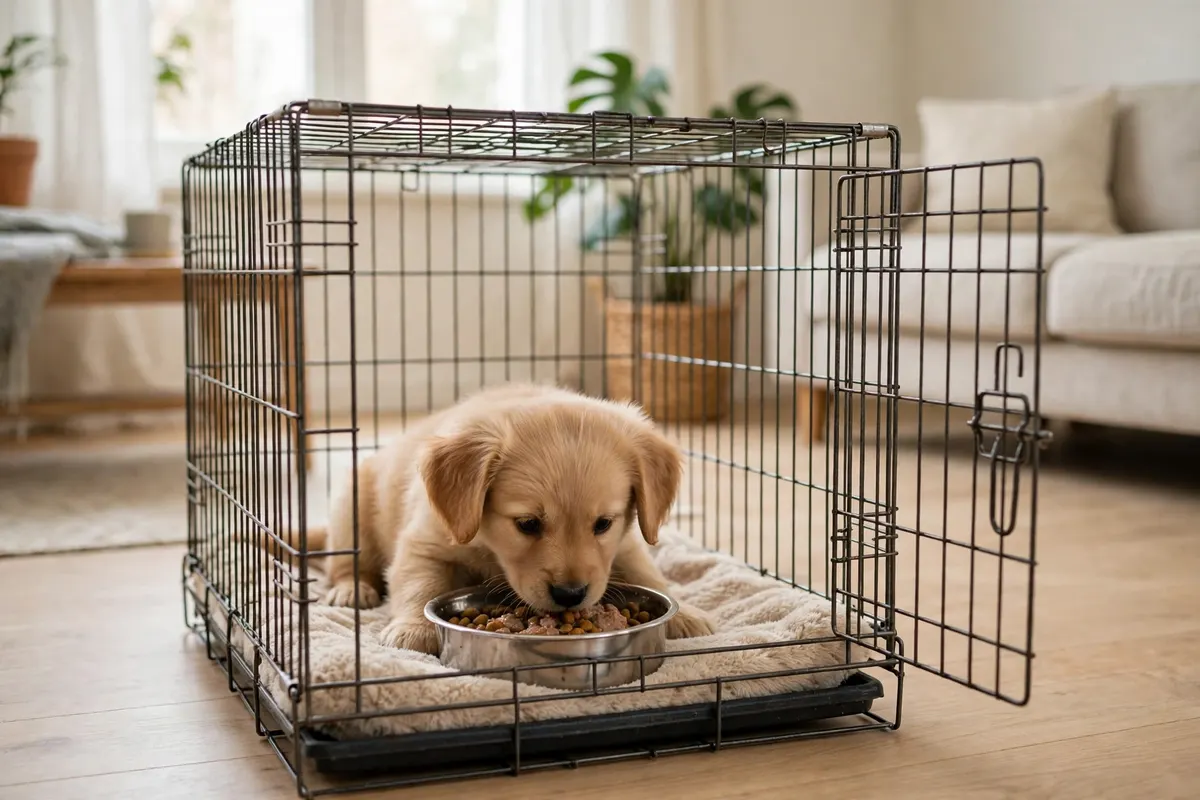
Once your puppy is comfortable, start feeding its regular meals near or inside the crate. This builds a positive association with the space. If your puppy is comfortable, put the food dish at the far end of the crate. If it is still reluctant, put the food only as far as it feels comfortable entering, and push it farther back at each meal.
Step 4: Close the door for brief periods
Once your puppy stands fully inside the crate comfortably, close the door while it eats. Open the door as soon as it finishes, or at the first sign of stress, whichever comes first. Then build up slowly over several sessions: from seconds to one minute, then to several minutes. If whining, panting, cowering, frantic scratching, or escape attempts begin, let your puppy out and shorten the next session rather than waiting for the behavior to intensify.
Step 5: Practice alone time at home
Once your puppy eats meals inside the crate and stays calm with the door closed, start confining it for short periods while you are home. Use a treat to tempt it in, and give a training cue of your choosing, such as “Crate” or “House.” Praise your puppy and give the treat, then close the door.
Sit beside the crate while your puppy settles. Then stand up, move around the room, and briefly step out of sight. Return before your puppy becomes distressed. When you return, sit quietly by the crate for another minute or two, then let your puppy out.
Repeat this while gradually increasing the time, and work toward about 30 minutes of calm crate time while you are home.
Step 6: Practice short departures
Once your puppy can relax quietly in the crate for about 30 minutes, start leaving it alone in the crate while you go out for short periods. Put your puppy in the crate with your cue and a treat. Vary when you put it in during your “getting ready to leave” routine so the crate does not start to signal your departure.
Keep your leaving calm and quiet — a brief praise and a treat are enough — and keep your return just as calm. Do not get overly enthusiastic when you come back, or your puppy will feel more anxious about your departures.
Keep crating your puppy occasionally while you are home too, so it does not always associate the crate with you leaving.
Step 7: Build a calm nighttime routine
Once your puppy handles longer periods in the crate, start crating it overnight. Give it a potty break before bed. Put the crate in your bedroom so you can hear night cries. If your puppy needs a break during the night, take it out calmly on a leash for a quiet bathroom break, then return it to the crate without play.
How do I crate train a puppy?
Introduce the crate gradually, reward calm behavior, feed meals inside, close the door for brief periods, and build up to short absences — always at your puppy’s pace, and never as punishment.
How long does it take to crate train a puppy?
Most puppies take days to a few weeks, depending on age, temperament, and past experience. Some finish in three days; others need three weeks. Move to the next stage only when your puppy is relaxed at the current one.
The First 7 Days — A Simple Checklist
Every day follows the same loop: potty, then play, then a crate nap, then potty again. Only put your puppy in the crate after its needs for exploring, play, food, and potty are met, and take it out before the next potty or meal is due.
Puppy Crate Training Schedule by Age
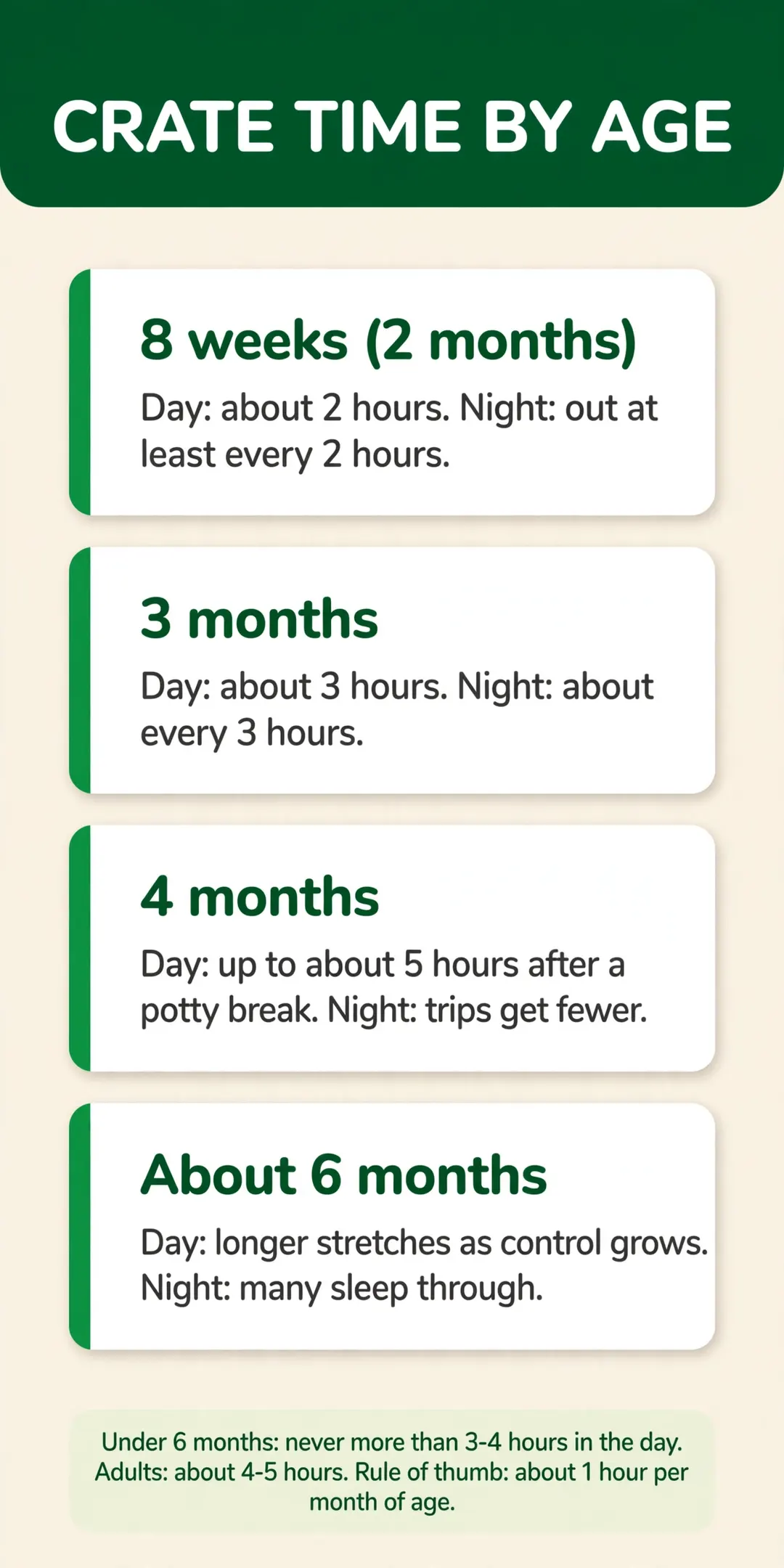
How long a puppy can stay in a crate depends on its age, size, health, activity, food and water intake, sleep, and past experience. Never use a schedule to make a puppy hold it longer than it can manage. Two VCA sources give slightly different numbers, so use the lower number when you are starting out.
| Age | Daytime crate time | Overnight |
|---|---|---|
| 8 weeks (2 months) | About 2 hours | Out at least every 2 hours |
| 3 months | About 3 hours (up to 4 right after a potty break) | About every 3 hours |
| 4 months | Up to about 5 hours right after a potty break | Night trips get fewer |
| About 6 months | Longer stretches as control grows | Many puppies sleep through the night |
Humane World advises that puppies under six months should not stay in a crate for more than three or four hours at a time during the day, because they cannot hold their bladder or bowels that long. For adults, the limit is about four to five hours during the day. The AKC’s rule of thumb is that a puppy can hold its bladder for about as many hours as it is months old, up to about nine months to a year.
How long can a puppy stay in a crate?
Puppies under six months: no more than three to four hours at a time during the day. Adults: a few hours, with a walk and company before and after. Never longer than the puppy can hold its bladder or bowels, or it will be forced to go where it sleeps.
How long can a puppy stay in a crate at night?
About as many hours as the puppy is months old, then a toilet trip. An 8-week-old puppy can hold it for about two hours, so expect two or more night trips. A 6-month-old may manage around six hours. Set an alarm and take the puppy out before it wakes and cries.
Should I crate my puppy at night?
Yes, once your puppy is comfortable with longer periods in the crate. Put the crate in your bedroom at night so you can hear it, and take it out for quiet potty trips when it wakes. Never shut a puppy in for the first time at bedtime — practice during the day first.
Crate Training a Puppy at Night
Do a calm bedtime routine: a play session, a calm wind-down, and a last toilet trip. Then a treat into the crate, your cue, door closed, lights low, and you in bed right beside the puppy. Expect to get up. For very young puppies, set an alarm and take them out before they wake and cry, so the puppy learns that night trips are quiet and routine, not a reward for crying.
If your puppy cries, wait a few minutes first. If it continues, take it out for a quick, boring toilet trip, then straight back to bed. Keep night trips boring: no play, no fuss, no lights. Some crying in the first few nights is normal.
What to Do When Your Puppy Cries in the Crate
Every puppy cries in crate training at some point. First, ask why. Whining that starts within minutes of going in is likely stress or anxiety, especially in puppies that have not yet learned to be alone. A puppy crated overnight that whines or fusses most likely needs the bathroom. Whining that starts after your puppy has settled for a while is more likely boredom, hunger, or a bathroom need. Crying can also signal fear, loneliness, pain, hunger, overheating, or a session that is too difficult.
If the fussing is short and mild, wait a few minutes for quiet, then reward the quiet and open the door. Never open the door while your puppy is whining, because that teaches crying is the ticket out. But never leave a dog to cry it out either. If the crying persists or escalates, stop the session, comfort your puppy, and return to an easier step. You probably moved too fast.
If your puppy wakes at night and fusses, assume it needs to potty and take it out. If the crying turns to panic — drooling, clawing at the door, or howling that will not stop — let the puppy out and stop crate training for now. That is not a training phase; that is distress. Use a gated room instead and ask your vet or a certified behaviorist for help.
How long should I let my puppy cry in the crate?
There is no magic number of minutes. If the crying is brief and does not escalate, give your puppy a few minutes to see if it settles. If it keeps building, do not sit through it — go back a stage and make the sessions shorter. The two times you do not wait are a nighttime potty need and panic.
Should I let my puppy cry it out in the crate?
No. The AKC says never leave a dog to cry it out. Wait for a few seconds of quiet, then reward and open the door. Long crying that keeps building is not something to sit through.
What to Do If Your Puppy Has an Accident in the Crate
Stay calm and do not punish your puppy. Clean up the mess with an enzymatic cleaner so no smell remains. Then shorten the next crate interval and check the cause: was the puppy left too long, was the crate too big, was it tired, active, or recently fed? A puppy that soils its crate was usually asked to hold it longer than it could, or the crate gave it a separate toilet corner. Fix the cause, not the puppy, and go back to a shorter interval that works.
Common Crate Training Mistakes
When Should I Stop Crate Training My Puppy?
There is no fixed age. Your puppy is ready when it can stay calm and accident-free in the house for the time you would otherwise crate it, and when it chooses to rest in the crate on its own with the door open. Transition gradually: leave the crate door open while you are home, then try short absences with the puppy free in a puppy-proofed room. Keep the crate available as a safe den even after you stop closing the door — many dogs keep using it as their quiet place for life.
Frequently Asked Questions
Introduce the crate gradually, reward calm behavior, feed meals inside, close the door for brief periods, and build up to short absences — always at your puppy’s pace.
Most puppies take days to a few weeks. Some finish in three days; others need three weeks.
Buy for the adult size and use a divider panel. The puppy’s space should let it stand, turn around, and lie down fully stretched — and no bigger.
Where your family spends time during the day, and in your bedroom at night so you can hear night cries.
Puppies under six months: no more than three to four hours at a time during the day. Adults: a few hours, with a walk and company before and after.
About as many hours as the puppy is months old, then a toilet trip. An 8-week-old needs a trip about every two hours.
Yes, once your puppy is comfortable with longer crate periods. Keep the crate in your bedroom and take it out for quiet potty trips.
Check the basics first. If the fussing is short and mild, wait a few minutes for quiet, then reward it. If it wakes at night, assume it needs to potty.
A few minutes of mild fussing is fine to wait out. Long crying that keeps building is not — go back a stage.
No. Never leave a dog to cry it out. Wait for a few seconds of quiet, then reward and open the door.
Stay calm, clean it up, shorten the next interval, and check the cause. Never punish the puppy.
No. Never use the crate as punishment. It must stay a safe, positive place.
When your puppy stays calm and accident-free in the house and chooses the crate on its own. Transition gradually and keep the crate available.
No, when used right — short, positive sessions, never as punishment. It becomes cruel when a dog is crated all day and all night.
Small treats or part of its meal, and a safe chew or food-stuffed toy. Bedding is debated: PetMD recommends soft bedding, while Lionheart K9 says no bedding. Remove the collar before unsupervised crating.
After a play session, a calm wind-down, and a last toilet trip, put a treat in the crate, use your cue, close the door, and sleep right beside the puppy. Set an alarm for potty trips before the puppy wakes.

Sources: UC Davis School of Veterinary Medicine, PetMD, American Kennel Club, Humane World for Animals, VCA Animal Hospitals, ASPCA. Figures shown as ranges where sources disagree. No reliable crate price was found — no price figure is given in this article. Last checked 23 Nov 2026.