Ear Mites in Dogs: Signs, Treatment, Home Remedies & Prevention

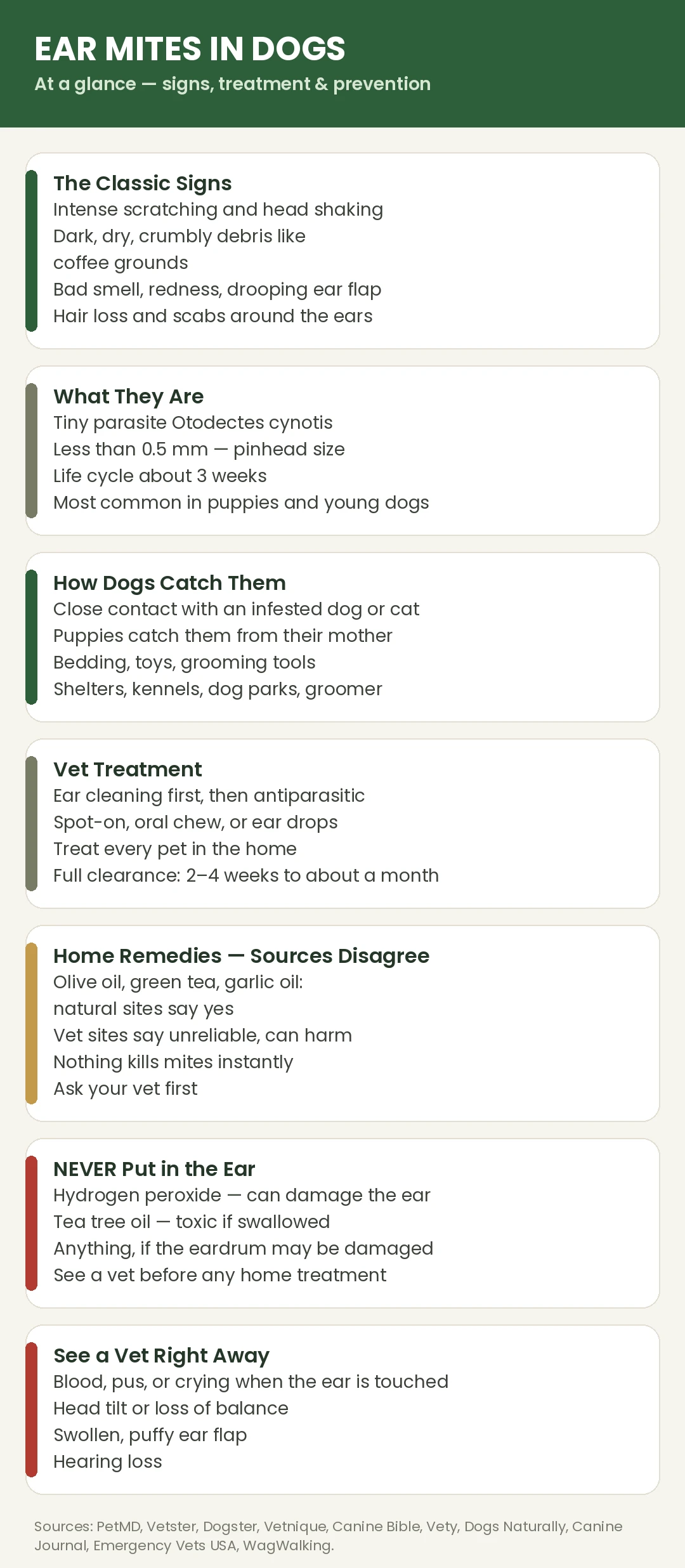
Ear mites in dogs are tiny parasites that live in the ear canal and make a dog scratch, shake its head, and build up dark, crumbly debris like coffee grounds. The parasite behind almost every case is Otodectes cynotis. It spreads fast between dogs and cats, but it responds well to vet treatment.
Key Takeaways — Short Answer
What Are Ear Mites in Dogs?
Ear mites are tiny parasites, close relatives of ticks and spiders, that live on the surface of the ear canal. The species behind almost every case in dogs is Otodectes cynotis. Adults measure less than half a millimetre — about the size of a pinhead — and look like tiny white specks, if you can see them at all.
Mites feed on wax, skin oils, and skin cells without burrowing. They do not bite.
The mite life cycle has four stages: egg, larva, nymph, and adult, and takes about three weeks — Dogs Naturally puts the egg-to-egg cycle at 18 to 28 days, with eggs hatching in about 4 days. Adults live for roughly 2 months.
How common are ear mites in dogs? Sources disagree, because they count different things. Dogster says ear mites cause up to 50 percent of otitis externa cases in dogs, and Vety says roughly 50 percent of ear infections in dogs. Emergency Vets USA says they account for only a very small percentage of ear problems in dogs, and Today’s Veterinary Practice puts infestation at 6.7 percent of pet dogs. Read the 50 percent figures as a share of ear-inflammation cases, not a share of all dogs.
Signs and Symptoms of Ear Mites in Dogs

Intense scratching and head shaking are the classic signs.
The signs can affect one ear or both and range from mild to severe. Call your vet if you notice: intense scratching, often with a back leg; frequent head shaking; rubbing the ears on the floor or furniture; dark, dry, crumbly debris like coffee grounds; a bad smell; redness, swelling, or a drooping ear flap; scabs or crusts around the ears and head; hair loss around the ears; pain — your dog yelps or pulls away when you touch an ear; head tilting; and ears that droop when they normally stand upright.
The intense, nonstop itch is usually the giveaway. One useful clue is the pinnal-pedal reflex: rub your dog’s ear and the back leg on the same side starts scratching.
Some dogs show hardly any signs and have normal-looking ears, yet still pass mites on, so check every pet. Dogs may also turn irritable or restless, or cry when their ears are handled.
Can you see ear mites in dogs? Barely — they are pinhead-size white specks. Do ear mites smell? Yes, infested ears often carry a foul odor. Do ear mites hurt dogs? Yes — the ear can become painful once scratching opens sores or a secondary infection sets in.
Vomiting and diarrhea are not typical signs of ear mites; Dogs Naturally mentions both only as possible side effects of mite drugs.
Ear Mites vs Wax, Yeast, and Ear Infection — How to Tell
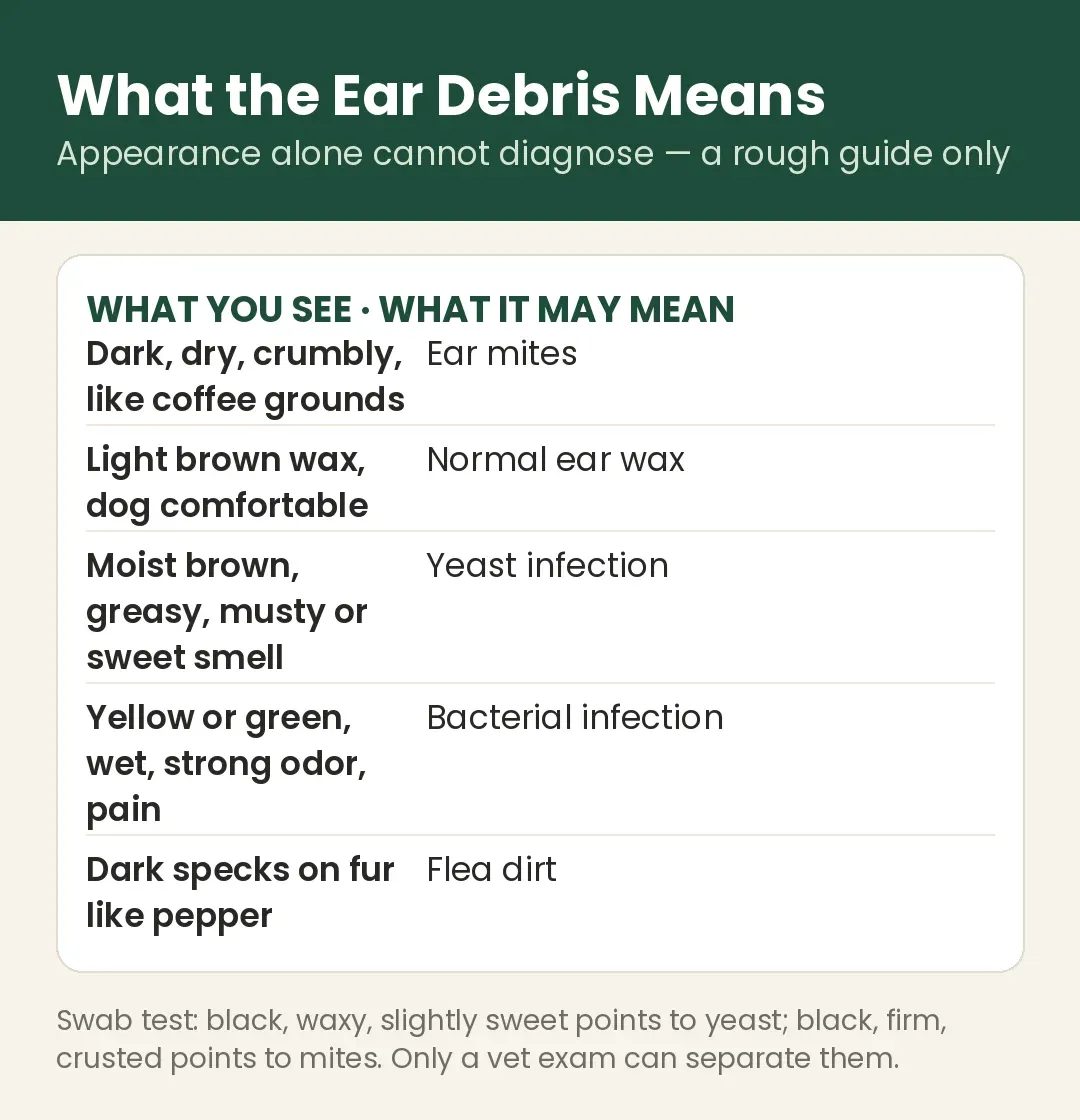
Dark material in your dog’s ear does not automatically mean ear mites. Use this table as a rough guide only — appearance alone cannot diagnose anything.
| What you notice | What it may mean |
|---|---|
| Dark, dry, crumbly debris that looks like coffee grounds | Ear mites |
| Small amount of light brown wax, dog comfortable | Normal ear wax |
| Moist brown or greasy discharge with a musty or sweet smell | Yeast infection |
| Yellow or green, wet discharge with a strong odor and pain | Bacterial infection |
| Dark specks on the fur or skin that look like pepper | Flea dirt |
Canine Journal adds a practical swab test: black, waxy material with a slightly sweet smell points toward yeast, while black, firm, crusted debris points toward mites.
The coffee-grounds look is not unique to mites, and both can be present at once. Only a vet’s exam can separate them.
How to Check for Ear Mites in Dogs at Home
Only your vet can confirm ear mites for certain, but you can safely check at home. Pick a calm moment with good light and gently fold the ear flap back.
Wipe a little debris out of the visible part of the ear with a cotton pad. Tap it onto black paper and look closely with a magnifying glass or your phone’s zoom: tiny white moving specks are mites. Note any smell, heat, swelling, or pain, and check every pet.
Never push a cotton swab into the ear canal, and never point a syringe down into it — that can rupture the eardrum.
How Do Dogs Get Ear Mites? Causes and Spread
Dogs get ear mites through direct close contact with an infested animal. One exposure is enough.
Cats are the most common source. Dogs also catch mites from other dogs, ferrets, and rabbits. Puppies usually catch mites from their mother while nursing. Shelters, kennels, boarding facilities, dog parks, and the groomer all carry higher risk.
Mites can also linger briefly on bedding, toys, grooming tools, and crates. Dogs outdoors around stray or feral animals face more risk.
Can dogs get ear mites from grass? The same goes for chickens, although Vety and Dogster do name rabbits as hosts. Can dogs get ear mites in winter?
Some dogs face higher risk: puppies and young dogs, shelter and boarding dogs, outdoor dogs near strays, floppy-eared dogs such as Basset Hounds and Cocker Spaniels, and dogs not on regular parasite prevention.
Are Ear Mites Contagious? Dogs, Cats, and Humans
Ear mites are highly contagious between animals. If one pet in the house has them, the others will soon have them too. Dogs can catch them from cats, and dogs can give them to cats, so treat every pet at the same time, even without symptoms.
Can humans get ear mites from dogs? Almost never. The mite cannot survive or reproduce on human skin. PetMD calls human cases highly unlikely, with a rare itchy rash if a mite jumps on and bites. Dogster notes rare cases in people, including tinnitus — a ringing or buzzing noise in the ear.
Can ear mites infest your house? PetMD says yes — mites can be found in bedding or toys an infected animal touched — but they do not survive long in the environment.
How long are ear mites contagious in dogs? There is no fixed number of days: a dog stays contagious until the mites are gone, which takes weeks of treatment.
Can ear mites spread to other parts of the body? Yes, sometimes. Mites usually stay in the ear canal, but Dogster says they can rarely migrate outside it and cause dermatitis around the neck, back, feet, or tail. Canine Bible says the same: as the infestation grows, mites may invade other parts of the body.
Can dogs get ear mites in only one ear? Yes. Dogster says mites infest one ear first and can spread quickly to both ears because they reproduce fast. Treat both ears even if only one looks affected.
How Vets Diagnose Ear Mites in Dogs
Your vet asks about preventatives, when symptoms began, and whether other cats or dogs live in the house, then examines the ears with an otoscope, a lighted magnifying tool. Live mites sometimes appear as tiny moving white dots against the dark debris.
The key test is an ear swab under the microscope, called ear cytology. The vet collects debris with a cotton swab, mixes it with a drop of mineral oil on a glass slide, and views it under the microscope. A stained slide from the same swab shows bacteria or yeast, which need their own treatment.
Your vet will usually swab both ears even if only one looks affected, and the exam also checks that the eardrum is intact before any drops go in. The otoscope alone can miss mites — Today’s Veterinary Practice reports that in one comparison study, one-third of infested cats were not diagnosed by otoscope alone. That finding comes from cats, but it shows why the microscope swab matters.
If no mites turn up, the itch more likely comes from a bacterial or yeast infection, or from allergies. Most dogs with itchy ears actually need ear medication with an antibiotic, antifungal, or anti-inflammatory product.
How to Get Rid of Ear Mites in Dogs — Vet Treatment
Getting rid of ear mites takes a vet-recommended antiparasitic treatment. Your vet chooses the product for your dog’s age, breed, health, and infection level. This article names products only — it gives no doses.
Treatment starts with ear cleaning, then the vet prescribes an antiparasitic: spot-ons between the shoulder blades — selamectin (Revolution) and imidacloprid with moxidectin (Advantage Multi); oral chews — fluralaner (Bravecto), afoxolaner (NexGard), and sarolaner (Simparica); and ear drops — milbemycin (MilbeMite) and ivermectin (Acarexx). Some products are used off-label, yet are highly effective under a vet’s guidance.
Will Bravecto kill ear mites? Yes — fluralaner is listed as effective by PetMD, Canine Bible, Vety, and Dogs Naturally. Will NexGard? Yes — Canine Bible’s table and Vety list afoxolaner as a treatment. Will ivermectin? Yes — listed as an oral or injectable option, often off-label, and certain breeds may be sensitive to it.
A bacterial infection gets a topical antibiotic ointment, a yeast infection gets an antifungal, and very itchy dogs may get steroids such as prednisone. PetMD says the vet usually cleans the ears first with a cleanser such as Epi-Otic Advanced, or TrizULTRA+ Keto Flush if a secondary bacterial infection is present, and may prescribe an ointment such as Animax for a bacterial or yeast infection.
In the studies Canine Bible cites, selamectin and afoxolaner reached 100 percent efficacy, fluralaner 99.8 percent, and sarolaner 93.3 percent.
Canine Bible publishes an efficacy table: selamectin and afoxolaner reach 100 percent in the cited studies, fluralaner 99.8 percent, and sarolaner 93.3 percent.
A single treatment is often enough, but a repeat may be needed to catch mites that hatch from eggs after the first dose. Over-the-counter ear mite products exist, but Emergency Vets USA says most do not work effectively, and Vety says they are less effective than prescription options — a vet visit is strongly recommended. The best treatment is the one your vet picks for your dog — plus ear cleaning, treating every pet, and a recheck.
What Kills Ear Mites Fast? (and Why “Instantly” Isn’t Real)
Nothing kills ear mites instantly. The fastest route is a prescription topical antiparasitic or oral medication, and selamectin reaches full effectiveness within the first week.
Dogs usually feel better within a day or two. Full clearance takes longer: PetMD says up to 30 days, Vety says 2 to 4 weeks, and Vetster says at least 6 weeks.
Do they go away on their own?
How to Clean Your Dog’s Ears Safely During Treatment
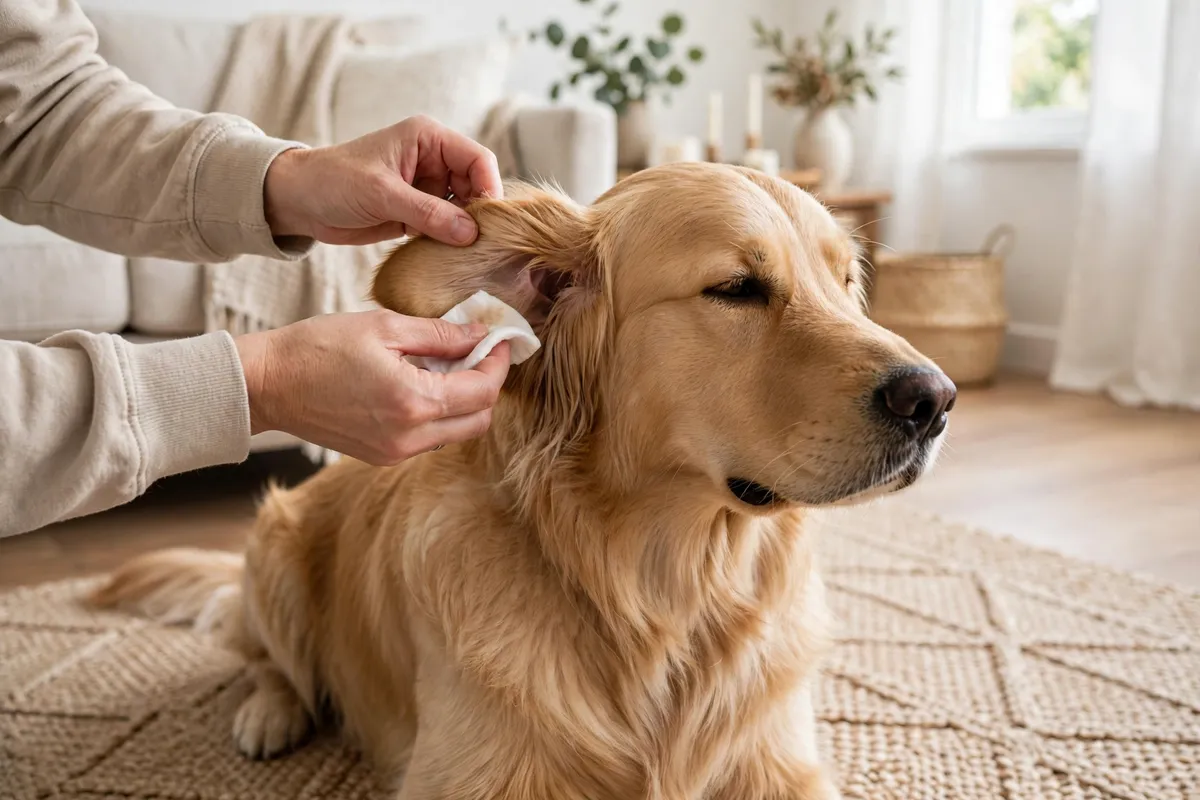
Clean gently with a cotton pad — never push anything deep into the ear.
Cleaning removes debris and lets treatment reach the canal, but it cannot clear mites alone — eggs keep hatching for about three weeks.
Only clean an ear when your vet has confirmed the eardrum is intact. Fill the canal with a veterinary-approved ear cleaning solution, massage the base for 20 to 30 seconds, let your dog shake, then wipe the ear opening and flap with cotton balls or gauze. Hold any syringe at an angle to the entrance, never pointed down into the canal.
How often? Sources disagree. PetMD says once daily until the mites and infection are gone. Vety recommends weekly to biweekly cleaning. Canine Bible recommends at least once a month. Dogs Naturally says do not clean daily, because over-cleaning disrupts the healthy bacteria in the ears. Follow your vet’s instruction.
Home Remedies for Ear Mites in Dogs — What Sources Actually Say
Sources disagree sharply about home remedies, so this section gives both sides instead of picking one.
Olive oil. Dogs Naturally cites the Manual of Natural Veterinary Medicine: clean the ear with olive oil, remove debris, and repeat every 3 days for 2 weeks. Canine Journal says half a dropper-full in each ear, massaged in, repeated several times a day for up to six weeks. Canine Bible says carrier oils such as olive, almond, or mineral oil can smother mites, a few drops daily for weeks.
Vetnique, Vety, and Emergency Vets USA say the opposite. Vety says olive oil may smother some mites temporarily but does not kill eggs. Emergency Vets USA says you would need a small amount daily for at least six weeks, and it may not kill all the mites.
Mineral oil. WagWalking gives a full mineral-oil method: a generous amount on a cotton ball, swab the flap and canal, several drops into the canal, then wipe off. Emergency Vets USA says some natural-medicine vets recommend a few drops daily for at least 3 weeks.
Green tea. Dogs Naturally calls green tea a natural antiseptic: 3 to 4 drops in each ear once a day for 4 weeks. Canine Bible warns it may not be strong enough for a significant infestation. Vetnique lists green tea among the remedies not to rely on.
Garlic oil. Dogs Naturally recommends garlic oil, citing herbalists Mary Wulff and Greg Tilford: garlic contains sulfur and mites hate it. Apply it twice a day. Vety says the opposite: garlic oil is ineffective, and garlic is toxic to dogs in many forms.
Apple cider vinegar. Canine Bible says to mix equal parts raw, unfiltered apple cider vinegar and distilled water and wipe the visible parts of the inner ear once daily — never on raw, inflamed, or broken skin. Vety says it is ineffective and can burn raw, inflamed skin.
Coconut oil. Vety says its effect is minimal and it can promote bacterial growth in warm, moist ears.
Vitamin E, yellow dock, honey, aloe vera, Vaseline, baby oil. Canine Journal offers vitamin E — half an ounce of carrier oil mixed with 400 IU of vitamin E, used like the oil treatment — and yellow dock: simmer 1 teaspoon of dried root in 1 cup of water for about 20 minutes, strain, and apply every 3 days for 3 to 4 weeks.
WagWalking suggests honey — 2 teaspoons of unpasteurized honey in 2 ounces of water, put in the ear and wiped off, repeated daily. Canine Bible mentions aloe vera gel on the outer ear only, and quotes Cornell professor William Miller Jr.: baby oil, a few drops several times a day for a month, can get rid of an ear mite infestation.
Essential oils. Dogs Naturally suggests adding 1 to 3 drops of one essential oil per ounce of olive oil: peppermint, catnip, St John’s Wort, or calendula. Emergency Vets USA warns tea tree oil is toxic if a dog ingests it. Do not add essential oils without a vet’s say-so.
What kills ear mites naturally? Dogs Naturally answers green tea or olive oil.
What NOT to Put in a Dog’s Ear
Hydrogen peroxide. Sources conflict. WagWalking tells readers to apply hydrogen peroxide on a cotton ball to wipe out the ear canal. Canine Journal says the opposite: it can irritate the skin and damage the ear. Vety agrees it is ineffective and damages healthy tissue.
Tea tree oil. Emergency Vets USA says it works like other oils, but it is toxic if a dog ingests it. Do not use it without a vet’s guidance.
Dog products on cats, and cat products on dogs. Products are made for each species. Banfield’s cats guide says never use a dog product on a cat unless your vet says so. Ask your vet before using a cat product on a dog.
Never put anything in your dog’s ear without veterinary guidance if the eardrum may be damaged.
Ear Mites in Puppies — Special Care
Puppies catch ear mites from their mother while nursing. PetMD, Vety, and Dogster all name puppies and young dogs as the most affected group.
What do ear mites look like in puppies? The same as in adult dogs — intense scratching, head shaking, and dark coffee-grounds debris.
Very young puppies have tiny, delicate ear canals — ask your vet before any drops. Newly adopted puppies should have a vet exam, ears included, before they meet other pets.
Pregnant or nursing dogs need vet guidance before medication.
Why Ear Mites Keep Coming Back
Ear mites that keep coming back almost always have one of four causes: the course was stopped too early; not every pet was treated; mites survived outside the ear, on the head, neck, or tail; or bedding was not washed, or a new animal brought mites in again.
If ears are still dirty or itchy after a full course, go back to your vet — it may be an infection, allergy, or another problem.
Treating All Pets and the Home
Treat all dogs, cats, ferrets, and rabbits at the same time, even without symptoms. Vety warns that skipping even one pet leads to reinfection within weeks.
Wash bedding, toys, and grooming tools, vacuum resting spots, and clean crates. Vetnique says high-temperature drying kills mites.
Sources disagree on how much home cleaning matters. Vetster says bedding “does not play a significant role in transmission”. The University of Saskatchewan takes the stronger view: mites can survive off the host in bedding and fomites. Treating your pets matters far more than cleaning the house.
How Long Does It Take to Get Rid of Ear Mites? Recovery and Follow-Up
The itching usually eases within a day or two, but full clearance takes longer: PetMD says up to 30 days, Vety says 2 to 4 weeks, and Vetster says at least 6 weeks.
Finish the full course even after the itching stops. How do I know if my dog’s ear mites are gone? Do not judge by clean-looking ears alone — PetMD says to bring your dog back for a repeat ear cytology.
When to See a Vet Right Away — Red Flags and Complications
See your vet before putting anything in your dog’s ear if there is blood, pus, a bad smell, or crying when you touch the ear — the eardrum may be damaged. Go soon for a head tilt, loss of balance, or a swollen, puffy ear flap. A swollen flap is usually an aural hematoma — a blood blister from scratching — which typically needs surgical drainage. Vety puts that surgery at $300 to $1,500 or more.
If untreated, the mites persist, secondary infections set in, and the ear canal can thicken into chronic otitis. Deep infection can affect hearing and balance, and Canine Bible warns severe cases can cause partial or complete hearing loss.
Can ear mites kill a dog? Not typically on their own — the danger comes from untreated complications. The University of Saskatchewan is the only source that links ear mites with seizures. A seizure is an emergency: call your vet at once.
How to Prevent Ear Mites in Dogs
Use year-round parasite prevention — many monthly flea, tick, and heartworm products also control ear mites. Check ears weekly for changes in debris, odor, redness, or comfort.
Have new dogs and puppies vet-checked, ears included, before they mix with other pets. Limit contact with strays and check ears after boarding or shelter stays. There is no vaccine for ear mites, and none is needed.
How Much Does Ear Mite Treatment Cost?
Vety puts the typical total at $50 to $300: a mild case $100 to $200, a case with complications $200 to $400 or more. A hematoma surgery adds $300 to $1,500 or more.
Emergency Vets USA gives lower figures: one dose $12 to $25, ear drops $15 to $40, cleanser $10 to $25, and the exam plus diagnostics $45 to $75 or more. Cost depends on your clinic, your dog’s size and weight, and complications. Pet insurance may cover the exam and treatment if the condition is not pre-existing. No single agreed figure exists.