How Long Do Golden Retrievers Live? The Real Numbers

Golden Retrievers live 10 to 12 years on average. That is the number the American Kennel Club gives, and it is the number most veterinary sources repeat. It is also shorter than many owners expect, and shorter than Goldens lived a few decades ago. The main reason is cancer. Roughly six in ten Golden Retrievers die of cancer or develop it during their lives, and no other common breed carries that burden. This guide lays out every figure with its source, explains why the numbers differ, and covers what you can actually do to give your Golden the longest, healthiest life possible. Nothing here promises extra years. Every medical decision belongs with your vet.
The Short Answer
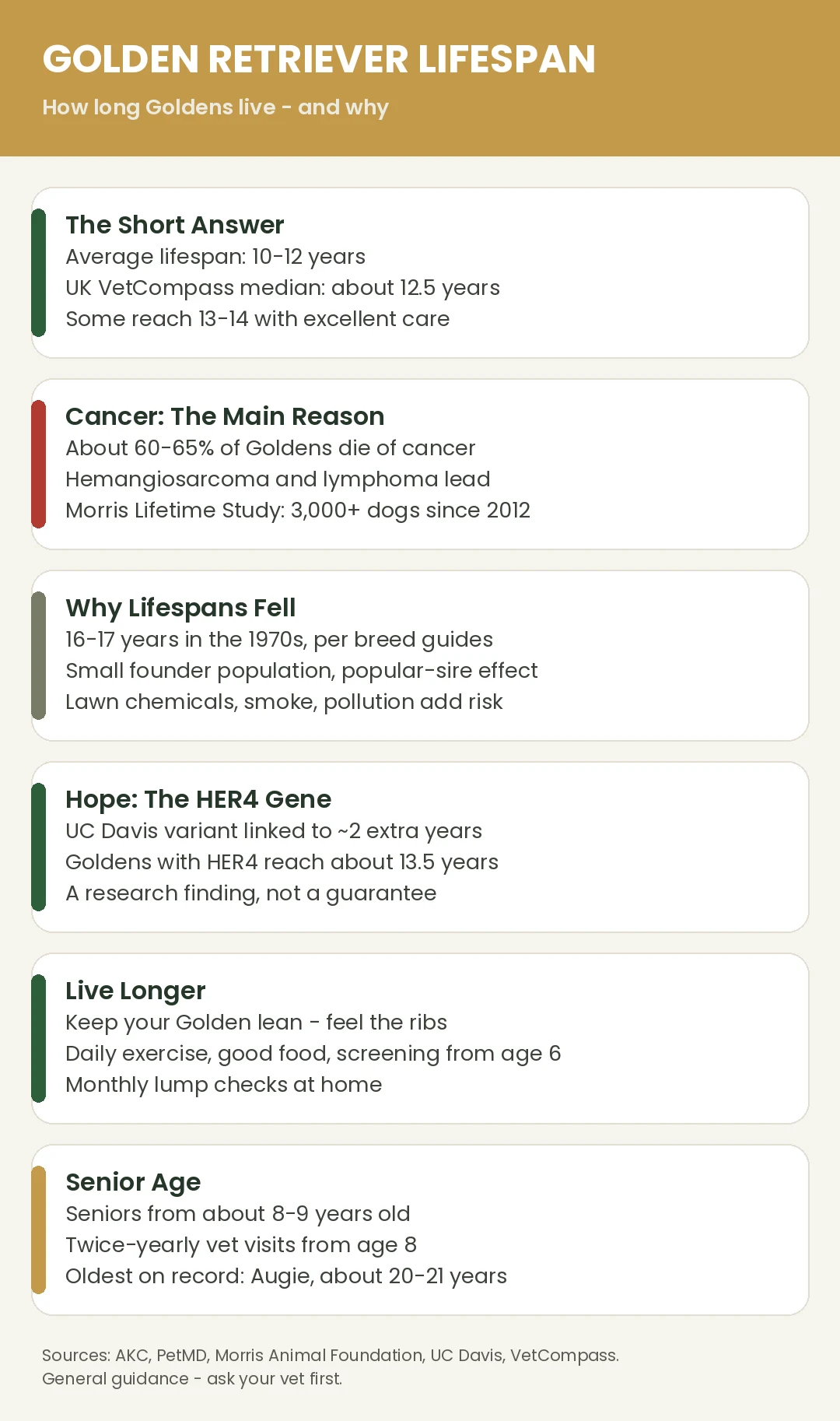
A Golden Retriever usually lives 10 to 12 years. Some Goldens pass away at eight or nine, often from cancer diagnosed in middle age. Others reach 13 or 14 with excellent care, and a few live into their teens. The oldest Golden Retriever on record, a dog named Augie from Tennessee, lived to about 20 or 21 years. Goldens are considered seniors from about eight or nine years old. The biggest factors you can influence are weight, diet, exercise, and early cancer screening. Genetics sets the starting point. Your daily care decides where your dog lands inside the range.
| Source | Lifespan figure |
|---|---|
| AKC breed page | 10–12 years |
| PetMD Golden Retriever profile | 10–12 years |
| UK VetCompass study (LabraJoy) | Median longevity ~12.5 years |
| Journal of the American Animal Hospital Association (via 33rd Square) | Average 10.7 years |
| Sidewalk Dog / Puppy Longevity | 10–12 years today; 16–17 years in the 1970s |
Lifespan by Type and Sex
Not all Goldens are the same, and the sources break the breed down by type and sex. Devoted to Dog gives this table, and it is that site’s table, not a study:
| Type | Average lifespan | Notes |
|---|---|---|
| American Golden Retriever | 10–12 years | Modern AKC standard average |
| English Cream Golden Retriever | 10–12 years | Same as standard, despite marketing claims |
| Field-bred Golden Retriever | 11–13 years | Slightly longer; less inbreeding, more activity |
| Female Golden Retriever | 10–12 years | Some studies find females live slightly longer; the gap is small |
| Male Golden Retriever | 10–12 years | Any gap versus females is small |
| Goldendoodle (Golden × Poodle) | 10–15 years | Mixed breed, often longer than purebred Golden |
English Cream Goldens deserve a note. Breeders sometimes market them as healthier and longer-lived than American Goldens. Devoted to Dog says the lifespan is the same, despite the marketing claims. There is no evidence that English Cream Goldens live longer. Field-bred Goldens, the leaner, more athletic working lines, may live slightly longer, at 11 to 13 years, with less inbreeding and more activity behind the difference. That figure comes from Devoted to Dog’s table, not from a published study.
The male-female gap is small. A very large 2024 UK study of companion dogs of all breeds found females had a median life expectancy of 12.7 years against 12.4 for males. That study covered all breeds, not Goldens alone, so do not read it as a Golden-specific figure. For Goldens, the sources agree that any gap between males and females is small.
Why Golden Retrievers Do Not Live Longer: Cancer
Cancer is the main reason Golden Retrievers do not live longer. Goldens have one of the highest cancer rates of any dog breed, and the disease shortens many lives that would otherwise run longer.
The figures vary by study, so here they are side by side:
Treat 60 to 65 percent as the range across studies. The studies counted different dogs in different ways, but they all point the same way: cancer kills most Goldens.
The most common and aggressive cancers are hemangiosarcoma, a cancer of the blood-vessel lining that often strikes the spleen or heart, and lymphoma, a cancer of the lymphatic system. The Morris Lifetime Study has logged hundreds of diagnoses across four major cancers: hemangiosarcoma, lymphoma, mast cell tumor, and osteosarcoma. Hemangiosarcoma is often silent until it is advanced, which is why it kills so many dogs before anyone knows it is there.
The Morris Animal Foundation Golden Retriever Lifetime Study has followed more than 3,000 Golden Retrievers since 2012, tracking their nutrition, environment, lifestyle, and genetics across their whole lives. It exists because of the breed’s cancer rate. It is one of the largest and longest studies of a single dog breed ever run, and its findings shape everything vets know about Golden longevity today.
Why Lifespans Fell From 16–17 Years
Golden Retrievers used to live longer. Sidewalk Dog and Puppy Longevity both say Goldens routinely lived to 16 or 17 years in the 1970s, and most reach only 10 to 12 today. That is a staggering decline in a single breed within a few decades, and the primary driver is cancer.
Treat that claim carefully. Neither site cites a primary source for the 1970s figure in the text returned for this article. The claim is consistent across both sites, and it matches the pattern of rising cancer rates, but this guide attributes it to those sites rather than presenting it as a measured fact.
Why did cancer rise? Genetics is the main answer. Golden Retrievers descend from a relatively small founder population. The popular-sire effect made it worse: a handful of males produced a disproportionate share of offspring, which concentrated certain genetic risk factors over generations. Puppy Longevity explains it plainly: genetics set the foundation before you bring your puppy home, and a narrow gene pool concentrates risk.
Environment plays a part too. The Lifetime Study identified several environmental risk factors: exposure to lawn chemicals and pesticides, secondhand smoke, and proximity to industrial pollution. You cannot rewrite your dog’s DNA. You can control what your dog breathes, walks on, and lives around.
The HER4 Gene: A Reason for Hope
UC Davis research offers one reason for hope. The university identified a gene variant, HER4, linked to nearly two extra years of life in Golden Retrievers. Devoted to Dog reports that Goldens with the HER4 variant reach about 13.5 years on average, against 10 to 12 for the breed as a whole. That is a research finding, not a test you can buy at the vet, and it does not guarantee any individual dog a longer life. But it proves that genetics can work in a Golden’s favor as well as against it, and it gives breeders a target for the future.
Other Health Problems That Shorten Life
Cancer dominates, but it is not the whole story. Goldens face several other well-documented health risks:
Hip and elbow dysplasia. Roughly 20 percent of Golden Retrievers develop hip dysplasia, according to Puppy Longevity, and elbow dysplasia is common as well. The joints form abnormally, which leads to arthritis and pain. Responsible breeders screen for both using OFA or PennHIP evaluations before breeding. Ask for the parents’ clearances.
Hypothyroidism. The thyroid gland underproduces hormone, which slows metabolism and causes weight gain, lethargy, and coat problems. It is manageable with medication once a vet diagnoses it.
Heart disease. Subvalvular aortic stenosis, a narrowing below the aortic valve, is the heart condition Infipet names for the breed. It can shorten life if severe.
Skin conditions. Goldens are prone to skin problems, including hot spots and allergies. Skin disease rarely shortens life directly, but it affects quality of life and can signal allergies that need management.
Obesity. Obesity shortens lifespan measurably in dogs, just as it does in humans. Infipet is direct about this. A Golden that carries extra weight faces more joint disease, more cancer risk, and a shorter life. Keeping a Golden lean is the single most effective thing most owners can do.
Life Stages: What to Expect at Each Age

A senior Golden on a garden path — greying muzzle, slower pace.
Goldens move through predictable life stages, and your care should shift with them:
Puppy (0–1 year). Rapid growth, vaccinations, and socialization. Feed a large-breed puppy formula that controls growth speed. Avoid over-exercising growing joints. Teach manners early: a Golden puppy that jumps up at 30 pounds becomes an adult that jumps up at 70 pounds.
Young adult (1–3 years). Peak energy. Establish the weight, diet, and exercise habits that will protect long-term health. This is the window when good habits pay off most.
Mature adult (4–7 years). Metabolism slows. Watch weight carefully and begin discussing baseline bloodwork with your vet. This is also the age when many cancers begin to develop silently, so learn your dog’s normal: appetite, energy, lumps, and behavior.
Senior (8+ years). The highest-risk window for cancer and joint disease. Twice-yearly vet visits and senior screening become essential. Most vets call a Golden a senior from about eight to nine years old. PawFigures puts the threshold at 8.25 years, using 75 percent of the breed’s mid-range lifespan. Either way, eight is the age to get serious about screening.
PawFigures gives a fuller stage table: puppy under 1 (0–15 in human years), young adult 1–3 (15–35), mature adult 4–8.2 (35–56), senior 8.2–12 (56–77), and golden years 12+ (77+). Those human-year equivalents use a size-adjusted veterinary chart for large breeds. They are rough guides, not exact conversions.
What Helps a Golden Live Longer
What helps a Golden live longer.
No step guarantees extra years. But the sources agree on the habits that shift the odds:
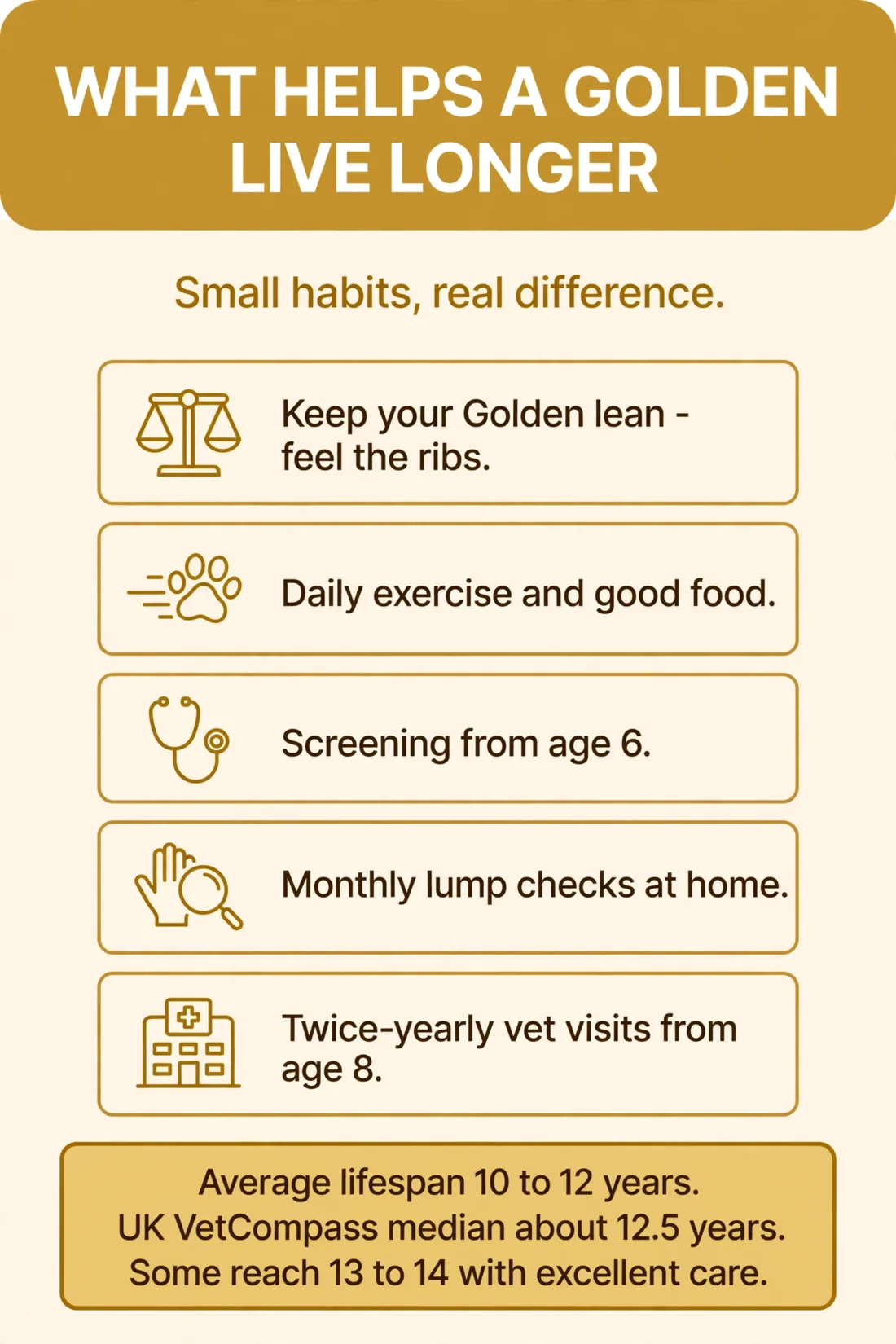
Keep your Golden lean. You should be able to feel the ribs without pressing hard, and see a slight waist when viewed from above. Measure the food. Limit treats. Weigh your dog regularly. Obesity correlates with increased cancer risk across species, and it worsens joint disease.
Feed well. Give a high-quality diet with named protein sources, appropriate fat levels, and no excessive fillers. Puppy Longevity suggests a diet rich in antioxidants and omega-3 fatty acids. Ask your vet what suits your dog.
Exercise daily. Goldens are active dogs. Regular movement keeps joints healthy, supports healthy weight, and helps the heart. Aim for daily walks and play. Avoid over-exercising growing puppies and arthritic seniors.
Screen early and often. From age six, talk to your vet about annual abdominal ultrasounds and blood panels to catch problems early. After age seven, Devoted to Dog recommends bi-annual exams. At home, do a monthly self-exam: run your hands over your dog’s body and look for new lumps, swelling, unexplained weight loss, decreased appetite, or persistent lethargy. Monthly self-exams take five minutes and can buy your dog months of treatment advantage.
Cut environmental risks. Minimize exposure to lawn chemicals, pesticides, and cigarette smoke. Keep your dog off freshly treated lawns. Do not smoke around your dog.
Choose health-tested parents. If you are buying a puppy, ask for OFA clearances for hips and elbows, and a family health history going back several generations. A reputable breeder shares those records freely.
Mind spay and neuter timing. Devoted to Dog says diet, weight, spay/neuter timing, and annual screenings all measurably affect lifespan. Ask your vet what timing suits your dog. Treat those percentages with caution.
The Oldest Golden Retriever: Augie
The oldest Golden Retriever on record is Augie, a female Golden from Tennessee. The sources differ slightly on her age: Sidewalk Dog says she lived to nearly 21 years; Native Pet says she lived 20 years and 11 months; LabraJoy says she turned 20 in April 2020. Treat her age as about 20 to 21 years. She is an outlier, not a target. Most Goldens who reach 13 or 14 are doing very well, and a 14-year-old Golden is a real senior, often with slower joints and a gray face. FursnPaws says some Goldens have been recorded living to 16 to 18 years, but treat those figures as that site’s claim only.
Golden Retriever Age in Human Years
People ask how old their Golden is in human years. There is no single right answer, because dogs age faster early and slower later, and size changes the rate. LabraJoy cites a formula from a UC San Diego team that studied DNA aging in Labrador Retrievers: human age equals 16 times the natural log of the dog’s age, plus 31. By that formula, a one-year-old dog is about 31 in human years, and a ten-year-old dog is about 68. PawFigures uses a size-adjusted veterinary chart instead: 10 dog years equals 66 human years for a large breed. Both are rough guides. Neither changes how you care for your dog. What matters is the life stage, not the human-year number.
Golden Retriever Lifespan FAQs
The Bottom Line
A Golden Retriever gives you ten to twelve years of loyalty, joy, and companionship, and asks in return for a lean body, good food, daily exercise, and a vet who checks for cancer early. Genetics sets the range. Your care decides where inside it your dog lands.