Dog Ear Infection: Symptoms, Yeast vs Bacterial, Treatment, Cost & Prevention
A dog ear infection hurts, smells bad, and keeps coming back if you treat only the surface. This guide explains the signs, the causes, how vets tell yeast from bacteria, what treatment involves, what it costs, and how to prevent the next flare-up. Read it as general information only.
Key Takeaways — Short Answer
A dog ear infection means inflammation of the ear canal. Vets call it otitis. Most cases affect the outer canal, a condition called otitis externa. The most common signs are head shaking, scratching, redness, a bad smell, discharge, and pain. Yeast and bacteria both cause ear infections, and you cannot tell them apart by looking or smelling. Only a vet swab under a microscope, called cytology, tells you which one it is. No home remedy reliably cures an ear infection. Left untreated, it can spread to the middle or inner ear and cause hearing loss and balance problems.
What Is a Dog Ear Infection?
An ear infection is inflammation of the ear canal, the tube that carries sound to the eardrum. Yeast or bacteria overgrow inside the canal and inflame its lining. Small numbers of both organisms live in healthy ears without causing trouble. Infection starts when something changes the ear environment.
A dog ear has five parts: the ear flap, called the pinna, the ear canal, the eardrum, the middle ear, and the inner ear. The canal has an L shape. It runs down, then turns sideways toward the eardrum. This shape traps moisture and debris, so dogs get ear infections more easily than people do.
Vets divide ear infections into three types by location. Otitis externa affects the outer ear canal and causes most cases. Otitis media affects the middle ear, behind the eardrum. Otitis interna affects the inner ear and can disturb hearing and balance. VetLens splits cases as 80 percent externa, 15 percent media, and 5 percent interna.
An infection can start suddenly, which vets call acute, or it can keep returning, which they call chronic. It can affect one ear or both ears. Both ears often point to a body-wide cause, such as an allergy. One ear more often points to a local cause, such as a foreign body or mites in that ear.
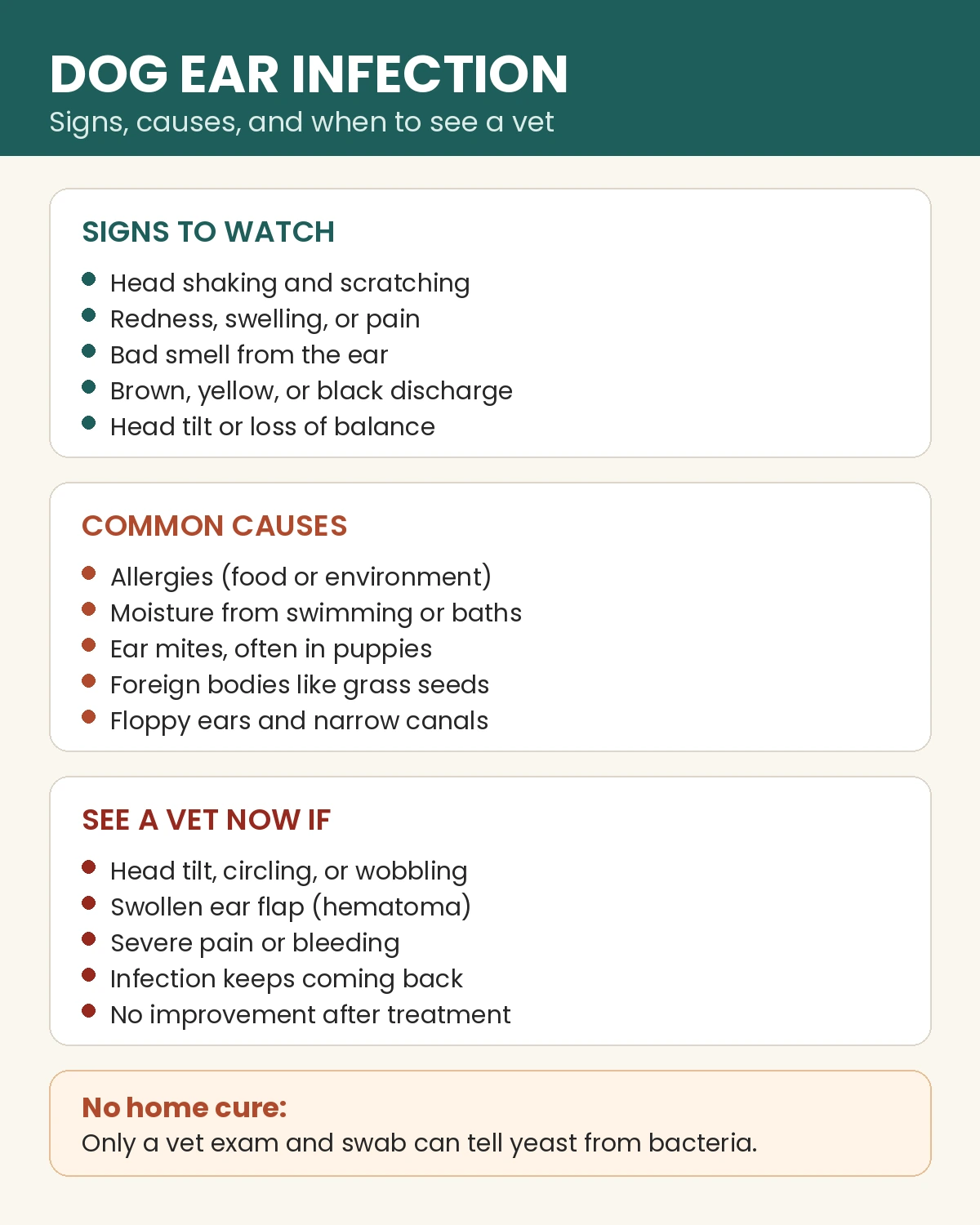
Signs and Symptoms — How to Tell If Your Dog Has an Ear Infection
Watch for behavior changes first. Dogs shake their heads, scratch at one ear, paw at the ear, or rub the side of the head along the floor or furniture. Some hold one ear lower than the other. Others flinch or yelp when you touch the ear, or refuse to let you touch it at all.
Look inside the ear flap in good light. You may see redness, swelling, or heat. The skin may look crusty or scabby, and hair may thin around the ear from scratching. A swollen, fluid-filled ear flap can appear after violent head shaking. Vets call this an aural hematoma, and it needs a vet visit.
Smell the ear. A clean dog ear should not smell strongly. An infected ear often gives off a yeasty, sour, or foul smell. Discharge often follows. Its color gives a hint, not a diagnosis. Yeast often produces dark brown, waxy discharge. Bacteria often produce yellow, creamy, or green discharge. Blood in the discharge means the ear is badly inflamed, so book a vet visit promptly.
Middle and inner ear infections add deeper signs. Your dog may tilt the head, lose balance, walk in circles, or show flicking eye movements. Vomiting can follow. Hearing may drop. In some cases the facial nerve suffers, so your dog drools, drops food, blinks oddly, or shows dry eyes and unequal pupils.
Can a dog have an ear infection without obvious symptoms? Yes, sometimes. Early inflammation can sit deep in the horizontal canal, where you cannot see it from outside. Your dog may shake the head now and then, or scratch a little more than usual. Check and sniff your dog’s ears every week, so you catch small changes early.
Yeast vs Bacterial Ear Infection — What Is the Difference?
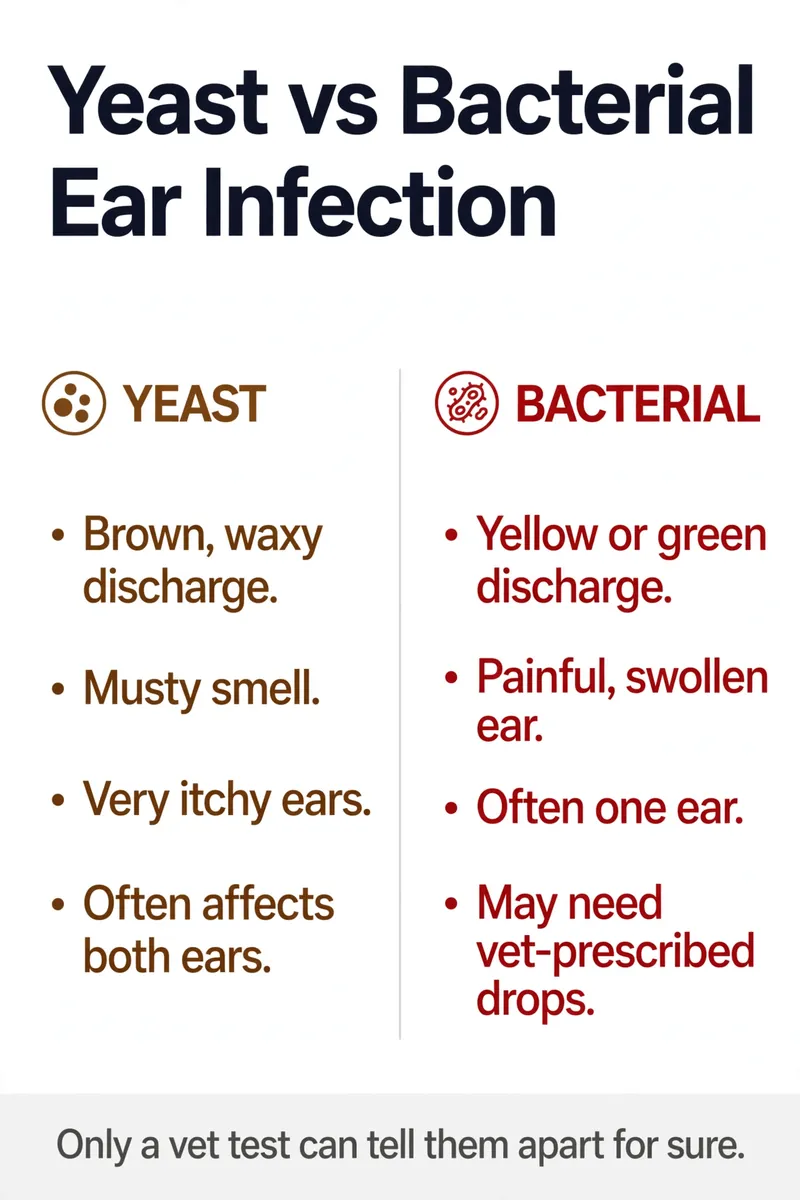
Yeast and bacteria both live in normal dog ears in low numbers. An infection starts when the ear environment changes and one or both overgrow. The two look alike from the outside, and many dogs carry both at once.
Yeast ear infections usually come from Malassezia pachydermatis, a yeast that lives on dog skin. They tend to produce dark brown, waxy, greasy discharge with a musty, sweet, or “corn chip” smell. Allergies, moisture, and waxy ears often sit behind them. Vets treat them with antifungal drops, usually with an anti-inflammatory.
Bacterial ear infections more often come from Staphylococcus pseudintermedius, Staphylococcus aureus, Pseudomonas aeruginosa, Proteus, or Corynebacterium. They tend to produce yellow, creamy, or green discharge with a sharper, foul smell. The ear often hurts more. Vets treat them with antibiotic drops chosen for the organism type. Rod-shaped bacteria, such as Pseudomonas, may need different drug classes than round cocci.
| Feature | Yeast (Malassezia) | Bacterial |
|---|---|---|
| Discharge | Dark brown, waxy, greasy | Yellow, creamy, or green; can be bloody |
| Smell | Musty, sweet, “yeasty” | Sharper, more foul |
| Common link | Allergies, moisture, waxy ears | Chronic or severe cases, damaged canal |
| Treatment | Antifungal drops | Antibiotic drops, chosen by cytology or culture |
Use this table as a guide only. Appearance overlaps, and mixed infections are common, so color and smell never prove the cause. Only cytology, a swab stained and read under a microscope, separates them. Cytology also shows whether the bacteria are cocci or rods, which changes the drug choice.
One study gives a sense of scale, not a rule for your dog. A 2025 analysis in the journal Animals found Staphylococcus pseudintermedius in 41 percent, Staphylococcus aureus in 23 percent, and Pseudomonas aeruginosa in 19 percent of bacterial isolates from dogs with otitis externa. In that dataset, Pseudomonas showed 93 percent resistance to amoxicillin-clavulanic acid. Those figures describe that study population only.
What Causes Dog Ear Infections?
An ear infection rarely starts on its own. An underlying problem inflames the ear first, then yeast or bacteria overgrow. Vets group the causes in three layers.
Primary causes start the inflammation. Allergies lead the list. Food allergy and environmental allergy, also called atopic dermatitis, inflame the ear lining, change the wax, trap moisture, and lower local defenses. In many dogs, repeated ear infections are the first or only sign of a food or environmental allergy. Ear mites cause intense itching, especially in puppies, and often lead to a secondary infection. Foreign bodies such as grass seeds or foxtails lodge in the canal. Hormonal disease, such as hypothyroidism or Cushing’s disease, can drive repeats. Growths, polyps, autoimmune diseases, and certain cancers can also sit behind an infection.
Predisposing factors make infection more likely. Floppy ears and narrow canals trap warm, moist air, and heavy ear hair does the same. Swimming and frequent bathing leave water in the canal. Over-cleaning strips protective oils and irritates the lining.
Perpetuating factors keep the infection going. The canal wall thickens and narrows, which vets call stenosis or hyperplasia. Middle-ear involvement hides infection behind the eardrum. Resistant bacteria survive the first round of drops.
VCA Animal Hospitals reports that allergies play a role in as many as 43 percent of ear infection cases, especially chronic or recurrent ones, and that ear infections occur in 65 to 80 percent of dogs with food allergies. Those are VCA’s figures, not a universal rate.
Which Dogs Get Ear Infections Most Often?
Any dog can get an ear infection, but some breeds face higher odds: Cocker Spaniels, Springer Spaniels, Basset Hounds, Beagles, Labrador Retrievers, Golden Retrievers, Poodles, Shar-Peis, Bulldogs, German Shepherds, and Schnauzers. Floppy ears, narrow canals, excess ear hair, and a tendency to allergies explain most of the risk.
Puppies get ear infections too, often through ear mites, which spread easily between young dogs and cats. Senior dogs face a different confusion: sudden balance problems in an older dog can come from vestibular disease, not from an ear infection, so a vet must sort out the cause.
Dogs with itchy skin elsewhere often have itchy ears too. If your dog licks its paws or rubs its face and the ears flare up at the same time, an allergy may drive both problems. Tell your vet about the skin signs, not just the ear signs.
How Vets Diagnose a Dog Ear Infection
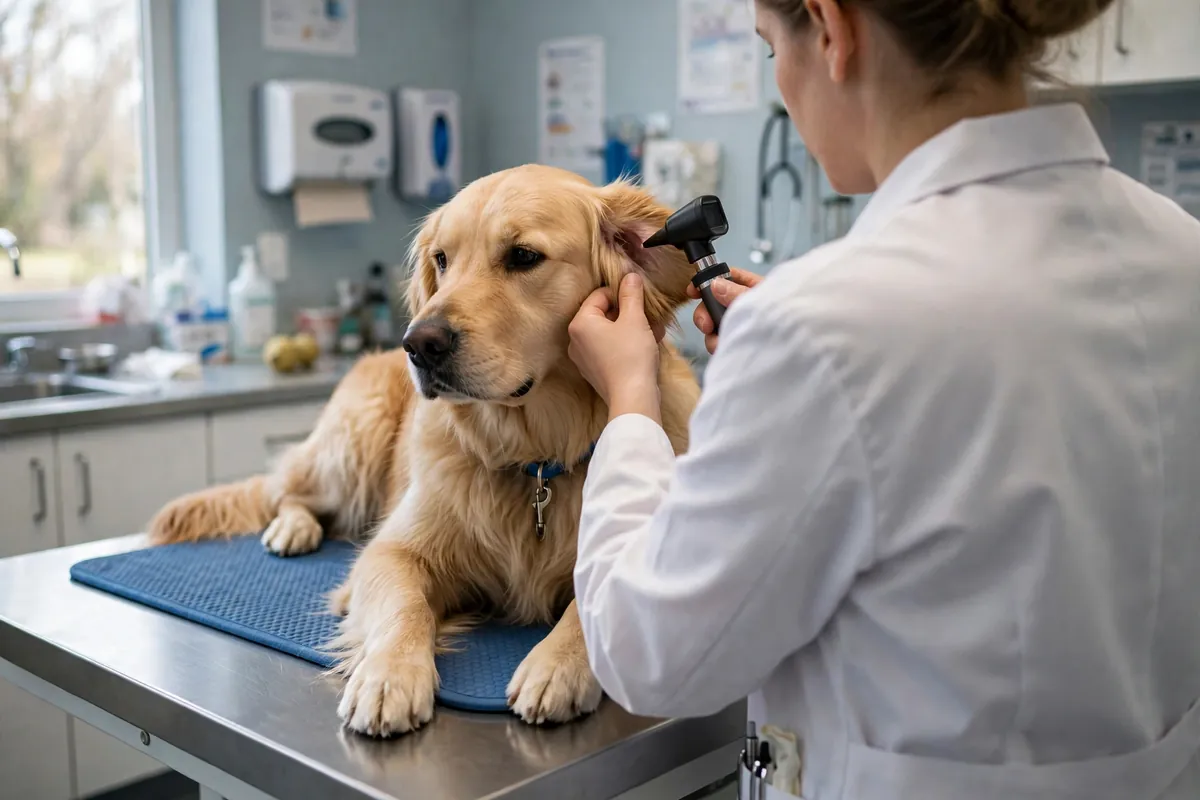
Vets look inside the ear with an otoscope and test a sample to find the cause.
Your vet starts with a history. Expect questions about how long the signs have lasted, past infections, allergies, diet, medicines, your ear-cleaning routine, and recent baths, grooming, or swimming.
Next comes the otoscopic exam. Your vet looks down the canal with an otoscope, a lighted instrument with a magnifier. The exam checks redness, swelling, discharge, debris, foreign objects, growths, and whether the eardrum is intact. A ruptured eardrum changes which cleaners and medicines are safe. If the ear hurts too much, or debris blocks the view, your vet may suggest sedation.
Then comes ear cytology, the key test. Your vet rolls a swab of discharge onto a glass slide, stains it, and reads it under a microscope. The slide shows yeast cells, round cocci, rod-shaped bacteria, or a mix, plus white blood cells that signal active infection.
For chronic, severe, or resistant infections, your vet may order a culture and sensitivity test. The lab grows the organism and tests which medicines kill it. Blood tests can check for endocrine disease. X-rays, CT, or MRI can map middle or inner ear disease.
Do not clean the ear before the first vet visit if you have already booked one. Cleaning strips away the discharge the swab needs. Clean only after diagnosis, on your vet’s instructions.
How Vets Treat a Dog Ear Infection
Treatment follows the diagnosis, not a guess. Your vet cleans the ear first, often with a medicated cleanser, so the medicine can reach the canal lining. Discharge and wax can block topical medicine. Painful ears may need sedation for a proper deep clean.
Then your vet prescribes medicated ear drops. Bacterial infections get topical antibiotic drops. Yeast infections get topical antifungal drops. Many drops combine an antibiotic, an antifungal, and a steroid to cut swelling and itch. Mixed infections get treatment for both organisms at once. Drops usually go in once or twice a day. Your vet may also use long-acting gels applied in the clinic, such as Osurnia, which lasts 7 days, and Claro, which lasts 30 days.
Severe or deep infections need more than drops. Your vet may prescribe oral antibiotics, oral antifungals, steroids, or anti-inflammatory pain relief. Middle-ear infections often need oral medicine because drops cannot reach behind the eardrum.
Surgery is the last step, for severe chronic disease that no longer responds to medicine. The canal may have scarred shut, so drops cannot enter. Options include lateral ear resection, which removes the vertical part of the canal, and total ear canal ablation, called TECA, often with ventral bulla osteotomy, called VBO, which removes the whole diseased canal. TECA can leave permanent hearing loss, but it removes the diseased tissue and stops the pain.
Finish the full course, even if the ear looks better after a few days. Stopping early can let the infection return, sometimes in a resistant form. Go back for the recheck. Your vet repeats the cytology to confirm the infection has truly cleared.
How to Give Ear Drops and Clean Your Dog’s Ears
Ask your vet to show you the technique at the visit. The steps below follow the vet sources in this guide, but your vet’s instructions for your dog come first.
Warm the bottle in your hand for a few minutes, since cold drops feel unpleasant. Lift the ear flap so you can see the canal. Fill the canal gently with the cleaner or the prescribed number of drops. Lower the flap and massage the base of the ear for 20 to 30 seconds. You should hear a squelching sound. Let your dog shake its head. The shake brings loosened debris up. Wipe the ear opening with a cotton ball or gauze. Never push a cotton swab or Q-tip down the canal. Reward your dog with a treat when you finish.
Use the cleaner before the drops, not after, so you do not wash the medicine out. Ask your vet whether to wait a few minutes between cleaning and drops so the ear dries first.
Use only a vet-approved ear cleaner made for dogs. Vet sources name products such as Epi-Otic, TrizEDTA, Zymox, and Vetericyn Plus Ear Rinse. These products suit a dog’s ear pH and often contain drying agents. Never use hydrogen peroxide, rubbing alcohol, or products made for humans or other animals. They can damage the ear lining and kill healthy cells.
How often should you clean? Sources disagree, so follow your vet. PetMD says every day or every other day during treatment. The MSD Veterinary Manual says start once a day, then drop to once or twice a week. VetLens says weekly for prone breeds. One treatment guide says once or twice a week during treatment, not daily, because over-cleaning irritates the lining and slows healing.
Can You Treat a Dog Ear Infection at Home?
No. No home remedy reliably cures a dog ear infection. The right drops depend on whether yeast or bacteria are involved, whether white blood cells show active infection, and whether the eardrum is intact. You cannot learn any of that at home. PetMD states this plainly: there are no effective home remedies for dog ear infections, although an over-the-counter medicated ear cleanser can help a mild infection.
Home care still has a place, but only as support. Gently wipe the visible ear flap with a damp cotton pad. Stop your dog from scratching, for example with a soft cone. Book a vet appointment. Those three steps are the safe home routine.
Do not put vinegar, hydrogen peroxide, alcohol, tea tree oil, or other essential oils in the ear. Do not use coconut oil, aloe vera, honey, green tea, or witch hazel as ear treatment. Do not use leftover drops from a previous infection or from another pet. Last spring’s yeast infection does not predict this summer’s organism. Do not use human ear drops or human antifungal creams. Some are toxic if the eardrum is ruptured. None of these products belong in an inflamed dog ear.
Why do so many sites promote apple cider vinegar? Low-authority home-remedy sites list a one-to-one mix of vinegar and water as a cure. Vet sources say the opposite. The MSD Veterinary Manual warns that vinegar mixtures worsen swelling and secretions and raise infection risk. The AKC, NextGen PetCare, and DogHealthInsider give the same warning. A liquid poured into an ear with a ruptured eardrum can damage hearing.
Over-the-counter products sit in a gray area. A vet-approved ear cleanser can support treatment and help prevention, but it cannot cure an active infection on its own. VCA states that a vet must diagnose the exact cause before any drops can work properly, because a foreign body, polyp, or tumor needs more than medicine. A groomer’s cleaning is not a substitute for a vet exam.
If you cannot afford a vet, say so at the clinic and ask about low-cost options. An uncomplicated ear infection is one of the cheaper vet visits, because it usually needs only an exam, a swab, and medicated drops. Ask about payment plans, local low-cost clinics, and animal charities. Do not let cost push you toward a home remedy that can harm the ear.
How Long Does It Take to Heal? Recovery Timeline
Sources give different healing times, so read the range, not one number. PetMD says ear drops run once or twice a day for 7 to 10 days. The AKC says most uncomplicated infections resolve in 1 to 2 weeks. VetLens says a typical course runs 7 to 14 days, with improvement in 3 to 5 days. The MSD Veterinary Manual says infections usually need repeated checkups until no infection shows, often 2 to 4 weeks. One treatment guide splits it by organism: bacterial infections take 1 to 2 weeks, yeast infections take 2 to 3 weeks. Severe infections can take months.
VetLens gives a useful day-by-day picture for an uncomplicated case. Days 1 to 3 bring some improvement in comfort and less scratching. Days 5 to 7 bring a clear drop in discharge and odor. Days 10 to 14 bring most infections to a close, with a recheck exam to confirm. Chronic cases need ongoing management, allergy control, and regular maintenance cleaning.
How can you tell the ear is healing? Scratching eases. The smell fades. Discharge thins and clears. Redness calms. Pain on touch fades. These signs help, but they do not prove the infection has cleared. Only a recheck exam and repeat cytology prove it. If the infection is not getting better, or it returns right after treatment ends, go back to the vet. Your vet may order a culture to find a resistant organism or look harder for an underlying cause.
What Happens If a Dog Ear Infection Goes Untreated?
An untreated ear infection spreads. It can move from the outer canal into the middle ear, then the inner ear. The eardrum can rupture. Hearing can drop, sometimes permanently. Balance can fail, so your dog tilts the head, circles, or stumbles. The facial nerve can suffer, so one side of the face droops. The canal wall can thicken and narrow until drops can no longer enter, which vets call stenosis. At that point only surgery can fix the ear.
Violent head shaking can burst blood vessels in the ear flap. The flap swells into a painful, fluid-filled pouch, an aural hematoma. Hematomas often need surgery. The ear infection itself also causes pain every day it goes untreated. Dogs may eat less, grow lethargic, and withdraw.
Can an ear infection spread to the brain? PetMD says it is extremely rare but possible. Most infections stay in the external ear. A severe inner ear infection can, in rare cases, extend toward the brain. That risk is one more reason to treat early, not a reason to panic about a simple outer ear infection.
Can a dog ear infection be fatal? An untreated severe infection can cause serious, lasting harm, including deafness and chronic pain, and it needs vet care.
Recurring Ear Infections — Why They Keep Coming Back
A repeat infection means the first treatment cleared the organisms but not the cause. Allergies cause most repeats. Food allergy, environmental allergy, or both can inflame the ear again and again. Endocrine disease, such as hypothyroidism or Cushing’s disease, can drive repeats too. A narrow canal, a growth, or a middle-ear infection that never fully cleared can also keep the cycle going.
If your dog has had more than two or three ear infections in its life, or three in one year, ask your vet to hunt for the underlying cause instead of prescribing another round of drops. Allergy work usually starts with a strict elimination diet for 8 to 12 weeks to find a food trigger, most often a protein source. Environmental allergies may need allergy testing, allergy shots, or medicines such as Apoquel or Cytopoint. Blood tests can check thyroid and other hormone levels.
Long-term management often means weekly preventative ear cleaning, a diet change, maintenance drops, and rechecks until the vet confirms the ear has cleared. Some dogs need lifelong treatment.
Ear mites deserve a separate note here, because owners confuse them with infection. Mites produce dark, dry, crumbly discharge that looks like coffee grounds, with intense itching. They strike puppies most often and spread easily between dogs and cats. A vet diagnoses mites under the microscope. Mites often lead to a secondary bacterial or fungal infection, so your dog may need both treatments.
Are Dog Ear Infections Contagious?
Most dog ear infections are not contagious. Yeast and bacteria already live in every dog’s ears, so one dog cannot “catch” another dog’s yeast infection. Ear mites are the exception. Mites are extremely contagious between pets. If one pet has mites, treat all pets in the home at the same time, on your vet’s advice.
Can a dog ear infection spread to humans? Mites can move between pets, but the infection itself is a dog ear problem, not a human health risk. Wash your hands after handling an infected ear, as you would after any wound care, and let your vet answer any household-specific worry.
How Much Does Treatment Cost?
Costs vary by clinic, location, and severity, so no single national price exists. VetLens gives the clearest breakdown for 2026: a typical uncomplicated case costs $100 to $300, including an exam at $50 to $100, ear cytology at $40 to $80, and medication at $30 to $120. A culture and sensitivity test adds $100 to $200. Chronic or severe cases cost $300 to $2,000 or more.
One non-vet site, ReptileKnowledge, gives a much higher total of $500 to $1,000 or more. That figure conflicts with VetLens, so this guide records it as a conflicting outlier. Ask your clinic for an estimate before treatment starts.
Does dog insurance cover an ear infection? Coverage depends on the policy and whether the insurer counts the infection as a pre-existing condition. Check your policy wording or call your insurer.
How to Prevent Dog Ear Infections
Prevention beats treatment, especially for dogs that have had an infection before. Check and sniff your dog’s ears every week. Look for redness, swelling, discharge, or a new smell.
Dry the ears after swimming or bathing. Towel-dry the inside of the ear flap. Ask your vet about a drying ear solution if your dog swims often. Keep water out of the ears during baths.
Clean only as often as your vet advises. Over-cleaning irritates the ear lining and can cause the very infection you want to prevent. Use a vet-approved cleaner with the right pH and drying agents. Wipe the outer ear with gauze or a cotton ball, never a swab down the canal.
Manage allergies with your vet. That may mean a diet trial, itch control, or allergy shots. Keep up parasite prevention, including protection against mites. Ask your groomer to keep the hair around the ear canal opening thinned and trimmed. Sources disagree on plucking: VetLens lists it under prevention, while the MSD Manual and NextGen say to ask your vet first. Your vet’s call settles it.
When to See a Vet — Emergency Signs
Book a vet appointment as soon as you suspect an ear infection. Ear infections hurt, and early treatment works faster and costs less. Go the same day, or seek urgent care, if you see any of these signs: a head tilt, loss of balance, circling, or flicking eye movements; sudden deafness; facial drooping; bleeding from the ear canal; a swollen, fluid-filled ear flap; severe pain or refusal to let anyone touch the head; or signs that worsen during treatment, or new signs after starting drops, such as reduced hearing, head tilt, or vertigo. In that last case, stop the medication and get your pet evaluated.
While you wait for the appointment, keep it simple. Gently wipe the outer ear flap with a damp cotton pad. Stop your dog from scratching, with a soft cone if needed. Do not clean deep inside the ear, because the vet needs the discharge for the swab. Do not start leftover drops, home remedies, or human products.
FAQs
The Bottom Line
A dog ear infection is painful, common, and treatable, but it needs a vet, not a home remedy. Learn the signs, book the visit early, finish the full course of drops, and go back for the recheck. Then work with your vet on the underlying cause, most often an allergy.