How to Cut Dog Nails at Home: Step-by-Step Guide (Without Cutting the Quick)
Cutting your dog’s nails sounds harder than it is. The whole job comes down to three things: knowing where the quick is, taking off small amounts, and keeping the experience calm. Most dogs need a trim every 3 to 4 weeks. If you can hear the nails clicking on hard floors, they are already overdue. This guide walks you through the tools, the preparation, the cut itself, black nails, dewclaws, and what to do if you nick the quick.
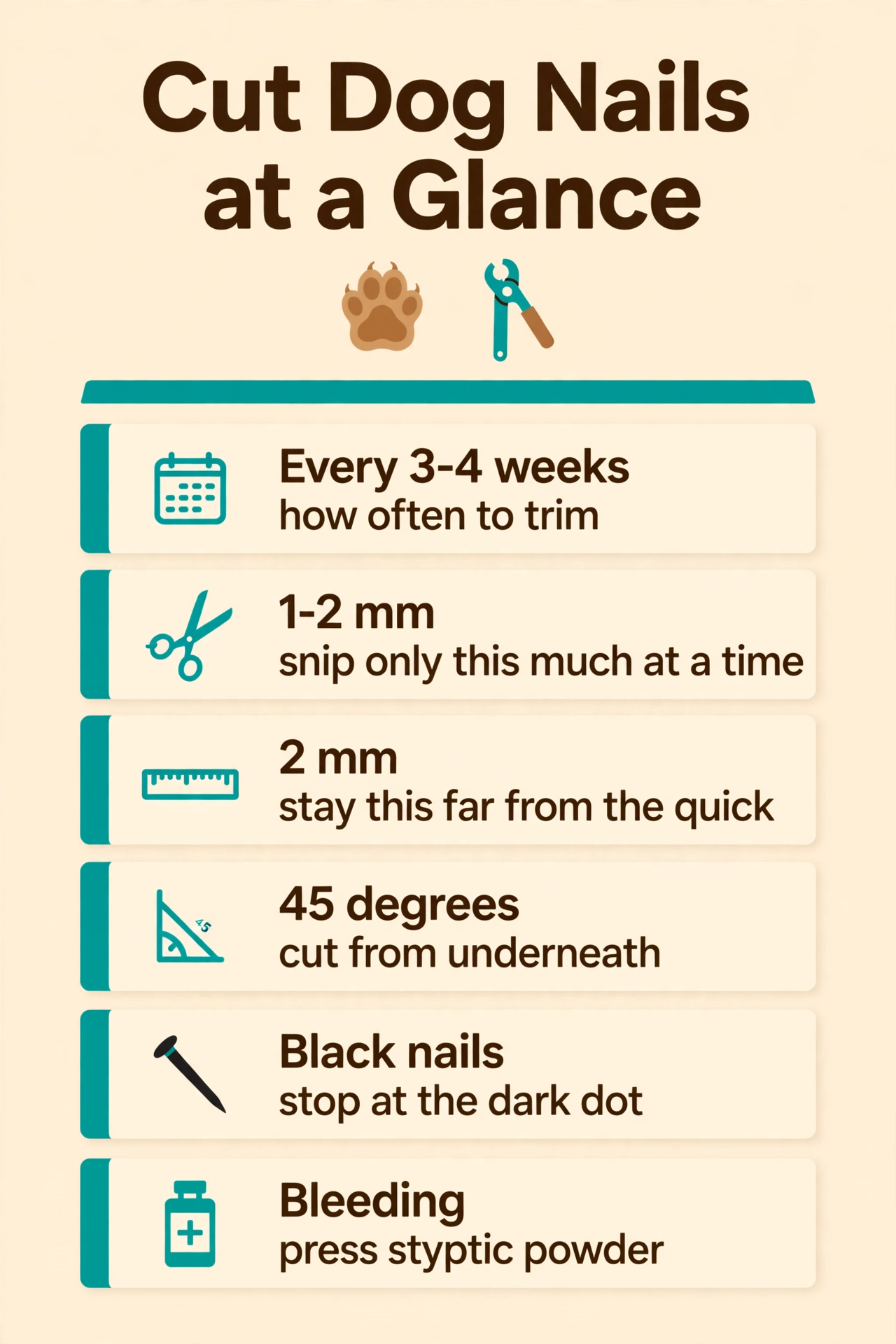
Key Takeaways — Short Answer
What Is the Quick? (And Why It Matters)
A dog’s nail has two layers. The outside is a dead, nerveless shell made of keratin protein. Inside sits the quick — a core of blood vessels and nerves that supplies the claw. Cutting into the quick hurts your dog and makes the nail bleed, so almost everything in nail trimming is about finding the quick and staying in front of it.
On light or clear nails, you can see the quick through the nail as a soft pink region or a pink stripe. On black nails, you cannot see it at all, which is why black nails need a slower method (see the black-nails section below). If a dog’s nails grow too long, the quick grows with them. Frequent trims make the quick recede back to a normal length, so overgrown nails need several small trims over weeks, not one big cut.
What You Need to Cut Dog Nails
Gather everything before you start, so you never have to leave a half-trimmed dog to fetch something.
Do not use human clippers. Human clippers are designed for a flat surface, but dog nails are cupped, so human clippers can squish the nail and cause pain or injury. Use clippers made for dogs.
Clippers or Grinder — Which Should You Pick?
Four main tool types exist, and the right one depends on your dog’s size, nail type, and comfort.
| Tool | Good points | Things to consider |
|---|---|---|
| Scissor clippers | Quick, precise, good for thick nails; suit small dogs and puppies | Must be sharp, or they crush the nail instead of cutting it |
| Plier-style clippers | Strong grip, good for medium and large dogs | Heavier in the hand |
| Guillotine clippers | Easy to use on small and medium nails; the nail sits in a hole and a blade pushes up to cut it | Harder to see exactly where you are cutting |
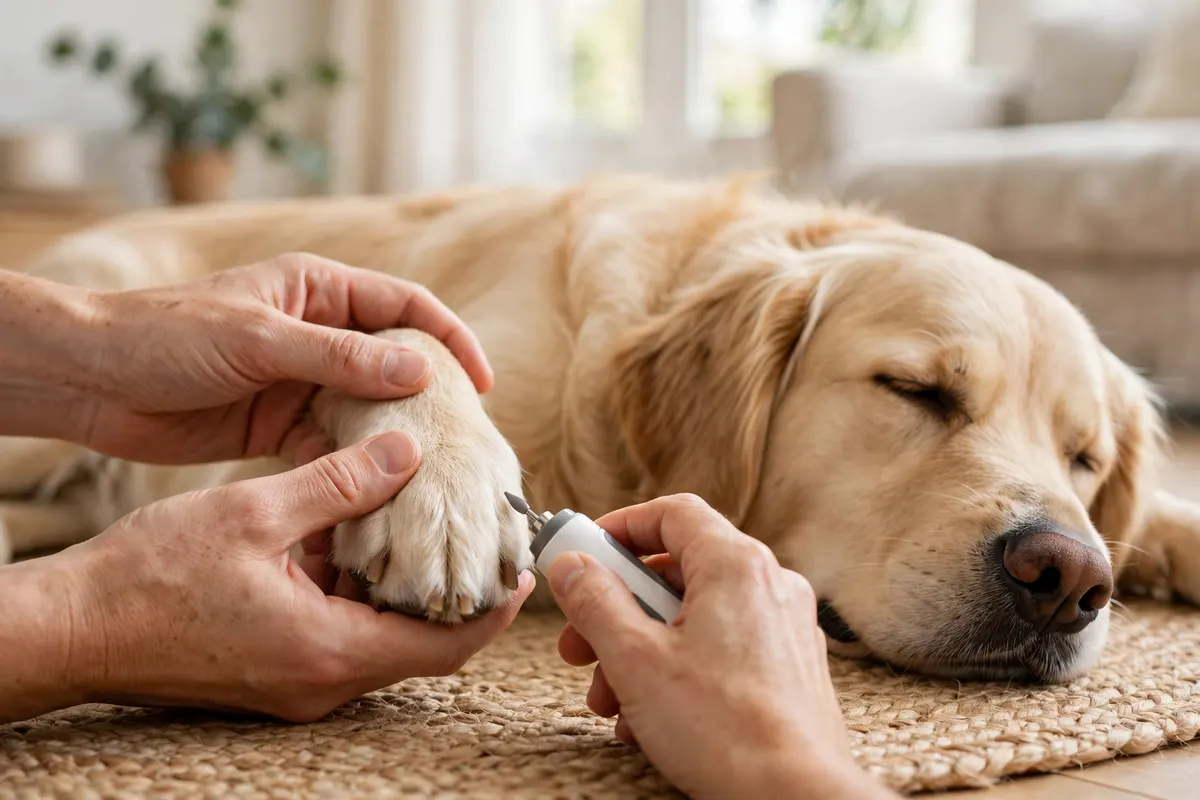
| Nail grinder (e.g. Dremel rotary) | Smooth finish, easy to go slowly, no sudden snip | Noise and vibration bother some dogs; keep long fur away from the spinning head |
For a small dog or puppy, scissor clippers (or even cat nail clippers) are easiest to handle. For a large dog with thick nails, choose plier-style or guillotine clippers — a scissor pair may not be strong enough. For a medium dog, either style works. If you are not sure, ask your vet. A grinder suits owners who feel nervous about clippers, because it files the nail down a little at a time instead of cutting it. You can also file your dog’s nails instead of cutting them, though filing alone takes much longer on a large dog.
Get Your Dog Ready First (The 7-Day Plan)
Most dogs dislike nail trims, so preparation matters more than technique. The AKC publishes a 7-day plan, and it works because it never asks the dog to do too much at once.
Between those days, touch your dog’s paws and legs regularly, and massage the paws gently. While you do, inspect the paws: pain, sores or raw spots, nail breakage, swelling or redness, lameness, or odd nail colour all go to the vet before you attempt a trim. Choose a relaxed time — if your dog is in the mood to play, wait until they are lounging. Pick a quiet space with good lighting. Never pin your dog down or force a trim; if the dog panics, stop and try another day.
How to Cut Dog Nails, Step by Step
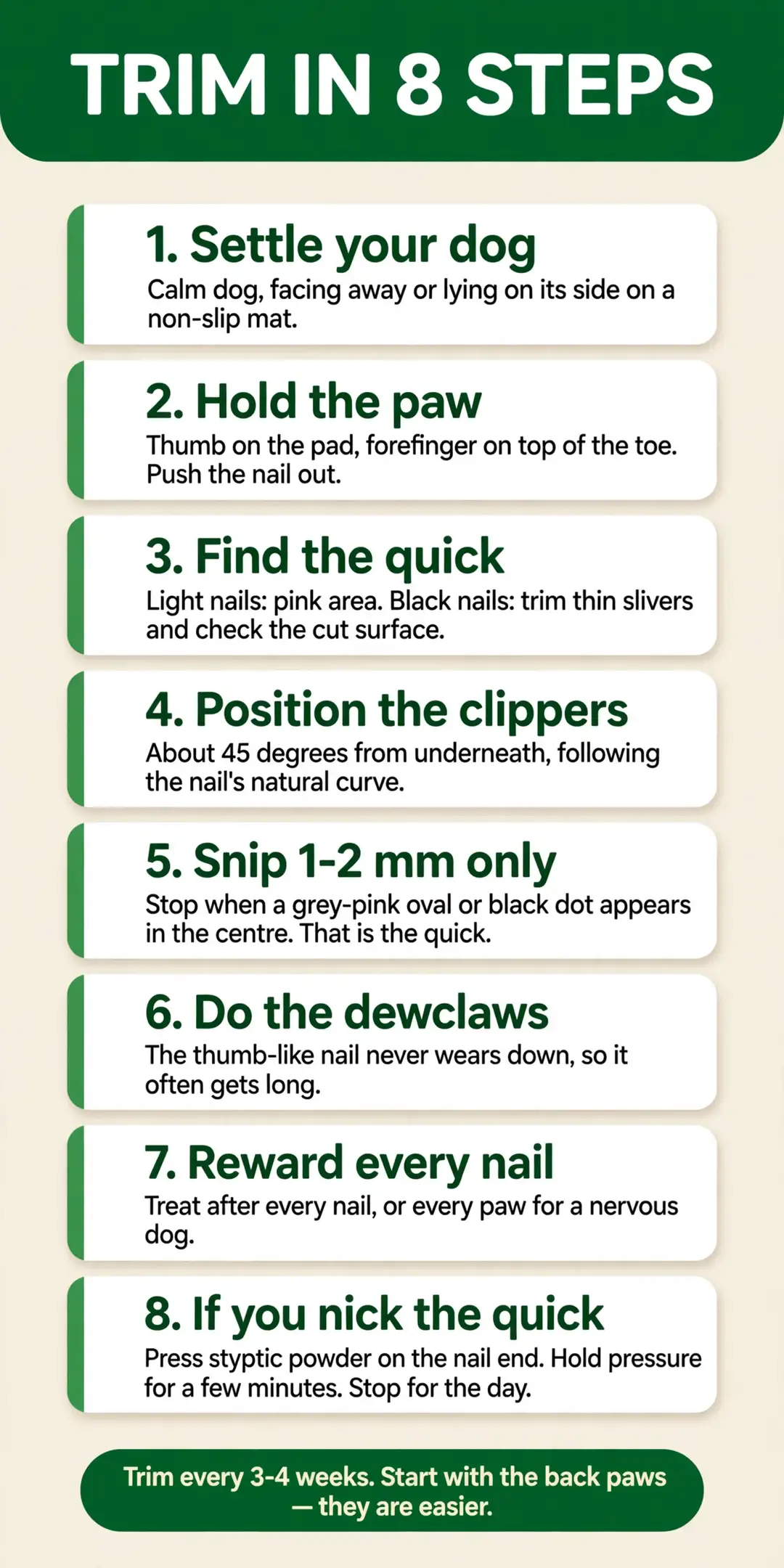
- Settle your dog. Many dogs are calmest facing away from you, or lying on their side on a non-slip mat. Drape a forearm gently over the shoulders so the dog cannot stand up mid-cut. If the dog is very wriggly, ask a second person to hold the dog while you focus on the trimming.
- Hold the paw and extend one nail. Pick up a paw and place your thumb on the pad of a toe and your forefinger on the top of the toe, on the skin above the nail. Make sure none of the dog’s fur is in the way. Push your thumb slightly up and backward on the pad while pushing your forefinger forward. This extends the nail.
- Look for the quick. On light nails, find the pink area first. On black nails, plan to cut thin slivers and check the cut surface after each snip.
- Position the clippers. For scissor-style clippers, hold them horizontally and perpendicular to the nail. For guillotine-style clippers, hold them perpendicular so the cut runs from bottom to top. PetMD and Petful advise cutting at about a 45-degree angle from underneath, following the nail’s angle. The AKC and Zoetis describe clipping the tip straight across. In practice, both mean the same thing: cut only the tip, at a slight angle that follows the nail’s natural curve.
- Snip a small amount. Take off only 1 to 2 mm. On the cut surface, watch for a grey-to-pink oval appearing in the centre (Washington State University Veterinary Teaching Hospital). That means you are getting close to the quick, so stop on that nail.
- Check the cut surface on dark nails. The cut end looks whitish when it is only the safe outer layers. As you trim closer to the quick, the centre begins to look like a black dot. Stop when you see it. If you see pink at the centre, that is the quick — do not cut more.
- Do the dewclaws. The dewclaw is the thumb-like nail on the inner side of the paw. It never wears down on its own, so it often gets long. Clip it the same way.
- Reward and move on. Give a treat after every nail, or every paw for a nervous dog. Smooth rough edges with a file or grinder if you like.
Start with the back paws. Their nails are usually shorter and easier to trim, and dogs tend to be calmer about having their back paws handled. Stop any trimming if your dog seems distressed.
How to Cut Black Dog Nails
Black nails hide the quick, so you cannot see where to stop — you have to feel your way there in thin slices. Trim very short lengths off the nail and look at the centre of the cut surface straight on after each trim. The sources describe the stop signal in four slightly different ways, and they all point to the same thing: when the centre of the cut surface changes colour, stop.
PetMD’s source (Sexton) says to look for a black dot in the centre. Petopedia says to stop when a small dark dot or a moist, grey-pink centre appears. Petful, citing Washington State University, says to stop when a grey-to-pink oval appears. The AKC and WebMD say to watch for a chalky white ring that marks where the quick starts.
Any of these signals means you have reached the quick’s neighbourhood — stop cutting that nail.
Go slower than you think you need to. Trim a little at a time, check after every snip, and remember that you can always take more off tomorrow.
How Short Should You Cut? How Often?
The goal is to trim the nails short enough that the nail does not touch the floor when the dog is standing. If the dog has long quicks, that may be impossible — in that case, cut to within about 2 mm of the quick. The sources give slightly different numbers here: wikiHow says trim to within 2–4 mm of the quick, while Zoetis, WebMD, and Petful say within about 2 mm. About 2 mm is the practical answer.
Most dogs need their nails trimmed about every four weeks, according to PetMD’s source (Sexton); Petful says every 3 to 4 weeks. Once you hear the nails start to tap on hard surfaces, it is time — that sound means the nails are already too long. Overgrown nails cause real harm: pain, splayed feet, and even torn nails that need veterinary care. If the nails are badly overgrown, trim a little every week. The quick recedes a bit after each trim, so after a few weeks you can get the nails back to a normal length.
What to Do If You Cut the Quick
It happens to experienced groomers too. Stay calm — your dog will pick up on any panic. Keep hold of your dog so they do not run around getting blood everywhere, and remember that staying calm also keeps their blood pressure lower, which helps the bleeding stop sooner.
Pinch a bit of styptic powder or cornstarch between your thumb and finger and press it directly on the end of the bleeding nail. Hold gentle pressure for a few minutes. Give your dog a treat and stop for the day. If the bleeding does not stop after several minutes of steady pressure, call your vet.
If Your Dog Will Not Let You Cut Their Nails
A scared dog needs patience, not force. Go back to the preparation steps: touch and treat, hold and treat, introduce the tool without cutting, then trim a single nail and call it a day. Trim one nail at a time across several days if that is what your dog can handle. A second person holding the dog helps. Some dogs do best lying on their side; others do best facing away from you.
If your dog still will not let you, there is no shame in having the nails trimmed by a professional groomer or at your vet’s office. A vet or vet tech can also give you a first lesson — the AKC’s chief veterinarian, Dr. Jerry Klein, suggests exactly that if you have never clipped nails before, and WebMD says the same. Whatever you do, never pin your dog down to force a trim — it makes the next trim harder, not easier.
Puppy Nail Trimming
Start early. Puppies that get used to paw handling young grow into adults that accept trims calmly. Touch the puppy’s paws gently, massage them, and press on the nails a little. Follow the same 7-day plan, but keep every session shorter. Use small-dog clippers or cat nail clippers, which are easier to handle on tiny nails. Trim the very tiniest tip from one nail, give a treat, and stop. One nail a day is a win for a puppy.
How Much Does a Professional Nail Trim Cost?
Nail trim prices at Petco, PetSmart, vets, and groomers vary by clinic, location, and dog size, so ask for a quote.
Ask your own vet clinic or groomer for their price. How long a trim takes varies with the dog. And how long a trim takes has no clear answer either; it varies with the dog.
Nail Problems: Black Spots, Bleeding After Walks, Broken Nails
What is the black stuff inside my dog’s nail? On the cut surface, a black dot in the centre means you are close to the quick — stop cutting. If a nail changes colour, show it to your vet.
Why is my dog’s nail bleeding after a walk or a run? A nail can wear down, crack, or tear on hard ground. Press styptic powder or cornstarch on the end and hold pressure. If it keeps bleeding, or the nail looks broken, see your vet.
What if a nail breaks? A torn nail hurts and can bleed a lot. Keep the dog calm, press powder on the end, and call your vet — a badly torn nail sometimes needs veterinary care.
Can cutting nails cause fractures? Cutting the tip of a nail does not involve the bones.