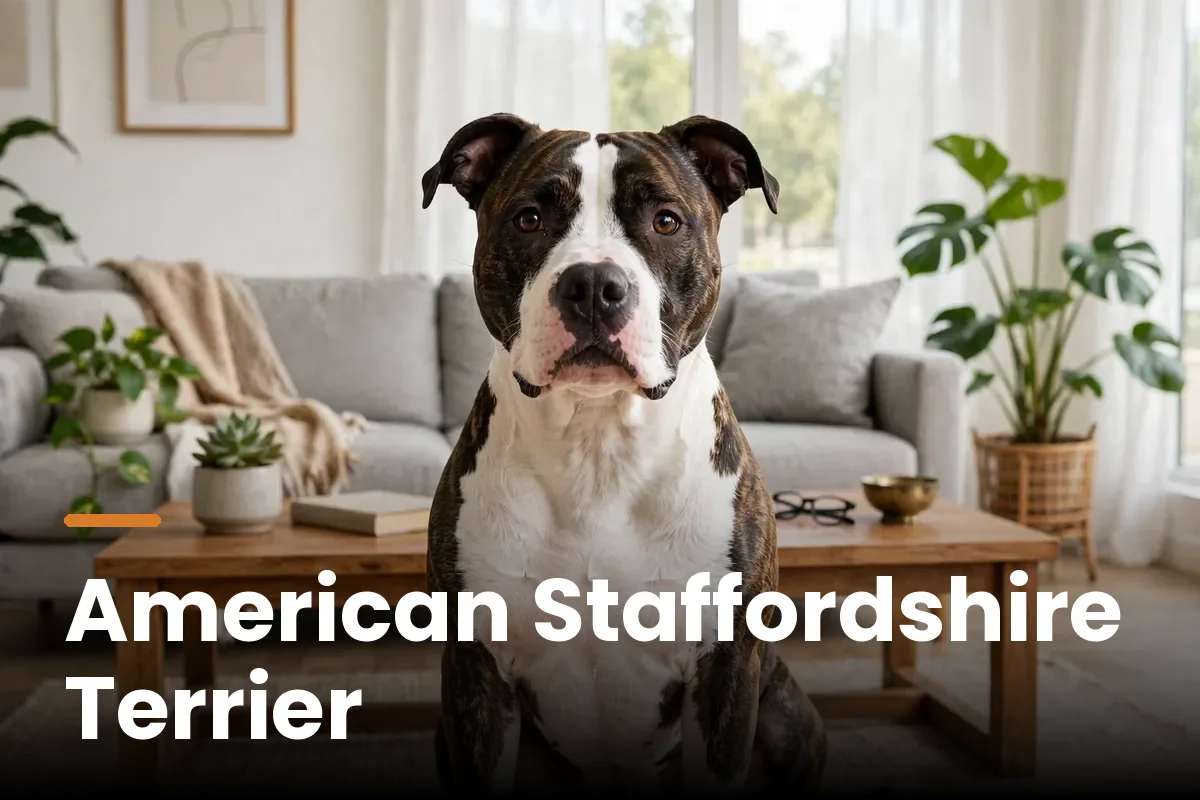
American Staffordshire Terrier: Complete Guide — Temperament, Size, Training, Health, Cost & Laws
The American Staffordshire Terrier is a medium-sized, muscular dog with a big heart and a strong body. People call it the AmStaff for short. It loves its people, it learns fast, and it needs a firm, kind owner who gives it daily exercise and clear rules.
This guide answers the questions people ask most. Is the American Staffordshire Terrier a Pit Bull? Is it dangerous? Is it good with kids? How big does it get? How much does it cost? Where is it banned? You will find clear answers below.
Key Takeaways
What Is an American Staffordshire Terrier?
What is an American Staffordshire Terrier? It is a medium-sized terrier breed from the United States. People also call it the AmStaff, the Staffie, the Staffy, or the American Staffy. These are nicknames for the same breed.
You can spot an AmStaff by its shape. It has a broad head, strong cheek muscles, a deep chest, and a short, glossy coat. It looks powerful, and it is powerful. It also looks friendly, and it usually is friendly with people.
The AmStaff belongs to the bull-and-terrier family. That family also includes the American Pit Bull Terrier, the Staffordshire Bull Terrier, the American Bulldog, the Bull Terrier, and the Boxer. They share ancestors, but they are not the same breed. Each one has its own breed standard, its own size, and its own history.
The American Kennel Club, the United Kennel Club, the Fédération Cynologique Internationale, and the Canadian Kennel Club all recognise the breed. The Staffordshire Terrier Club of America is the breed’s parent club in the United States.
American Staffordshire Terrier at a Glance
Here is the whole breed in one table. Read the notes under it.
| Fact | What the figures show |
|---|---|
| Other names | AmStaff, Staffie, Staffy, American Staffy |
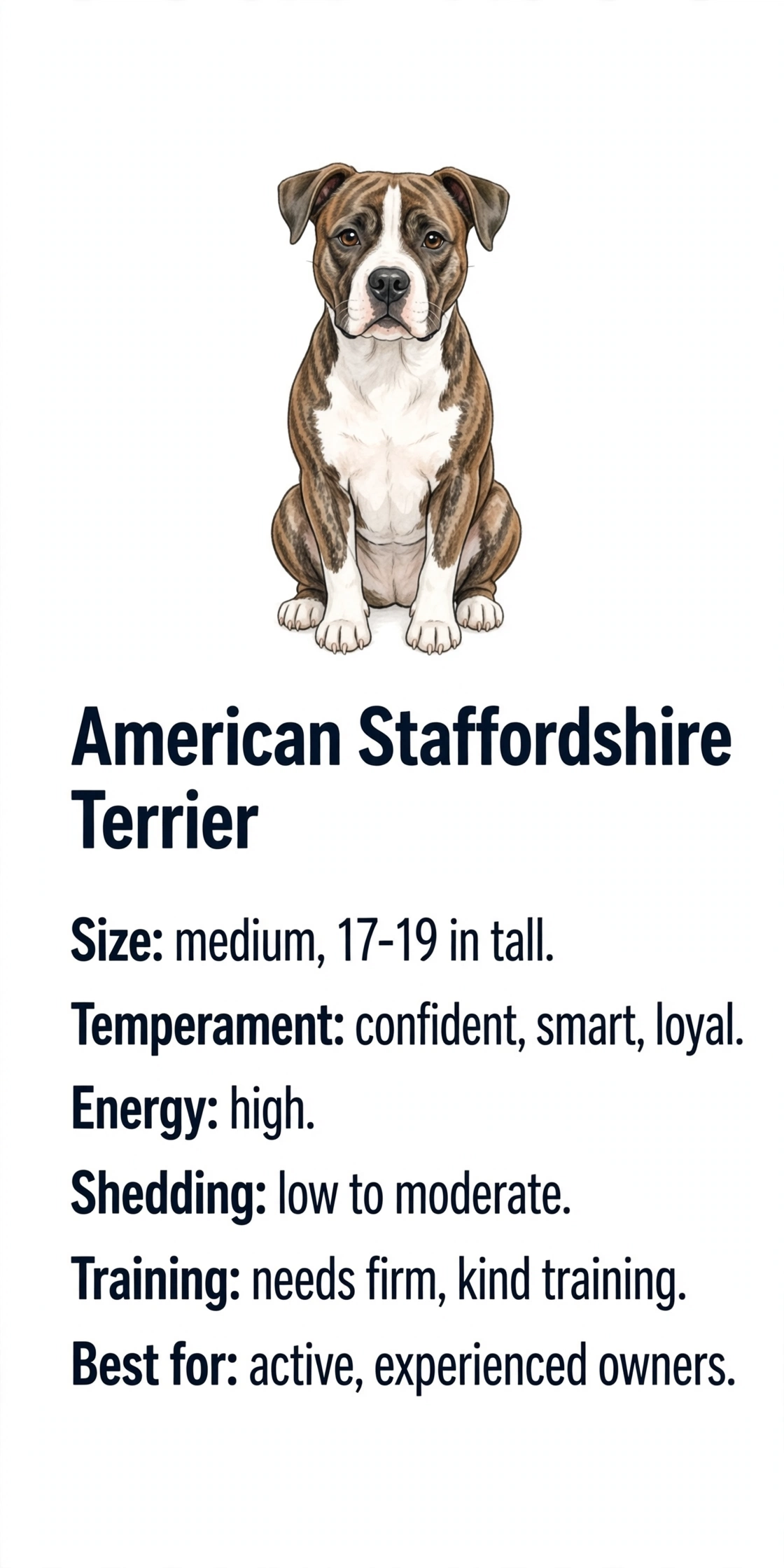
| Size | Medium |
| Height | 17–19 in tall; males 18–19 in, females 17–18 in |
| Weight | 40–70 lb in most breed guides; males 55–70 lb, females 40–55 lb |
| Lifespan | 12–16 years |
| Coat | Short, stiff, glossy, single-layer |
| Shedding | Low to moderate |
| Colours | Brindle, blue, fawn, red, black, white, brown, liver, solid, parti, patched |
| Temperament | Confident, smart, good-natured, loyal, affectionate, playful, brave, stubborn |
| Energy | High |
| Exercise | 30–60+ minutes a day |
| Trainability | Learns fast with firm, kind, positive training |
| Best for | Active, experienced people with time for training and exercise |
| Good with kids | Yes, with supervision |
| Good with other dogs | Often dog-selective — needs careful socialisation |
| Good with cats | Depends on the dog and on early socialisation |
| Apartments | Yes, if it gets enough exercise |
| Hypoallergenic | No |
Read the conflicts before you trust one number
The weight is the biggest conflict. Most guides list 40–70 lb, though some give 50–80 lb.
The lifespan runs about 12 to 16 years, and some dogs live 12 to 14 years. Use 12 to 16 years as the broad range. Food, weight, genes, and vet care all change the real number.
Plan on 30 to 60 minutes or more a day. A good walk, play time, and training each day works for most dogs, with more on days when your dog feels restless.
History and Origin — What Were They Bred For?
To understand this dog’s traits, it helps to know where it came from. This section covers the breed’s home country, its roots in England, and the work breeders originally made it for.
Where is the American Staffordshire Terrier from?
The American Staffordshire Terrier comes from the United States, but its roots sit in England. In the 1800s, breeders in England crossed bulldogs with terriers. They wanted a dog with the bulldog’s strength and the terrier’s speed and spirit.
The result was the bull-and-terrier type. People also used dogs from the White English Terrier and the Black and Tan Terrier lines in that mix.
Those dogs crossed the Atlantic with immigrants. In the United States, breeders shaped them into a larger, heavier dog. They bred for strength, courage, and a steady temper with people. Over time, the American dogs grew apart from their English cousins.
The American Kennel Club recognised the breed in 1936. At first it used the name Staffordshire Terrier. In 1969, the club renamed it the American Staffordshire Terrier. The new name set it apart from the smaller Staffordshire Bull Terrier from England.
What were they bred for?
What were they bred for? The early bull-and-terrier dogs worked in blood sports, then later as farm dogs, catch dogs, and all-round working dogs. They guarded property, helped with livestock, and worked beside their owners.
That past matters, but it does not decide the dog in front of you. Modern breeders select for a steady, people-loving temper. The American Staffordshire Terrier today works as a family companion, a therapy dog, a service dog, a search-and-rescue dog, and a dog-sport athlete.
It still carries the old strength and courage. It also carries a strong wish to please its owner.
The famous AmStaffs show that range. Sergeant Stubby served in World War I and became a decorated war dog. Pete the Pup, also called Petey, starred in the Our Gang comedies. Bud and Tige are two more AmStaffs people still remember by name.
Size, Appearance, Coat and Colours
Before you bring one home, it helps to know how this breed looks and grows. This section covers its build, coat colors, adult size, and the age when growth slows, so you can picture what your puppy will become.
What does an American Staffordshire Terrier look like?
What does an American Staffordshire Terrier look like? Picture a medium dog with a wide head, a short muzzle, and a deep, broad chest. Its body looks stocky and muscular. Its legs look strong. Its tail hangs low and tapers to a point. Its coat looks short and shiny.
The head tells you the most. It has a broad skull, strong cheek muscles, and a black nose. Its eyes look round and dark.
Its ears sit high. Most AmStaffs today keep natural rose ears or half-pricked ears. Some owners crop the ears, but cropping is a choice, not a need. An uncropped AmStaff looks just as much like an AmStaff.
How big do American Staffordshire Terriers get?
How big do American Staffordshire Terriers get? Most breed guides list 17–19 inches tall at the shoulder. Males usually stand 18–19 inches. Females usually stand 17–18 inches.
Weight follows the same pattern. Most guides list 40–70 lb overall. Males usually weigh 55–70 lb.
Females usually weigh 40–55 lb. Some guides list about 50–80 lb instead. That is the conflict noted in the At a Glance table.
Use the 40–70 lb range when you plan food, a crate, and a car seat, and ask your vet about your own dog’s healthy weight.
There is no recognised miniature AmStaff. There is no official “mini” AmStaff; the breed comes in one medium size. A very small adult is usually a mix or a different breed, so ask for the parents’ size before you buy.
What colors do American Staffordshire Terriers come in?
What colors do American Staffordshire Terriers come in? The coat comes in brindle, blue, fawn, red, black, white, brown, and liver. It can be solid, parti-coloured, or patched. A blue nose, a red nose, and a tri-colour coat all appear in searches, and they all fall inside the normal colour range.
The breed standard does not encourage all-white coats, coats that are more than 80% white, black and tan, or liver. That does not make those dogs unhealthy by itself. It means breeders who follow the standard avoid those colours.
The coat itself is short, stiff, glossy, and smooth. It has one layer, not a thick double coat. That short coat is why the dog sheds only a little and why it feels the cold. Give it a coat or a warm bed in winter.
Growth chart: when do they stop growing?
When do they stop growing? Most AmStaffs reach their full height by about 12–14 months, and they fill out with muscle until about 18–24 months. Puppies grow fast in the first six months, then they slow down. Males often finish a little heavier than females.
Growth runs in stages, not fixed numbers. Exact month-by-month weights vary by sex, parents, food, and health, so no single chart fits every puppy. Use the stages below, watch your puppy’s ribs and waist, and ask your vet to check the weight at each visit.
| Age stage | What to expect | What to do |
|---|---|---|
| 8–12 weeks | Small puppy, fast growth, needs frequent meals and sleep | Feed 3 meals a day, start house-training and gentle socialisation |
| 3–6 months | Rapid growth, teething, lots of energy | Keep training short, protect the joints, avoid long runs |
| 6–12 months | Height mostly done, still lean, strong chewing | Feed 2–3 meals a day, add recall and loose-leash work |
| 12–18 months | Adult height, muscle fills in | Move to adult food on your vet’s advice, keep exercise steady |
| 18–24 months | Full grown, adult muscle and weight | Set the adult feeding amount, keep the weight in check |
Temperament and Personality
Understanding this breed’s personality helps you decide if it is right for you. This section covers the typical temperament, how smart the breed is, and what dog-selective means for walks and meetings with other dogs.
What is the typical personality of an American Staffordshire Terrier?
What is the typical personality of an American Staffordshire Terrier? The American Kennel Club describes the breed as confident, smart, and good-natured. Many people add more words: loyal, affectionate, playful, clownish, brave, stubborn, and eager to please.
An AmStaff loves people. It follows its owner from room to room. It leans on your leg.
It tries to sit on your lap even though it weighs 50 lb or more. It greets guests with a wagging tail and a big smile. It wants to join the game, the walk, and the cuddle on the sofa.
It also has a strong will. It tests rules. It pulls on the leash. It jumps up when it feels excited. It guards its food or its toy if you never teach it to share. These are not signs of a bad dog. They are signs of a strong dog that needs a steady owner.
Are American Staffordshire Terriers smart?
Are American Staffordshire Terriers smart? Yes. Sources describe the breed as smart and eager to please, and it learns fast when you train in short, fun sessions. It picks up sit, down, stay, and recall quickly. It also picks up bad habits just as fast, so train the good habits first.
People search for an intelligence ranking for the AmStaff. Judge the dog by what it does: it solves puzzle feeders, it learns routines, and it reads your mood. Give it jobs to do, and it stays happy.
Dog-selective: what it means
Dog-selective means the dog likes some dogs and not others. Many AmStaffs love people and feel unsure about strange dogs. They may play well with a dog they know, then snap at a dog they do not know. They may chase small animals because of a strong prey drive.
This trait comes from the breed’s history, and training can manage it but may not erase it. Socialise your puppy early. Meet calm, friendly dogs. Teach a strong recall and a strong “leave it”. Keep the dog on a leash around strange dogs. Never let two AmStaffs sort out a fight by themselves.
Is an American Staffordshire Terrier a Pit Bull?
Is an American Staffordshire Terrier a Pit Bull? This is the most asked question about the breed, and the answer has two parts.
First, “Pit Bull” is not one breed. It is a type name that people use for several breeds: the American Staffordshire Terrier, the American Pit Bull Terrier, the Staffordshire Bull Terrier, and sometimes the American Bully. When someone says “Pit Bull”, they may mean any of these dogs.
Second, an AmStaff is not the same dog as an American Pit Bull Terrier. The two breeds share ancestors, but they have separate breed standards and separate registries. The AmStaff is the show-ring branch.
The American Pit Bull Terrier is the working branch, recognised by the United Kennel Club but not by the American Kennel Club.
How is the American Staffordshire Terrier different from similar breeds?
How is the American Staffordshire Terrier different from similar breeds, like the American Pit Bull Terrier? Use the table below. It covers the dogs people mix up most.
| Breed | How it differs from the AmStaff |
|---|---|
| American Pit Bull Terrier (APBT) | Leaner and lighter, bred for work more than for the show ring, recognised by the UKC, not by the AKC |
| Staffordshire Bull Terrier (Staffy) | Smaller and shorter, the English cousin, usually 24–38 lb, stockier in a smaller frame |
| American Bully | Shorter and wider, heavier bone, bred as a companion with a very bulky build |
| Cane Corso | Much larger, a mastiff-type guard dog, often 90 lb or more |
| American Bulldog | Larger and taller, a farm and catch dog with a heavier head |
| Boxer | Taller and leaner, with a longer muzzle and a bouncy, playful style |
The law does not always follow the breed table. Many cities and insurers group all of these dogs under “Pit Bull type”. That means your AmStaff may face the same ban as an American Pit Bull Terrier even though the breeds differ.
Check the law where you live before you fall in love with a puppy. The Banned, Restricted, and Insurance section below covers the laws in full.
Are AmStaffs Dangerous or Aggressive? — Honest Answer
Many people worry about this breed because of its reputation. This section looks at whether the dogs are dangerous or aggressive, why the image formed, the nanny dog claim, and what its bite force really means.
Is an American Staffordshire Terrier dangerous?
Is an American Staffordshire Terrier dangerous? A dog is not dangerous because of its breed name alone. A dog turns dangerous when it has no training, no socialisation, no exercise, and no supervision.
An AmStaff is strong, so a poorly trained AmStaff can do more harm than a poorly trained small dog. That is the honest risk, and it is the reason this breed needs a serious owner.
A well-raised AmStaff is usually gentle with people. It loves children in its own family. It greets strangers with a wag.
It rarely guards the house, because it likes visitors too much. But it can be dog-selective, and it can react fast when it feels threatened. Keep it on a leash.
Teach it to walk past other dogs calmly. Never leave it alone with a strange dog.
Are American Staffordshire Terriers aggressive?
Are American Staffordshire Terriers aggressive? The breed is not aggressive toward people by nature. It can show aggression toward other dogs, and it can show resource guarding around food, toys, and beds. It can also chase cats and small pets because of its prey drive.
Watch for the early signs. A stiff body, a hard stare, a raised tail, and a low growl all mean “back off”. Teach your dog to trade a toy for a treat.
Teach it to leave food alone until you say “take it”. Teach children to leave the dog alone while it eats and sleeps. These small habits stop most fights before they start.
Why do American Staffordshire Terriers have a reputation for being aggressive?
Why do American Staffordshire Terriers have a reputation for being aggressive? Three reasons feed the reputation. First, the breed’s ancestors worked in blood sports, and the name still carries that past.
Second, the dogs look strong, and strong dogs scare people. Third, bad owners use the breed for fighting and for guarding, and the news reports those dogs, not the thousands of calm family pets.
The reputation also grows because people mix up the breeds. A bite by any Pit Bull type dog gets reported as a “Pit Bull attack”. The AmStaff, the American Pit Bull Terrier, and the Staffordshire Bull Terrier all get blamed together.
The breed name takes the hit, even when the dog was a mix or a different breed.
The “nanny dog” myth — fact-check
People call the AmStaff a “nanny dog”. The story says the breed once worked as a nanny for children. That story is a myth. The dogs did live with families, and they did love children, but no one bred them to babysit.
Do not use the myth to skip supervision. An AmStaff can be a wonderful family dog, and it still needs an adult in the room with children. A strong dog can knock a small child over by accident.
A child can hurt a dog by pulling its ears or tail. Supervise every meeting between dogs and children, no matter how sweet the dog is.
What is the American Staffordshire Terrier bite force?
What is the American Staffordshire Terrier bite force? People ask this question a lot, and they want one number. Any PSI number you see online does not come from the sources used here.
The facts are clear. The AmStaff has a strong jaw, a broad head, and powerful cheek muscles. It can bite hard when it bites.
Jaw strength alone does not make a dog dangerous. A strong jaw with a calm temper, good training, and a responsible owner is safe. A strong jaw with no training and no control is not safe. Focus on training, not on the number.
Good With Kids, Family, Cats, and Other Dogs?
Temperament matters most when you share your home with children and other pets. This section looks at how the breed behaves with family, kids, cats, and other dogs, and whether it makes a good guard dog.
Are American Staffordshire Terriers good family pets?
Are American Staffordshire Terriers good family pets? Yes, for the right family. An AmStaff loves its family. It plays with children, it joins family walks, and it sleeps near its people. It needs a family that gives it exercise, training, and attention every day.
The wrong family is a busy family with no time for a dog. An AmStaff left alone all day will chew, dig, bark, and destroy things. It will not stay calm on its own. If your family works long hours and no one can walk the dog, pick a lower-energy breed.
Are American Staffordshire Terriers good dogs?
Are American Staffordshire Terriers good dogs? Yes, they are good dogs if you want a loyal, playful, people-loving companion and will train it. They are not good dogs if you want a dog that trains itself. The breed gives back exactly what you put in.
Are American Staffordshire Terriers good with children?
Are American Staffordshire Terriers good with children? Yes, with supervision. The breed loves children in its own family. It plays gently with older children. It can knock toddlers over by accident because it is strong and bouncy, so keep a close eye on small children.
Teach children the rules. Do not pull the dog’s ears or tail. Do not climb on the dog. Do not take its food or its toy. Do not wake a sleeping dog. Teach the dog the rules too. No jumping on children. No mouthing hands. Calm play earns treats and praise.
Are American Staffordshire Terriers good with cats?
Are American Staffordshire Terriers good with cats? It depends on the dog and on early socialisation. Some AmStaffs live happily with a cat they grew up with. Others chase cats because of a strong prey drive. A cat that runs away can trigger the chase.
Introduce them slowly. Keep the dog on a leash. Give the cat a high place to escape to. Reward calm behaviour. Never let the dog chase the cat, even once. If the dog fixates on the cat and will not look away, keep them apart and ask a trainer for help.
Does the American Staffordshire Terrier get along with other pets?
Does the American Staffordshire Terrier get along with other pets? It can, if you socialise it early and manage the meetings. It does best with pets it grew up with. It does worst with strange dogs and small animals that run.
Keep small pets like rabbits, guinea pigs, and birds in a secure cage the dog cannot reach. Do not let the dog meet them face to face. The prey drive is real, and it is not a training failure. It is part of the breed.
Can AmStaffs live with other dogs?
Can AmStaffs live with other dogs? Yes, some can. Many AmStaffs live well with one other dog, usually a dog of the opposite sex that they met as a puppy. Two adult males or two strong females often clash.
Meet on neutral ground first. Walk the dogs together before you let them share a home. Feed them in separate rooms. Give each dog its own bed, bowl, and toys. Watch the first weeks closely. If the dogs stiffen, stare, or guard, separate them and ask a trainer for help.
Are AmStaffs good guard dogs? Are they good guardian dogs?
Are American Staffordshire Terriers good guard dogs? They are poor guard dogs, and that surprises people. The breed looks tough, but it loves visitors. It greets a stranger at the door with a wag, not a warning.
Are AmStaffs good guardian dogs? As guardians they do a little better. They watch the home, they bark at strange sounds, and their size alone puts people off.
But they will not guard the house the way a German Shepherd or a Cane Corso does. Do not buy an AmStaff for protection. Buy it for company.
Training — Is the AmStaff Easy to Train?
Training shapes how well this strong, eager dog fits into your home. This section covers how easy the breed is to train, the best methods, crate and house training, and how to handle common behavior problems.
Is the American Staffordshire Terrier easy to train?
Is the American Staffordshire Terrier easy to train? Yes, and no. The dog learns fast. It wants to please you.
It picks up new cues in a few sessions. But it also has a strong will, and it will test you. Training is easy when you stay consistent. Training fails when you train for a week and then stop.
Use positive reinforcement. Reward the behaviour you want with treats, praise, and play. Keep sessions short, five to ten minutes, two or three times a day. End each session with a win. Never hit the dog. Never shout at it. Fear makes a strong dog dangerous, not obedient.
How to train an American Staffordshire Terrier
How to train an American Staffordshire Terrier? Start on day one. Teach the basics first: sit, down, stay, come, leave it, and drop it. Teach loose-leash walking before the dog grows strong enough to pull you over. Teach recall in a safe, fenced area with high-value treats.
Socialise the puppy early and often. Meet calm people, calm dogs, children, bikes, cars, and loud sounds. Keep each meeting short and happy. Reward calm behaviour. Stop before the puppy feels scared.
Teach impulse control next. Ask the dog to sit before meals, before walks, and before play. Ask it to wait at the door. Teach it to trade a toy for a treat. These small exercises teach the dog to think before it acts.
Use clicker training if you like it. The click marks the exact moment the dog gets it right. Pair the click with a treat, and the dog will offer the behaviour again. Keep the clicker in your pocket on walks, and use it to reward calm behaviour around other dogs.
Crate training and house-training
Crate training gives the dog a safe den. Make the crate comfortable with a bed and a chew toy. Feed meals in the crate. Close the door for short periods and build up slowly. Never use the crate as a punishment. A dog that loves its crate will settle there when the house gets busy.
House-training needs a routine. Take the puppy out after meals, after naps, after play, and first thing in the morning. Praise it the moment it goes outside. Clean accidents with an enzyme cleaner, and do not punish the puppy. Punishment teaches the dog to hide, not to hold it.
Common behaviour problems
Watch for these problems, and fix them early:
Exercise, Energy, and Dog Sports
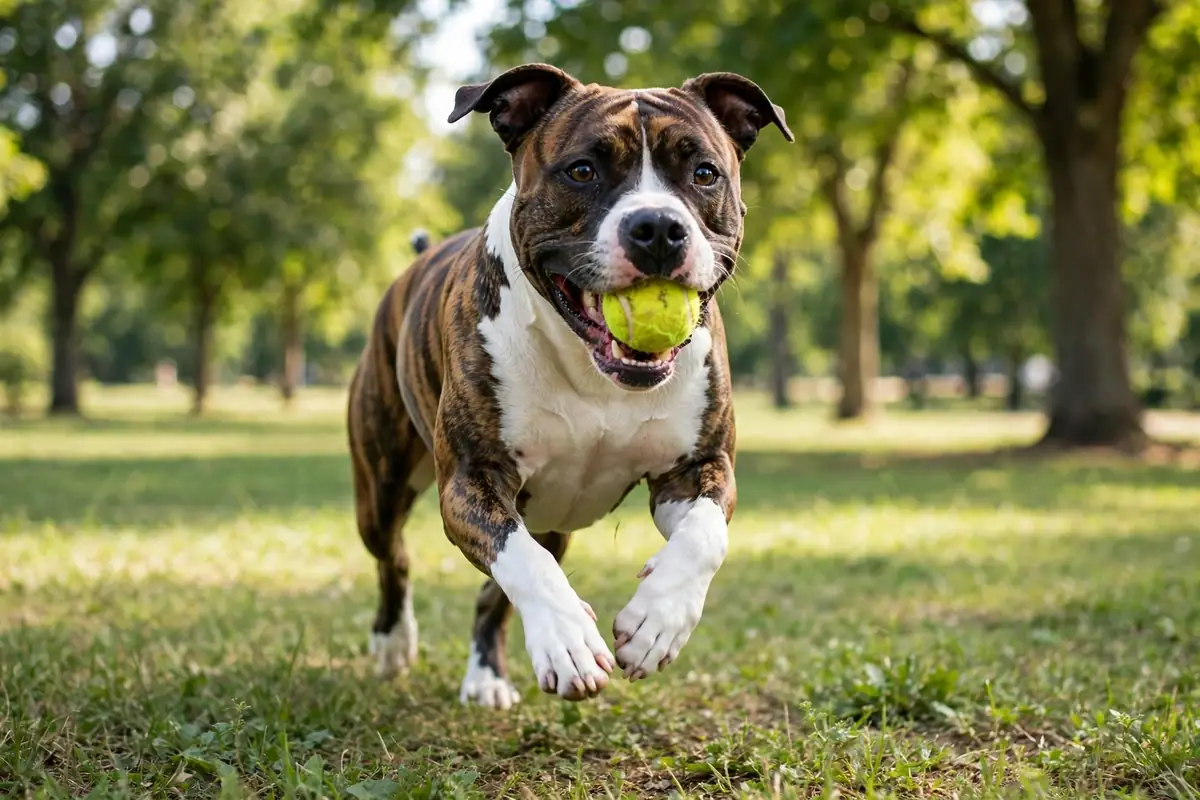
AmStaffs need daily exercise and play — fetch is a good outlet for their energy.
What kind of care and exercise does this breed need?
What kind of care and exercise does this breed need? It needs daily exercise, daily training, daily company, and simple grooming. It needs a strong owner who walks it every day, rain or shine. It needs a fenced garden or a safe place to run. It does not need a palace. It needs your time.
Plan for a high-energy dog. Give it a long walk, play time, and a training session each day. Add puzzle feeders and scent games on rainy days. A tired AmStaff sleeps well. A bored AmStaff destroys the house.
How much exercise does an AmStaff need?
Most dogs do well on 30 to 60 minutes or more a day. One long walk plus play and training works well for most owners. Puppies need less. Young adults need more. Senior dogs need less again, but they still need a daily walk.
Watch your dog, not the clock. A dog that paces, chews, and barks at night needs more exercise. A dog that sleeps soundly after a walk has had enough. Build up slowly with puppies. Protect their joints. Avoid long runs and hard jumps until the dog finishes growing.
Dog sports and activities
An AmStaff loves dog sports. Try agility, obedience, rally, weight pulling, dock diving, barn hunt, flyball, scent work, and coursing. A flirt pole and a game of tug of war work well in the garden. Fetch, hiking, and swimming all burn energy.
Teach tug of war with rules. The dog must drop the toy when you say “drop it”. The game stops when teeth touch skin. These rules keep a strong game safe.
Avoid exercise right after feeding. Wait at least an hour after a meal before hard play. This lowers the risk of bloat, a dangerous stomach condition that affects deep-chested dogs.
Can American Staffordshire Terriers live in apartments?
Can American Staffordshire Terriers live in apartments? Yes, if they get enough exercise. The breed does not need a big house. It needs a daily walk, play time, and training. An apartment dog that walks twice a day does better than a house dog that never leaves the garden.
Check the rules before you move in. Many landlords ban Pit Bull type dogs. Many insurers charge more or refuse cover. Ask in writing before you sign a lease. The Banned, Restricted, and Insurance section below covers the legal side in full.
Do American Staffordshire Terriers like to swim?
Many AmStaffs enjoy water, but they are not natural swimmers. Their dense, muscular build and deep chest make them sink more easily than a retriever would. Let your AmStaff wade and paddle in shallow water first, stay within arm’s reach, and use a canine life jacket on deeper water.
Rinse your dog after a swim and dry the ears and skin folds so moisture does not cause irritation.
Health Problems and Lifespan
A healthy dog starts with knowing what can go wrong. This section covers common health problems, how long the breed tends to live, and a vet care schedule, including signs of illness that mean you should call your vet.
What health problems are common in American Staffordshire Terriers?
What health problems are common in American Staffordshire Terriers? The breed is generally healthy, but it carries a list of known problems. Know the list, watch for the signs, and ask your vet to screen for the ones that matter:
How long do American Staffordshire Terriers live?
How long do American Staffordshire Terriers live? Most live 12 to 16 years. The real number depends on genes, weight, food, and vet care.
Help your dog live longer. Keep its weight in check. Feed it well. Exercise it daily. Take it to the vet once a year, twice a year when it turns senior. Brush its teeth. Watch for lumps, limps, and changes in thirst, appetite, and energy.
Vet care schedule and signs of illness
Take your puppy to the vet in the first week. Follow the vaccine schedule your vet sets. Bring the dog back for boosters, flea and worm treatment, and a yearly health check. Senior dogs need a check every six months.
Call the vet fast if you see these signs: a swollen belly with retching, trouble breathing, a limp that lasts more than a day, sudden weight loss, drinking far more water than usual, blood in the urine, a wound that will not heal, or a dog that will not eat for more than a day. Early care saves lives and money.
Senior AmStaff Care and Weight Management
A senior AmStaff changes slowly. It sleeps more. It walks more slowly. It may struggle to jump into the car. It may go grey around the muzzle. It may forget a cue it knew for years. These changes are normal, but a vet should check any sudden change.
Change the routine with age. Give the dog shorter, gentler walks, twice a day instead of one long run. Add ramps for the car and the sofa. Give it a soft, warm bed away from draughts. Keep training sessions short and happy. Keep the mind busy with scent games and puzzle feeders.
Feed a senior dog for its age and weight. Ask your vet about a senior diet and about joint supplements such as glucosamine and chondroitin. Keep the weight down. Extra weight hurts the hips, the elbows, and the knees, and this breed already carries a hip and elbow risk.
Weight management
Weight management matters more for this breed than for most. The dog loves food. It begs at the table. It eats fast. It gains weight fast, and extra weight makes hip dysplasia, elbow dysplasia, and cruciate injuries worse.
Weigh the dog every month. Feel its ribs. You should feel them under a thin layer of fat, not see them and not lose them under fat. Look at the waist from above. It should tuck in behind the ribs.
Feed measured portions. Do not free-feed. Use a slow feeder or a puzzle feeder so the dog eats slowly.
Count treats as part of the daily food, not on top of it. Cut treats to 10% of the daily food or less. Walk the dog every day.
If the dog gains weight, cut the food a little and add a little more walking, then weigh it again in two weeks.
Food and Nutrition — How Much to Feed?
Feeding well keeps this muscular dog healthy and lean. This section covers how much to feed, what daily care involves, and which foods to choose, so you can build a routine that fits your dog’s size and activity.
How much to feed an American Staffordshire Terrier?
How much to feed an American Staffordshire Terrier? There is no one amount for every dog. The amount depends on age, weight, activity, and the food you buy.
Follow the feeding guide on the food bag, then adjust it. If the dog gains weight, feed a little less. If it loses weight, feed a little more. Weigh the dog every month and let the scale decide.
Puppies eat three meals a day. Adults eat two meals a day. Split the daily amount into two meals so the stomach never fills too fast. Feed at the same times each day. Keep fresh water out all day.
How to care for an American Staffordshire Terrier?
How to care for an American Staffordshire Terrier? Give it a daily routine: a morning walk, a training session, play time, two meals, and a calm evening near you. Brush it once a week. Check its ears and teeth each week. Clip its nails every few weeks. Take it to the vet once a year.
Care also means company. This breed hates long hours alone. It needs people. If you work long hours, hire a walker, use a dog daycare, or pick a different breed. A lonely AmStaff is a destructive AmStaff.
What to feed
Pick a food that meets the Association of American Feed Control Officials (AAFCO) standard for your dog’s life stage. Large-breed puppy food helps puppies grow at a safe speed. Adult food suits most adults. Senior food suits older dogs.
Look for a food with named meat first, such as chicken, beef, or fish. Avoid foods that list only “meat meal” with no animal named. Ask your vet about omega-3 fatty acids for the coat and joints, and about joint supplements for older dogs.
Some dogs need a hypoallergenic diet. If your dog itches, licks its paws, or gets ear infections again and again, ask your vet about a food trial. Do not guess. A food trial takes weeks, and it works only if you feed nothing else during the trial.
Avoid exercise right after feeding. Wait at least an hour after a meal before hard play or a run. This lowers the risk of bloat. Feed in a calm place. Use a slow feeder if the dog gulps its food.
Grooming, Shedding, and Hypoallergenic?
Coat care is simple with this short-haired breed, but it still needs some routine. This section explains how much your dog sheds, whether the breed suits allergy sufferers, and the grooming habits that keep the coat healthy.
Do American Staffordshire Terriers shed?
Do American Staffordshire Terriers shed? Yes, they shed. They shed a little, not a lot. Shedding is low to moderate. Expect some short hairs on the sofa and on your clothes, and expect more shedding in spring and autumn.
Brush the dog once a week with a rubber brush or a soft bristle brush. Brushing takes loose hair off the dog and puts it in the brush instead of on your sofa. Bath the dog only when it smells or gets dirty, about once a month or less. Too many baths dry the skin out.
Is the American Staffordshire Terrier hypoallergenic?
Is the American Staffordshire Terrier hypoallergenic? No. No dog is fully hypoallergenic, and the AmStaff is not a low-allergy breed. It sheds, it makes dander, and it can trigger allergies.
If you have allergies, spend time with the breed before you buy. Sit with an adult AmStaff for an hour. See how your nose and eyes feel. No breeder can promise you an allergy-free dog.
Grooming routine
Grooming an AmStaff is simple. Brush the coat once a week. Check the skin for redness, hot spots, and lumps while you brush.
Clean the ears once a week with a vet-approved cleaner. Look inside the ears for redness or a bad smell. Brush the teeth two or three times a week with dog toothpaste.
Clip the nails every two to four weeks. If you hear the nails click on the floor, they need a trim.
Blue and fawn dogs need extra skin care. Their dilute coats link to colour dilution alopecia, which causes hair loss and skin infections. Watch their skin closely. Use a gentle shampoo. Ask your vet at the first sign of thinning hair or sore skin.
AmStaff Mixes — Most Popular Mixes
People search for AmStaff mixes more than any other AmStaff topic. This section fills that gap.
A mix takes traits from both parents, and you cannot predict which traits the puppy will get. A Lab mix may act like a Lab, like an AmStaff, or like both. Ask about both parents. Meet both parents if you can. Ask about their size, temper, and health.
Here are the mixes people search for most:
Before you buy a mix, ask three questions. How big will it grow? What is its temper with people and dogs?
What health tests did the parents have? If the breeder cannot answer, walk away. A rescue can often tell you more about an adult mix than a breeder can tell you about a puppy, because the adult dog already shows its size and temper.
Cost — Puppy Price, Adoption, and Lifetime Cost
Costs vary a lot, so plan before you bring one home. This section explains what a puppy costs, how adoption compares, and what you will spend over the whole life of your dog.
How much does an American Staffordshire Terrier cost?
How much does an American Staffordshire Terrier cost? The answer depends on where you buy, who you buy from, and where you live. Prices vary a lot, so expect a range rather than one fixed number.
A breeder puppy costs $700–$3,000 across the sources used here. Spot lists $700–$2,500. PuppyBase lists $800–$3,000 in one guide and $1,500–$3,000 in another. WorldDeer lists $1,000–$2,500. A broad purebred band from the American Kennel Club lists $500–$5,000. Price changes with the breeder’s reputation, the parents’ health tests, the puppy’s pedigree, and your state.
Adoption costs far less. Rescue groups and shelters usually charge $50–$300. That fee often covers vaccines, spaying or neutering, and a microchip. An adult rescue dog also shows you its real size and temper, which a puppy cannot.
The purchase price is the smallest cost. The annual cost runs about $1,400. The lifetime cost runs $20,000–$30,000. Food, vet care, insurance, training, toys, and grooming add up over 12–16 years. Plan for the lifetime cost, not just the puppy price.
Banned, Restricted, and Insurance — Laws You Must Know
Laws about this breed vary widely, and they can affect where you live and what you pay. This section explains why bans exist, where restrictions apply, how insurance and housing work, and what to do if your area bans your dog.
Why are American Staffordshire Terriers banned?
Why are American Staffordshire Terriers banned? Lawmakers ban the breed because of its strength, its history, and a run of serious bites by Pit Bull type dogs. Breed-specific legislation, or BSL, targets the breed instead of the owner.
Supporters say BSL stops bites before they happen. Critics say BSL punishes good owners and good dogs, and that it fails because it cannot tell one Pit Bull type breed from another.
The law does not ask what your dog is like. It asks what your dog looks like. If your dog looks like a Pit Bull type, the law may treat it as one, even if its papers say American Staffordshire Terrier.
Are they banned in some places? Is it banned in the UK?
Are they banned in some places? Yes. Breed-specific laws restrict or ban the breed in Austria, Canada (Ontario), Denmark, France, Germany, India, Ireland, Israel, Norway, Turkey, and the United States.
The rules differ by country, state, and city. Some places ban the breed outright. Some places allow it with a muzzle, a short leash, insurance, and a licence. Some places ban it only in public housing.
Is it banned in the UK? The UK Dangerous Dogs Act bans the Pit Bull Terrier type, and AmStaffs often fall under that type in practice. The law looks at the dog’s shape, not its pedigree papers.
If you live in the UK, get legal advice before you buy an AmStaff. Do not rely on a breeder who says the dog is legal.
Insurance and housing
Insurance is the second legal wall. Many home insurers put Pit Bull type dogs on a restricted list. They may refuse cover, charge more, or drop you after a claim. Ask your insurer in writing before you buy. Get the answer in an email, not on the phone.
Landlords do the same. Many rental agreements ban Pit Bull type dogs. Many public housing rules ban them too. Ask the landlord in writing before you sign a lease. If the lease bans the breed, the landlord can ask you to remove the dog or move out.
What to do if your AmStaff is banned where you live
What should you do if your AmStaff is banned where you live? Start with the law, not with hope. Read the exact rule for your city and state.
Ask a local lawyer or a breed rescue for help. Some owners move to a nearby town with no ban. Some owners apply for an exemption, a licence, or a court order.
Some owners muzzle the dog in public and keep it on a short leash to meet the rule.
If you plan to move, check the new area before you sign anything. Check the city law, the county law, the landlord’s rules, and the insurer’s rules. Do all four. A city may allow the breed while the landlord bans it, or the landlord may allow it while the insurer refuses cover.
Travelling with an AmStaff needs the same check. Airlines, hotels, and holiday rentals may ban Pit Bull type dogs. Call ahead. Carry the dog’s papers, vaccine records, and a photo. Keep the dog on a leash and muzzled where the law asks for it.
Is an AmStaff Right for You? — Pros, Cons, and First-Week Checklist
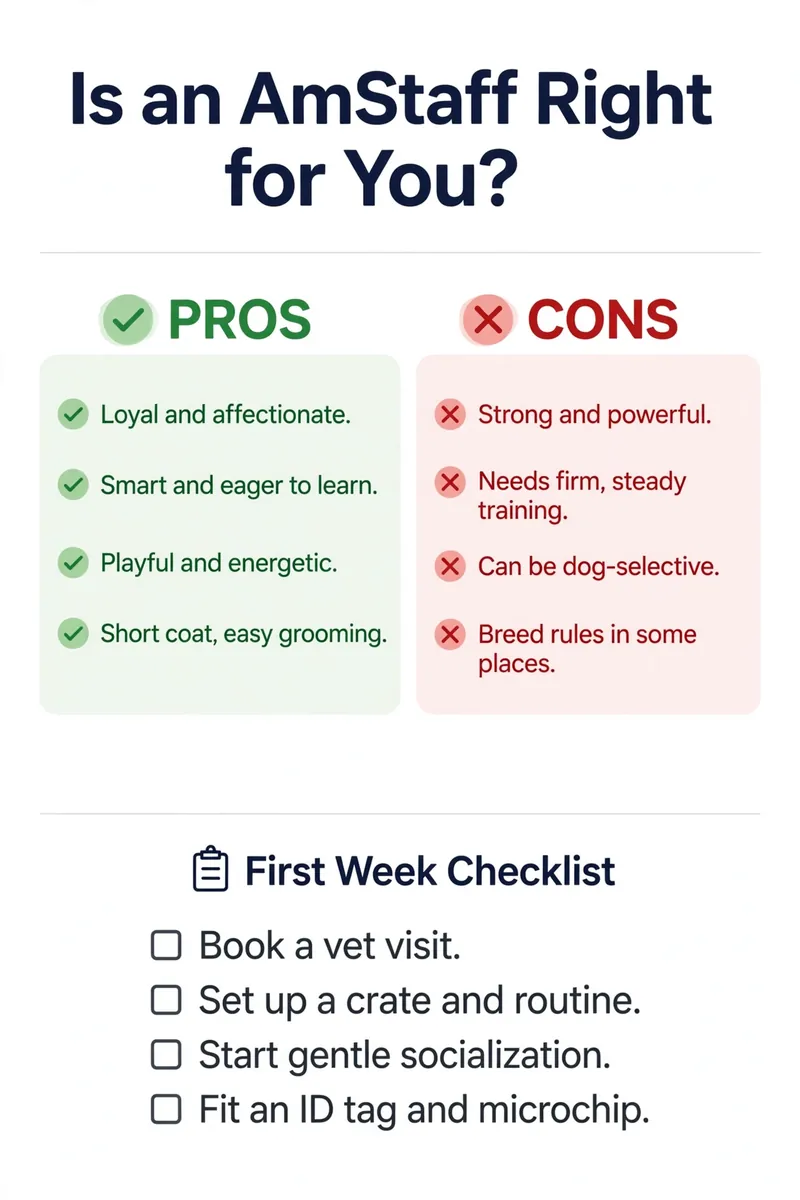
Who should get an AmStaff?
An AmStaff fits you if you want a loyal, playful, people-loving dog and you will train it every day. It fits you if you walk every day, rain or shine. It fits you if you have time for a puppy class, a training session, and a game of fetch.
It fits you if you can stay calm when a strong dog tests you.
It does not fit you if you work long hours and leave the dog alone all day. It does not fit you if you want a dog that trains itself. It does not fit you if you cannot handle a dog that pulls, jumps, and plays rough.
It does not fit you if your landlord, your insurer, or your city bans the breed.
You can succeed with an AmStaff as a first-time owner, but the breed is a hard first dog. The breed needs an owner who reads the dog’s body language, sets rules early, and keeps them.
If this is your first dog, join a training class before you bring the puppy home, and pick a trainer who knows bully breeds.
Pros and cons
Weighing the good and the bad helps you decide if this breed suits your life. Here is a quick look at what owners tend to love and what can be challenging, so you know what to expect.
Pros
Cons
First-week checklist — bringing a puppy home
Use this checklist in the first week. It covers the days most new owners get wrong.
Before the puppy arrives
buy a crate, a bed, a food bowl, a water bowl, a collar, a leash, puppy food, chew toys, a puzzle feeder, and an enzyme cleaner. Puppy-proof the house. Hide cables, shoes, and cleaning products. Pick a vet and book the first visit. Pick a puppy class and book a place.
Day 1
take the puppy to the same toilet spot every two hours. Feed three small meals. Let the puppy sleep a lot. Keep visitors to a minimum. Start the name, sit, and recall with treats.
Days 2–3
start the crate routine. Feed meals in the crate. Close the door for a few minutes at a time. Meet one calm person a day. Start loose-leash walking in the garden.
Days 4–7
visit the vet. Start the vaccine schedule. Meet a calm, friendly dog. Start a short training session twice a day. Set the daily routine and keep it the same every day.
Red flags when you buy
a breeder who will not show you the mother, a breeder who sells puppies under eight weeks old, a breeder with no health tests, a breeder who pushes you to pay fast, and a puppy that cowers or snaps when you touch it. Walk away from all of them.
A rescue or a good breeder will answer your questions, show you the parents, and take the dog back if things go wrong.
Where to find one
Adoption is the best first step for most people. Breed rescues and shelters know the adult dogs they have. They can tell you if a dog likes children, cats, or other dogs. The Staffordshire Terrier Club of America lists breed rescues, and local shelters list AmStaffs and AmStaff mixes every week.
If you buy from a breeder, check the health tests. Ask for hip and elbow scores, eye tests, and genetic tests for the conditions in the Health Problems and Lifespan section above. Ask to meet the mother.
Ask where the puppies live. A good breeder keeps puppies in the house, not in a shed. A good breeder asks you questions too.
Service, Therapy, and Famous AmStaffs
An AmStaff can work as a service dog, a therapy dog, and a search-and-rescue dog. The breed’s people skills help it in therapy work. It visits hospitals, schools, and care homes, and it calms people down.
Its nose and its drive help it in search and rescue. Its size and strength help it in detection work.
Not every AmStaff suits service work. The dog must stay calm around strangers, ignore other dogs, and work for long periods. A trainer can test a puppy for service work, but most AmStaffs do best as family companions and dog-sport athletes.
The famous AmStaffs prove the breed’s range. Sergeant Stubby served in World War I. He warned soldiers about gas attacks, found wounded men, and caught a spy.
He came home a hero with medals. Pete the Pup, also called Petey, starred in the Our Gang comedies. His calm, friendly face made the breed famous in the 1930s.
Bud and Tige are two more AmStaffs that fans of the breed still remember.
Fun facts to close with: the AmStaff smiles. Owners call it the AmStaff smile, a wide, open-mouthed grin that shows when the dog feels happy. The breed also snores, snorts, and talks with grumbles and sighs. It is a noisy, funny, loving dog, and it wants to be part of everything you do.