Heart Murmur in Dogs: Grades, Causes, Symptoms, Treatment, and Life Expectancy
A heart murmur in dogs is an extra sound your vet hears through a stethoscope. It means blood flows roughly through the heart instead of smoothly. A murmur is a sound, not a diagnosis.
It tells your vet to look for the cause. Many dogs with a murmur live normal lives for years. Every murmur needs a vet check, because only tests can show the cause.

What Is a Heart Murmur in Dogs?
A healthy dog heart makes a steady “lub-dub” sound. Valves open and close, and each closing makes one part of that sound. Blood flows smoothly from chamber to chamber.
A murmur adds a whooshing noise. The noise comes from turbulent blood flow. Blood may leak back through a valve that does not close well.
It may squeeze through a narrowed valve or vessel. Or it may pass through an opening that should not be there.
A murmur does not mean your dog has heart failure or feels sick. You may first learn about a murmur at a routine check-up, when your dog looks and acts fine. The sound alone cannot tell you the cause.
What Does a Heart Murmur Sound Like?
With a stethoscope, a vet hears the normal lub-dub plus a whoosh or soft swishing sound. The sound is a distinct “whoosh,” “shoosh,” or steady muffle over the heartbeat. Louder murmurs sound stronger and may cover the normal heart sounds.
You cannot hear most murmurs without a stethoscope. A grade 6 murmur is so loud that a vet can hear it with the stethoscope held just off the chest.
What Does a Heart Murmur Mean?
A murmur means blood flow in or near the heart is turbulent. That is all it means by itself. The cause may sit inside the heart, such as a leaky valve.
Or it may sit outside the heart, such as anemia, and the murmur may fade once your vet treats that problem. The American Kennel Club makes the same point: every murmur needs a vet to find the cause and decide if treatment is needed.
What Does a Heart Murmur Feel Like to Your Dog?
A murmur itself is only a sound, and a sound does not hurt. What hurts or tires a dog is heart failure, not the murmur. That means breathlessness, coughing, and weakness. If your dog acts normal, eats well, and plays as usual, the murmur itself likely causes no pain.
Types of Heart Murmurs in Dogs
Vets sort murmurs by timing in the heartbeat.
Systolic Murmurs
A systolic murmur happens when the heart squeezes to pump blood out. A leaky mitral valve often makes a systolic murmur. Narrowed valves, such as pulmonic stenosis or subaortic stenosis, can also make one.
Diastolic Murmurs
A diastolic murmur happens when the heart relaxes and fills with blood. These murmurs are rare in dogs. Causes include aortic insufficiency and narrowed mitral or tricuspid valves.
Continuous Murmurs
A continuous murmur runs through the whole heartbeat cycle, without a break. The classic cause is patent ductus arteriosus (PDA), a vessel between two large arteries that should have closed after birth.
Innocent (Physiologic) Murmurs
An innocent murmur comes from a normal heart. Vets also call it a physiologic murmur. It is soft, usually grade 1 or 2, and it causes no signs of illness. Puppies get innocent murmurs most often. Innocent murmurs need no treatment, only rechecks.
Heart Murmur Grades in Dogs (1 to 6)
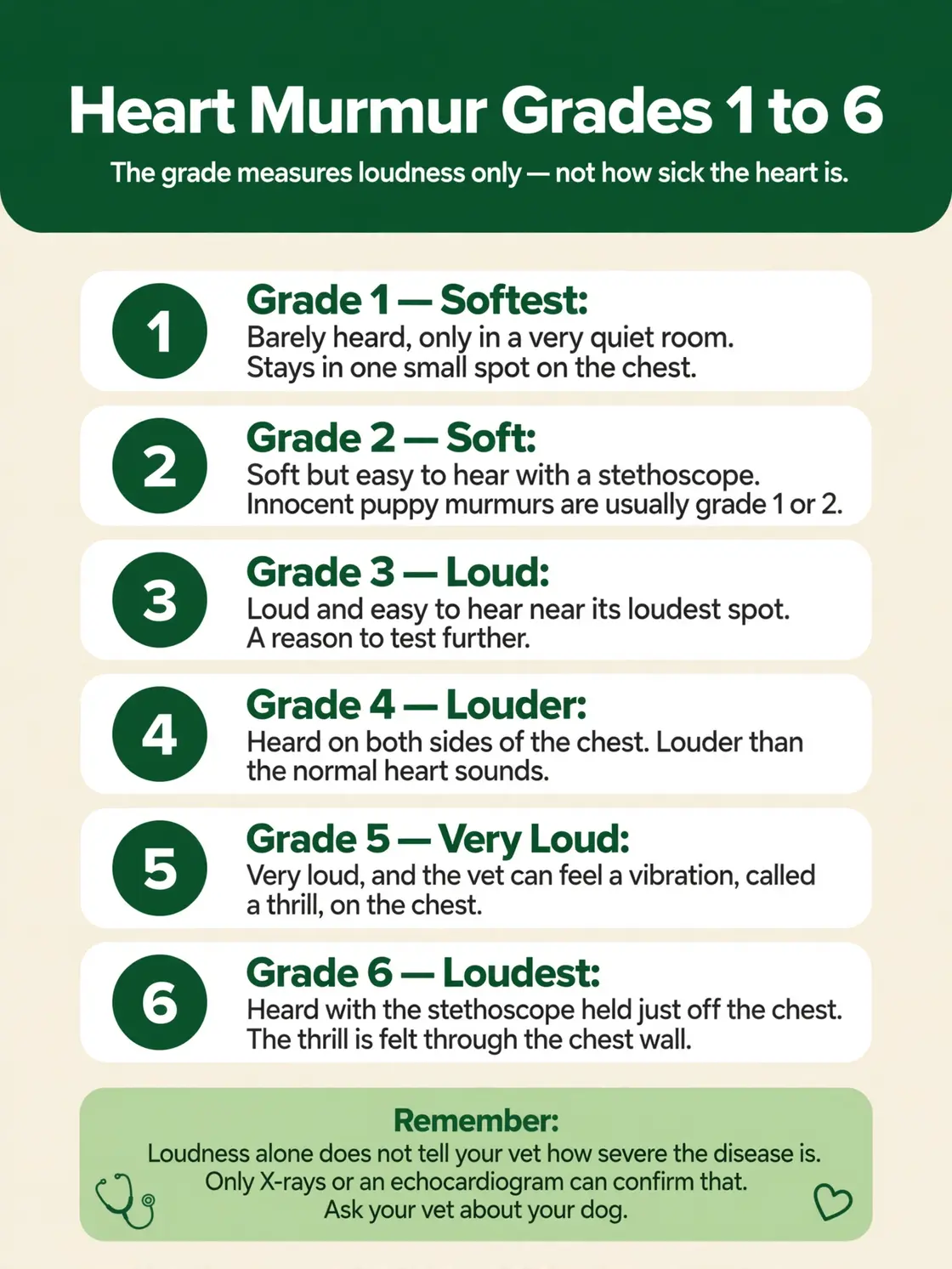
Vets grade murmurs by loudness, on a scale of 1 to 6 (written as I to VI). The grade tells your vet how loud the sound is.
And Grade 2 — Soft Murmurs
Grade 1 is the softest murmur. A vet can barely hear it, and only in a very quiet room. It stays in one small spot on the chest.
Grade 2 is soft but easy to hear with a stethoscope. Innocent puppy murmurs are usually grade 1 or 2. How serious is a grade 1 heart murmur in dogs?
It is the least serious grade, but it still needs a recheck.
And Grade 4 — Loud Murmurs
Grade 3 is loud and easy to hear near the spot where it is loudest. A grade 3 murmur is heard on one side of the chest and sounds about as loud as the normal heart sounds.
When people ask what a stage 3 heart murmur means, they usually mean a grade 3 murmur. It is loud and a reason to test further. Grade 4 is louder still.
A vet hears it on both sides of the chest, and it sounds louder than the normal heart sounds.
And Grade 6 — Very Loud Murmurs
Grade 5 is very loud, and the vet can feel a vibration — called a thrill — by placing a hand on the chest. Grade 6 is the loudest.
A vet can hear it with the stethoscope held just off the chest, and can feel the thrill through the chest wall. High grades point to strong turbulence, but even a grade 5 or 6 murmur does not fix your dog’s outlook by itself. The cause and the heart’s size decide that.
Does a Louder Murmur Mean Worse Disease?
Not always. This is one of the most common misunderstandings about murmurs. The Dog Health Handbook and Dialavet both say it plainly: loudness alone does not tell your vet how severe the disease is.
Some serious heart diseases cause soft murmurs or no murmur at all. In mitral valve disease, a murmur of grade 3 or louder more often comes with an enlarged heart, but only X-rays or an echocardiogram can confirm that.
Should I Worry If My Dog Has a Heart Murmur?
The short answer: take it seriously, but do not panic. If your adult dog has a new murmur, ask your vet about X-rays or an echocardiogram.
How Serious Is a Heart Murmur in Dogs?
How bad a murmur is depends on the cause, not on the sound. An innocent murmur is not serious at all. A murmur from a treatable problem outside the heart, such as anemia, often fades once the vet treats that problem.
A murmur from valve disease can stay mild for years or progress to heart failure. A murmur is dangerous — and can turn fatal — only when the disease behind it becomes severe and untreated — for example, advanced dilated cardiomyopathy with heart failure. The disease behind it can.
Are Heart Murmurs in Dogs Common?
Yes. Murmurs are common in dogs. About 10% of dogs develop heart disease in their lifetime, and mitral valve disease is the most common type.
Puppies often get innocent murmurs. Research puts the average at 28% of puppies under six months old, rising to 58% in Whippets. Another sample found murmurs in up to 20% of healthy 7-week-old puppies. The figures differ because the ages and samples differ.
Are Heart Murmurs in Dogs Painful?
No. A murmur is a sound, and a sound does not cause pain. Dogs in pain from heart disease feel the effects of heart failure — hard breathing, coughing, weakness — not the murmur.
Can Dogs Live a Normal Life With a Heart Murmur?
Many do, often for years. Many dogs with a murmur live a normal life. The outlook depends on the cause and how the heart changes over time.
Dogs with innocent murmurs live normal lifespans. Dogs with early mitral valve disease often live for years. Only about 30% of dogs with a leaky mitral valve ever develop congestive heart failure.
Heart Murmurs in Puppies
Puppy murmurs worry you more than almost any other kind. Most of them are innocent, but a few are not, so the line between them matters.
Are Innocent Murmurs Common in Puppies?
Yes. Innocent murmurs often appear in young, growing puppies, especially large-breed puppies that grow fast. The murmur may first appear at six to eight weeks of age.
When Does a Puppy Murmur Go Away?
Most puppies outgrow an innocent murmur by about four to five months of age. Some lose it as early as about 12 weeks, and others take until about 6 months. Your vet will usually recheck a quiet puppy murmur in a few weeks to see if it has gone.
Ask about a cardiologist if the murmur is still there at about six months, is loud, has a thrill, is heard in diastole, or is continuous.
My Puppy Has a Murmur — Should I Worry?
Usually not, but watch for red flags. A soft murmur in a puppy that eats well, grows well, and plays normally is most often innocent. Get a prompt exam instead of a routine recheck if the puppy is small for its age, tires quickly, breathes fast, or grows slowly.
A loud murmur, a murmur that is still present at six months, or any sign of illness needs a cardiology check.
What Causes a Heart Murmur in Dogs?
A murmur has three broad causes: a structural problem in the heart, a problem your dog was born with, or a problem outside the heart that changes blood flow. Some murmurs have no disease behind them at all.
Mitral Valve Disease — the Most Common Cause in Older Dogs
Mitral valve disease, also called mitral insufficiency or mitral regurgitation, is the most common cause of an acquired murmur in dogs. The mitral valve sits between the left atrium and the left ventricle. With age, the valve thickens and starts to leak, so blood flows backward.
It tends to affect small-breed dogs. As the leak grows, the heart works less well, and congestive heart failure can develop. Murmurs can appear as early as 4 to 6 years of age.
Cavaliers often develop them younger, and about half have a murmur by age 5.
Congenital Heart Defects Dogs Are Born With
Some dogs are born with a heart defect. Subaortic stenosis, pulmonic stenosis, and patent ductus arteriosus are hereditary in dogs. Ventricular septal defects, atrial septal defects, and Tetralogy of Fallot are not known to be hereditary. Surgery or a catheter procedure can fix some of these defects if your vet finds them early.
Dilated Cardiomyopathy (DCM)
In DCM, the heart muscle weakens and the chambers stretch, so the heart pumps poorly. DCM causes acquired murmurs in older dogs. It affects large breeds more often, such as Dobermanns, Great Danes, and Boxers.
Bacterial Endocarditis — an Infected Heart Valve
Bacteria in the blood can settle on a heart valve and infect it. Vets call this bacterial endocarditis. The bacteria can come from a wound or from dental disease. The infected valve leaks or narrows, and blood flow turns turbulent.
Causes Outside the Heart
Many murmurs come from problems outside the heart. These include anemia (low red blood cells), low protein in the blood, fever or infection, pregnancy, obesity, and extreme thinness. Hyperthyroidism raises cardiac output and can cause a murmur.
Heartworm disease and hypothyroidism also stress the heart. Excitement or stress makes the heart beat faster and harder. Murmurs from these causes often fade once your vet treats the underlying problem.
Are Heart Murmurs Hereditary?
Some are, and some are not. Some congenital heart diseases are hereditary, including subaortic stenosis, pulmonic stenosis, and patent ductus arteriosus. Many murmurs appear later in life and have nothing to do with genes.
So it is wrong to call heart murmurs genetic as a blanket rule. Only some defects are hereditary. The most common murmur of all, mitral valve disease in older small dogs, comes with age.
Can Stress or Anxiety Cause a Heart Murmur?
Stress and excitement can make a murmur louder, but they are not a known cause of heart disease.
Excitement or stress is a cause outside the heart. A faster, harder heartbeat changes blood flow and can create a murmur sound. Whether anxiety alone causes a murmur has no clear answer, so ask your vet.
Can Apoquel Cause a Heart Murmur?
No clear answer — ask your vet.
Which Breeds Get Heart Murmurs Most?
Breeds more prone to heart conditions and murmurs include Beagles, English Bulldogs, Chihuahuas, Spaniels, Poodles, Labrador Retrievers, Golden Retrievers, Collies, Yorkies, and Terriers. Cavaliers, Chihuahuas, Poodles, Shih Tzus, Yorkshire Terriers, Whippets, Dachshunds, and Toy Poodles face a higher risk of mitral valve disease.
Small breeds dominate the mitral valve list, while large and giant breeds dominate the DCM list.
Symptoms of a Heart Murmur in Dogs
How does a heart murmur affect a dog? The murmur itself has no symptoms — it is a sound. The disease behind it causes the signs. When signs appear, they usually mean the heart struggles.
Signs the Heart Is Struggling
The most common signs are: coughing, especially at night or when lying down; breathing problems or fast, heavy breathing at rest; poor stamina and tiring quickly; weakness or fainting; pale or blue gums; poor appetite and weight loss; and a swollen belly. If your dog tires on walks it used to enjoy, or coughs after lying down, see your vet soon.
Can a Heart Murmur Cause Coughing?
A murmur does not cause coughing by itself, but the disease behind it can. An enlarged heart can press on the airways, and fluid in the lungs from heart failure causes coughing. Coughing often comes with a serious murmur, often at night or after your dog lies down.
Can a Heart Murmur Cause Seizures or Fainting?
Seizures are not a typical sign of a murmur, but fainting is.
Collapse or fainting spells are signs of a serious murmur. A dog may faint when the heart cannot pump enough blood to the brain during effort or excitement.
Does a Heart Murmur Cause Panting or Fast Breathing?

The disease behind a murmur can cause fast or heavy breathing. A faster or harder breathing rate at rest or during sleep is a key warning sign. Call your vet if your dog breathes fast or hard while resting or asleep.
Treat a steady rate over 30 breaths a minute while asleep as a warning line.
Vomiting and Diarrhea — What We Know
No clear answer — ask your vet. Vomiting and diarrhea have many causes, and a dog with heart disease can have them for reasons unrelated to the heart.
Emergency Signs — Go to the Vet Now
Go to an emergency vet now if your dog struggles to breathe or breathes with its mouth open at rest. Go now, too, for blue, gray, or very pale gums, fainting or collapse, or a swollen belly with labored breathing.
Book a same-day visit if your dog has a new cough or tires quickly. Do the same if its sleeping breathing rate stays above 30 breaths a minute on more than one count.
How Vets Diagnose a Heart Murmur in Dogs
Diagnosis starts with listening and ends with imaging. The stethoscope finds the murmur; the tests find the cause.
The Stethoscope Exam — Timing, Location, Grade
Your vet listens to the heart on both the right and left sides of the chest. They note the grade, the timing (systolic, diastolic, or continuous), how long the murmur lasts, and where it sounds loudest. Most murmurs in dogs occur during systole.
Echocardiogram (Heart Ultrasound) — the Key Test
An echocardiogram, or echo, is an ultrasound of the heart. It is the most useful test to find where a murmur comes from and what causes it. It shows the beating heart and measures its size.
With Doppler, it also measures the speed and direction of blood flow. Your vet may refer your dog to a cardiologist for this test.
Chest X-Rays, ECG, Blood Tests, and Blood Pressure
Chest X-rays show heart size and fluid in the lungs. An electrocardiogram (ECG) records the heart rhythm and finds irregular beats. Blood tests look for anemia and other problems outside the heart.
The NT-proBNP blood test helps your vet judge whether a cough or breathing problem likely comes from the heart. Blood pressure checks can also help.
How to Detect a Heart Murmur at Home
You cannot detect a murmur at home. It takes a stethoscope and training to hear one. What you can do at home is watch the signs: count sleeping breaths, note coughing, watch energy on walks, and check gum colour.
If you notice any of the warning signs in this article, book a vet visit and tell the vet exactly what you saw.
How Is a Heart Murmur in Dogs Treated?
Vets treat the cause, not the sound. A murmur has no treatment of its own. The plan depends on what the tests show.
When No Treatment Is Needed
Innocent puppy murmurs need no treatment — only monitoring until they fade. A murmur from a problem outside the heart, such as anemia or fever, needs treatment of that problem, and the murmur often fades with it. A dog with early mitral valve disease and a normal-sized heart usually needs no medicine, only rechecks.
Treating the Cause, Not the Sound
Treatment follows the diagnosis. For heart disease, vets may use a special diet, medication, and supportive care. For some congenital defects, surgery or a catheter procedure can correct the problem. For endocarditis, vets treat the infection. For problems outside the heart, such as hypothyroidism or anemia, vets treat that disease.
Mitral Valve Disease Stages B1, B2, and C — What Changes
Vets stage mitral valve disease using guidelines from the American College of Veterinary Internal Medicine (ACVIM). The Dog Health Handbook and Dialavet both use this staging. Stage B1 means a murmur with a normal-sized heart: no medicine, recheck every 6 to 12 months.
Stage B2 means the heart has enlarged but the dog has no signs of heart failure: vets often start pimobendan to delay heart failure. Stage C means heart failure has developed: the dog needs ongoing medicine, including a diuretic, and regular rechecks.
What Medication Is Used?
Vets use three drug classes, and your vet sets the dose and schedule. Diuretics help the kidneys remove extra water. ACE inhibitors open blood vessels and reduce fluid buildup.
Inodilators such as pimobendan help the heart muscle pump and relax blood vessels. Your vet or cardiologist decides which drug, if any, fits your dog, based on the tests.
Can a Heart Murmur Be Cured?
Sometimes. An innocent puppy murmur goes away on its own. A murmur from anemia, fever, or another outside cause can fade once your vet treats that cause.
Some birth defects can be corrected, and the murmur may go away after repair. Medicine cannot cure mitral valve disease, but your vet can manage it for a long time.
Surgery for Congenital Defects
Surgery can correct some defects present from birth, such as pulmonic stenosis and patent ductus arteriosus. Catheter procedures can also close or open a defect without open surgery.
When to Treat a Heart Murmur
Treatment starts when the tests show it should. A soft murmur with a normal heart usually means watch and recheck. An enlarged heart, signs of heart failure, or a birth defect usually means act now. That is why testing matters: it decides whether to treat now or simply watch.
Life Expectancy for Dogs With a Heart Murmur
The answer depends on the cause and the stage, not on the grade alone.
How Long Can a Dog Live With a Heart Murmur?
Many dogs live normal lifespans. Innocent murmurs do not shorten life. Most dogs with early mitral valve disease live for years, and only about 30% ever develop heart failure. Dogs with harmless murmurs usually live a normal lifespan, while dogs with heart disease may live only months to years.
What a Grade 4 Murmur Means for Life Expectancy
A grade 4 murmur more often comes with serious heart disease than a soft murmur does. Your vet will usually recommend an echocardiogram or X-rays. For grade 4 in senior dogs, outlooks vary widely.
Small breeds average 2–4 years after diagnosis. Untreated grade 4 mitral valve disease often runs 6–18 months. Dogs treated with pimobendan and ACE inhibitors can live up to 3–5 years in mild-to-moderate cases.
Advanced DCM with arrhythmia may drop to weeks or months without strong care.
Life Expectancy by Grade — Why Grade Alone Cannot Answer It
People search for life expectancy by each grade, from grade 1 to grade 6. But grade alone cannot answer that question. A dog with a grade 5 murmur and no heart enlargement may outlive a dog with a grade 3 murmur and severe enlargement.
The cause and the echo findings matter more than the grade. Ask your vet for the cause and the heart measurements, because those set the outlook.
What the EPIC Trial Showed
The EPIC trial tested pimobendan in 360 dogs with mitral valve disease and heart enlargement but no signs of heart failure yet. Starting pimobendan delayed heart failure or cardiac death by about 15 months (median). This is why vets start treatment at stage B2, before signs appear.
Do Heart Murmurs Get Worse Over Time?
They can. A murmur can get louder as valve disease progresses, so keep up with rechecks. Mitral valve disease gets worse over time: the leak grows, the heart enlarges, and heart failure can follow over months to years.
If the murmur gets louder, or your dog starts coughing or breathing fast, see your vet. Those changes matter more than the grade number.
Does a Heart Murmur Mean Heart Failure?
No. A murmur does not mean heart failure, and it does not cause heart failure by itself. The disease behind it can lead there. A murmur can be an early sign of valve disease that may one day cause heart failure.
But most dogs with early valve disease never reach that point; only about 30% do. A murmur without those signs is not heart failure.
How Much Does Treatment Cost?
The cost depends on the cause. Expect to pay for a vet exam and likely tests such as bloodwork or an echocardiogram, plus follow-up visits and treatment. Ask your vet what to expect for your dog’s tests and treatment before you agree to them.
Daily Life With a Dog That Has a Heart Murmur
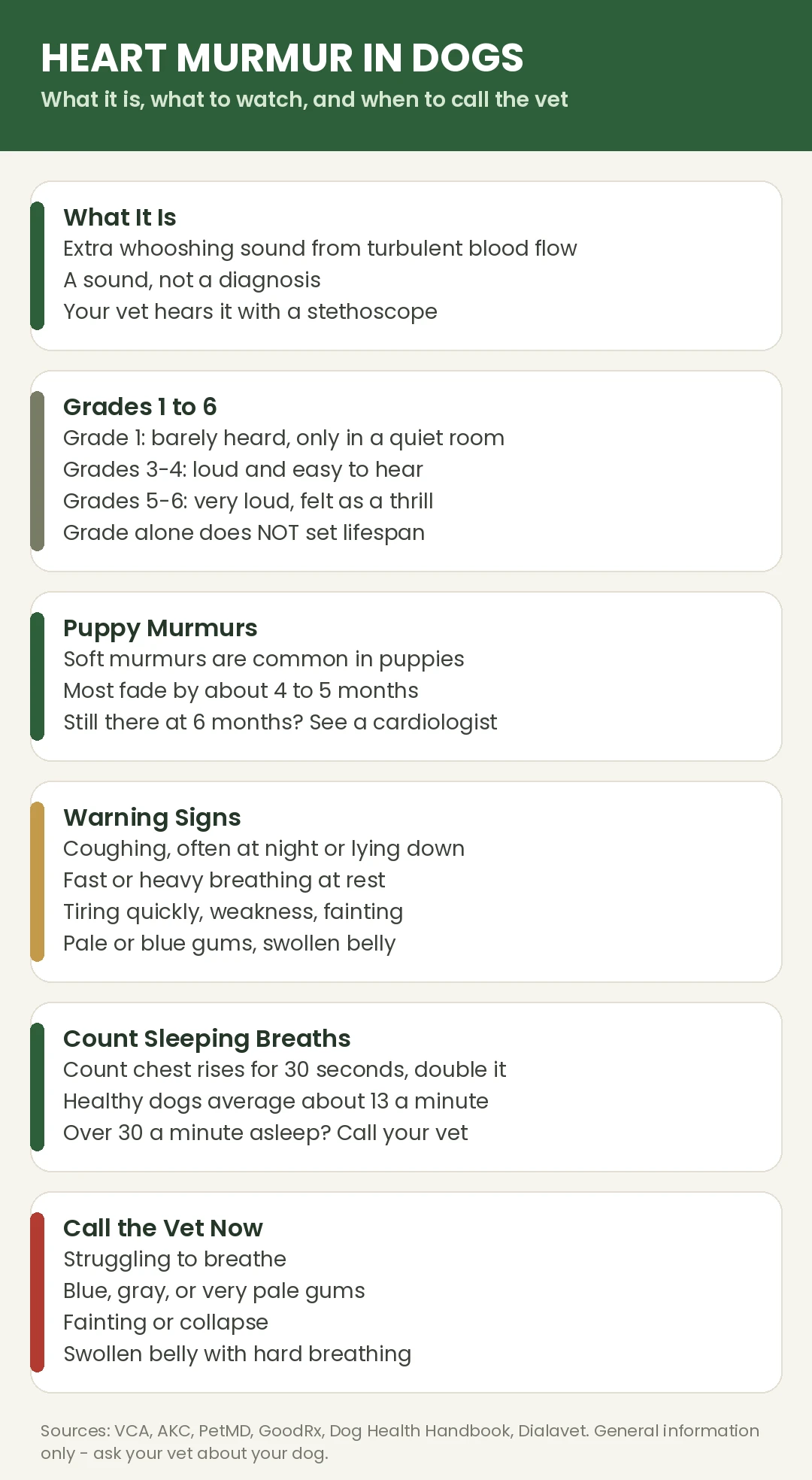
A murmur changes some things for your dog, but daily life can stay happy and active. This section covers walks, monitoring your dog’s breathing at home, diet, anesthesia, everyday care, and prevention, so you know what to do.
Is It OK to Walk a Dog With a Heart Murmur?
Yes. Walking is still good for your dog’s health, even with a murmur. Your vet may suggest shorter walks or avoiding some types of exercise, depending on the cause. Normal walks are usually fine for dogs without heart failure. Once heart failure develops, keep walks short and gentle.
Counting Sleeping Breaths at Home
Counting sleeping breaths is one of the best early-warning tools you have. Wait until your dog is deeply asleep in a cool room. Count each rise of the chest for 30 seconds and double it.
Healthy dogs average about 13 breaths a minute while asleep. Call your vet if the rate stays above 30 breaths a minute while asleep. Go now if it stays above 30 with labored breathing.
Food: What to Feed and What Not to Feed
Keep your dog lean, because extra weight makes the heart and lungs work harder. Avoid very salty foods such as deli meats, cheese, and chips, and limit treats. Dogs in heart failure may need a lower-sodium diet chosen with your vet.
Avoid grain-free diets, which have been linked to dilated cardiomyopathy. Ask your vet before changing food, since the right diet depends on the cause and the stage.
Can a Dog With a Murmur Have an Anaesthetic?
Often yes, with planning. A dog with a murmur can often have anesthesia, but your vet may suggest heart tests first to tailor it. Tell your vet about the murmur before any anesthesia, such as a dental cleaning. Dogs with heart disease may need tests or a few weeks of heart treatment first.
How to Help Your Dog Day to Day
Keep your dog lean and active at the level your vet advises. Keep up dental care, since poor oral health links to endocarditis. Give any prescribed medicine exactly as directed, and never stop or change it without your vet. Watch breathing, coughing, energy, and gum colour every week — small changes are the earliest signals.
Can You Prevent a Heart Murmur?
You cannot prevent most murmurs. Birth defects and age-related valve disease are not preventable. But you can lower the risks around them. Keep your dog lean, keep its teeth clean, control parasites, feed a balanced diet, and book regular checkups so your vet hears a murmur early.
Frequently Asked Questions
The Bottom Line
A heart murmur in dogs is a sound, not a diagnosis. It means blood flows roughly through the heart, and your vet must find why. Many murmurs are harmless, and many dogs live normal lives for years.
Sources
A note on the numbers: innocent puppy murmurs fade anywhere from about 12 weeks to 6 months. They show up in up to 20% of healthy 7-week-olds and an average of 28% of puppies under six months. Grades 3 and 4 are described in slightly different ways.
Life expectancy ranges from months to years, depending on cause and stage.