Can Dogs Eat Watermelon Rind? No — and Here’s What to Do If Yours Did

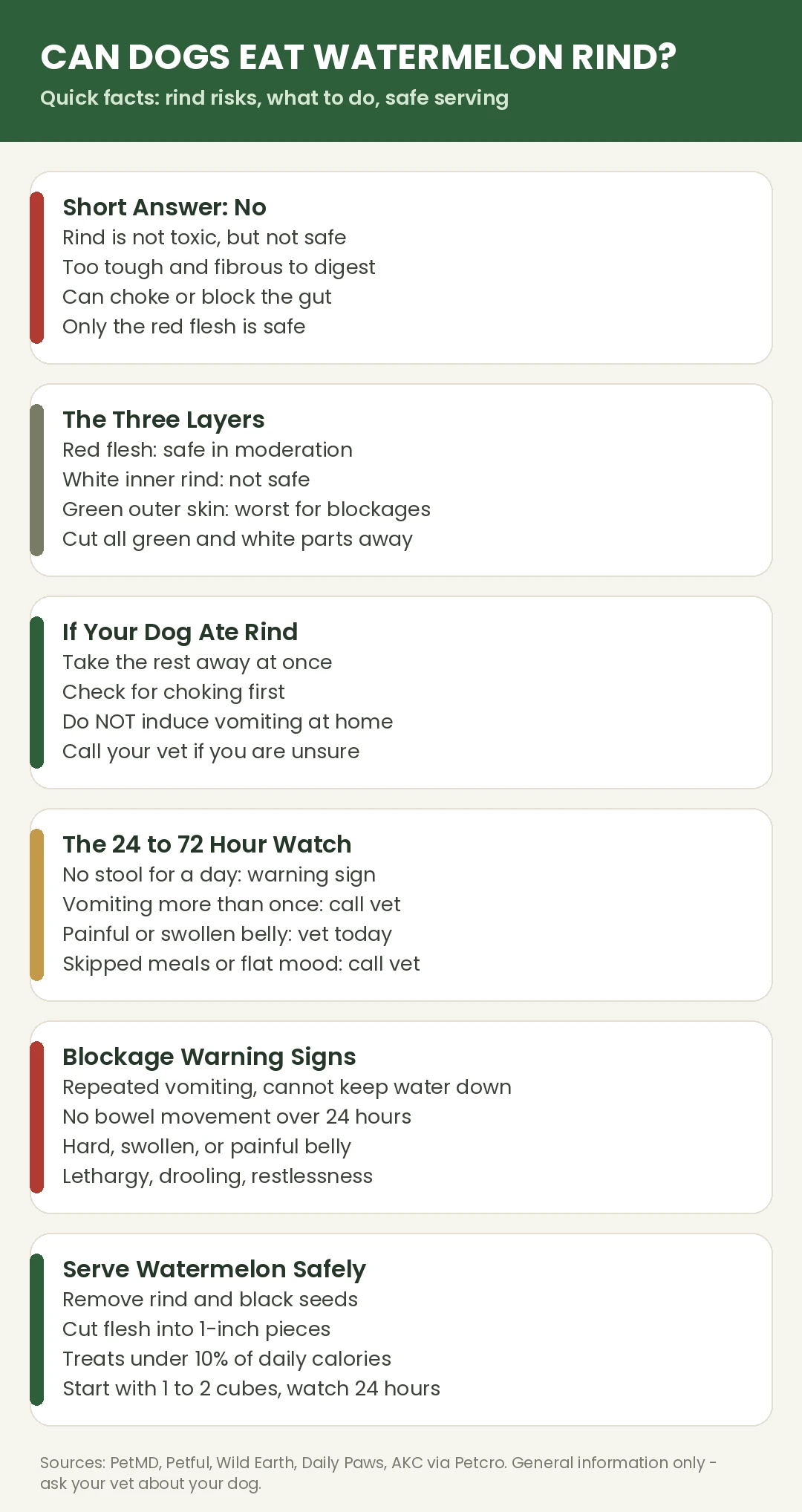
Can dogs eat watermelon rind? No. Dogs should not eat watermelon rind. The rind is not toxic, but it is tough, fibrous, and hard for a dog to digest, so a swallowed chunk can cause vomiting, choking, or an intestinal blockage.
The red flesh is a different story: it is safe in moderation, once you remove the rind and the seeds.
This guide explains why the rind is bad, what to do if your dog already ate some, how to watch your dog for one to three days, and how to serve watermelon safely.
Key Takeaways — Short Answer
Is Watermelon Rind Toxic to Dogs?
No. Watermelon rind is not toxic to dogs. The ASPCA Animal Poison Control Center does not list watermelon as a poisonous plant or food, and the rind contains nothing that poisons a dog the way grapes, raisins, onions, or xylitol do.
A dog that ate watermelon rind is dealing with a digestion and size problem, not a poisoning.
That does not make the rind safe. The hazard is mechanical, not chemical: a hard, fibrous chunk can choke a dog or lodge in the stomach or intestines. Remember it this way — the risk is the size, not a poison.
A dog that licks or nibbles a sliver of rind is rarely in danger. A dog that swallows a large chunk is the one at risk.
So when you ask whether watermelon rind is poisonous, toxic, harmful, or dangerous, the answer has two parts: not poisonous, but still harmful in the wrong amount. It is not good for dogs either.
People sometimes eat the rind pickled or stir-fried, and it does contain some fiber and the amino acid citrulline, but a dog gets none of that in a useful way.
The fiber is too tough for a dog to break down, and any nutrition in the rind is easier to get from the flesh or from a complete dog food. There is no amount of rind that is worth the risk.
For comparison, the most toxic fruits for dogs are grapes and raisins, which can cause sudden kidney injury even in small amounts. Cherries, apricots, and peaches carry pits that are both a blockage and a cyanide risk.
Watermelon flesh, by comparison, is one of the safest fruits you can share — it is the rind that causes the trouble.
Can dogs eat watermelon rind every day?
No. Watermelon rind is not safe for dogs on any schedule, so daily servings are a bad idea. The tough rind is hard to digest and can upset your dog’s stomach or block the gut. Offer only the seedless red flesh as an occasional treat, and skip the rind.
If your dog gets into the rind often, keep the trash and compost out of reach.
Why Is Watermelon Rind Bad for Dogs?
The rind is bad for one simple reason: it is far too fibrous and dense for a dog’s digestive system to break down comfortably. Here is the chain of events.
Dogs do not chew thoroughly the way people do, so a gulped piece of rind tends to travel through the gut largely intact. That sets up two problems, neither of which has anything to do with toxins.
First, digestive upset
The dense fiber commonly causes vomiting, gas, or diarrhea within a few hours, and the bigger the piece, the bigger the reaction. Wild Earth says the same: the rind is tough, fibrous, and hard for dogs to digest, and eating it can lead to stomach upset, choking, or even an intestinal blockage.
Second, and more serious, an intestinal blockage
A large piece, or several smaller pieces, can lodge in the throat as a choking hazard or get stuck further down in the stomach or intestines, where it may need veterinary treatment or even surgery to remove. The three risks are choking, gastrointestinal obstruction, and digestive upset.
The rind’s firm texture makes it easy for a dog to choke on, especially if it swallows large pieces, and smaller dogs face a higher risk.
The red flesh behaves the opposite way: it is about 92% water and breaks down easily. The rind does not. Much of it passes through partly intact, which is why it shows up in the stool or causes trouble on the way.
That is why it is not safe for dogs to eat watermelon rind on purpose, even in small amounts.
Who faces the highest risk? Toy breeds, puppies, and enthusiastic gulpers who swallow before they chew. Both risks climb sharply in these dogs. A dog that inhales everything is the most likely to swallow a large, unchewed piece, and a slow feeder bowl at mealtime is a simple way to teach slower eating.
Can big dogs eat watermelon rind?
Big dogs have a lower risk than small dogs, but rind is still not a safe treat. A large dog can swallow a big piece that sticks in the gut, and the tough fiber can cause vomiting or diarrhea. Size does not make rind safe, so offer only the red flesh.
Call your vet if your dog ate a lot of rind or acts unwell.
The Three Layers: Red Flesh, White Rind, Green Skin
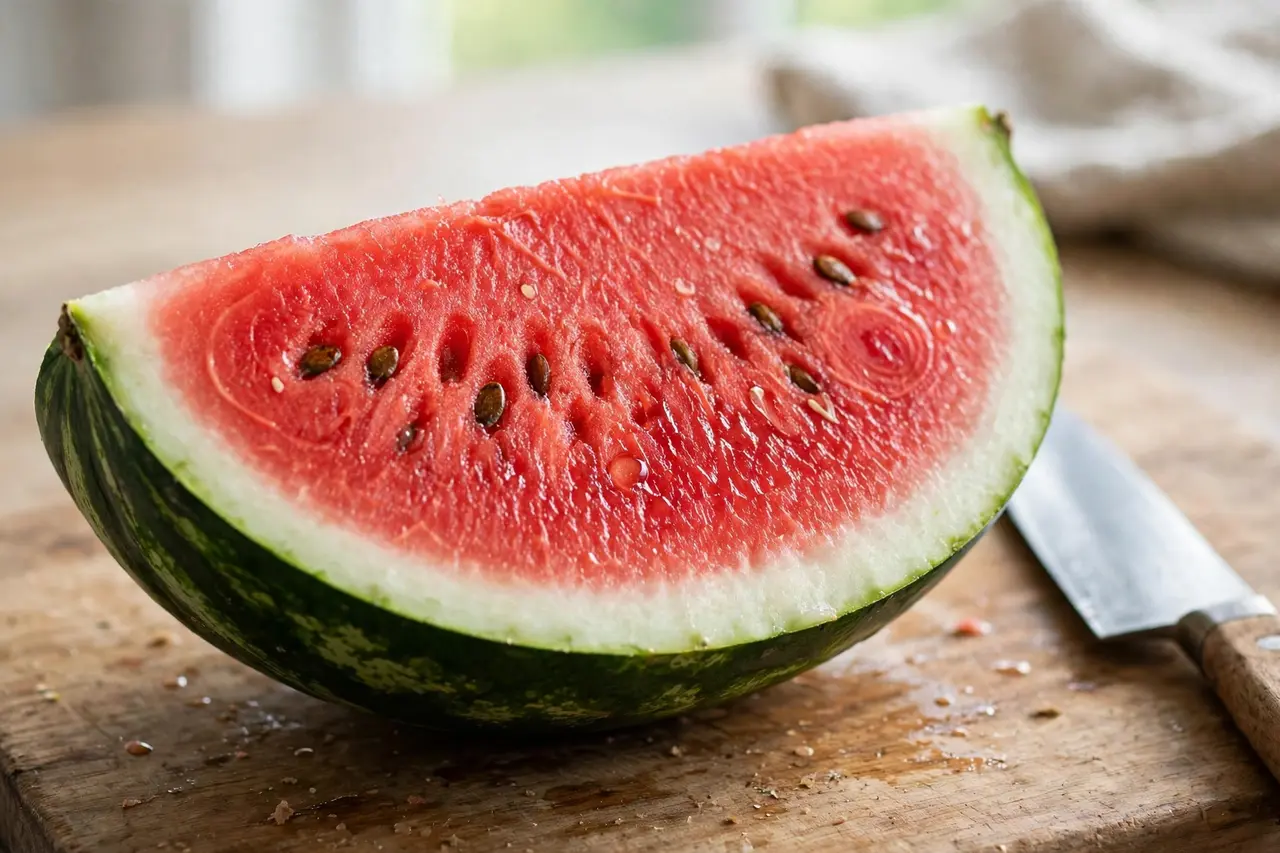
It helps to picture a watermelon as three distinct layers, because knowing which is which makes it obvious what to cut away before your dog gets anywhere near the fruit.
| Layer | Safe for dogs? | Notes |
|---|---|---|
| Red or pink flesh | Yes, in moderation | The sweet, watery inner fruit; the only part your dog should eat, once the seeds are removed |
| Pale green-to-white inner rind | No | The firm layer between the flesh and the skin; tough, low in flavor, hard to digest |
| Dark green outer skin | No | The hard striped exterior; the most fibrous layer and the worst for blockages; may also carry pesticide or wax residue |
The same three layers apply: the white and green rind is not safe, with choking, intestinal blockage, and pesticide residue as the concerns. Remove the rind thoroughly, including the white part immediately beneath the green skin, because those are the parts that pose the most significant risk.
The thin white band right next to the flesh is softer than the skin, but it is still rind and still too fibrous to feed on purpose. PetFoodPicks says the same: the pale greenish-white layer just under the rind will not poison your dog, but it is still hard to digest, so stick to the red part.
What about the green part? No. The green part is the rind, and the answer is the same for the green skin, the white part, and the whole rind: do not feed it.
What about yellow watermelon? Both red and yellow watermelon can offer nutritional benefits when fed in moderation and prepared properly, and yellow watermelon is fine as a treat. The flesh color does not change the rule — the rind still comes off.
Pesticide residue
One study found traces of pesticides such as carbofuran, chlorpyrifos, diazinon, and dimethoate in watermelon samples, and the green skin may carry pesticide or wax residue. It is a single study, not settled fact. Either way, washing the outside of the melon before cutting it is sensible, to remove dirt, residue, and pesticides.
Black seeds: remove them
The large, hard black seeds of a seeded watermelon can become a choking hazard, especially for small dogs, and eating a large number can contribute to an intestinal blockage. AKC, cited by Petcro, says they can cause a blockage, particularly for small dogs.
Wild Earth says black seeds can become a choking hazard and may cause digestive problems if a dog eats too many.
White seeds: fine in small amounts
The soft, pale white seeds you see in seedless watermelons are immature and harmless. Mild stomach upset is possible only if a dog eats a large amount. Some vets take the stricter line and say to remove seeds generally, but accidentally swallowing a few seeds is unlikely to cause problems for most dogs.
Trace cyanide
Watermelon seeds contain trace amounts of cyanide, but poisoning is highly unlikely — a dog would have to eat an enormous number of seeds. The real reason to remove seeds is choking and blockage, not poison.
Seedless is easiest
Seedless watermelon is the easiest and safest choice for dogs. If you use a seeded melon, remove every large seed you can find before serving. A few stray small seeds are unlikely to cause harm, but a large amount can lead to digestive upset or a blockage in smaller dogs.
What to Do If Your Dog Ate Watermelon Rind
Try not to panic. Most dogs that steal a little rind are fine, and the steps below take about a minute. What matters most is how big the piece was, how big your dog is, and whether your dog chewed it or swallowed it whole.
Take away the rest
Pick up any rind left on the floor, the plate, or in the trash so your dog cannot eat more while you sort it out.
Check for choking first
Gagging, pawing at the mouth, drooling heavily, or struggling to breathe right after eating means a piece may be stuck in the throat. Get to a vet immediately.
Estimate how much went down
Compare the piece with your dog’s size using the table below. Count pieces if you can, since several small chunks add up to one big one.
| Dog size | A lick or thumbnail-size nibble | One bite-size piece (about 1 inch) | A large chunk or a whole wedge |
|---|---|---|---|
| Toy (under 10 lbs) or puppy | Watch at home for 24 hours | Call your vet the same day | Call your vet now |
| Small (10 to 25 lbs) | Watch at home | Watch closely for 24 to 72 hours | Call your vet now |
| Medium (26 to 50 lbs) | Watch at home | Watch at home for 24 to 72 hours | Call your vet today |
| Large and giant (over 50 lbs) | Watch at home | Watch at home | Watch closely for 72 hours and call if any sign appears |
Use this table as a starting point, not a diagnosis. When the piece was large, your dog is small, or you simply do not know how much was eaten, call your vet.
Any dog with a history of intestinal surgery, a sensitive stomach, or a habit of swallowing objects should be treated one row smaller than its weight suggests.
Do not make your dog vomit at home
Inducing vomiting can send a hard piece of rind back up into the throat or airway. Only do it if a veterinarian tells you to. ICGI gives the same warning: do not induce vomiting without veterinary guidance.
Offer water and keep things quiet
Fresh water and a few calm hours help a mild upset settle. Skip rough play and long runs until you know how your dog is doing.
Call your vet if you are unsure
A quick call costs far less than a delayed blockage diagnosis, and your vet can tell you whether to watch at home or come in. If your dog swallows watermelon rind, contact your veterinarian for guidance, especially if signs of digestive distress begin.
The 24 to 72 Hour Watch
A rind blockage does not always show up right away. Food usually moves through a dog’s stomach within several hours, but a dense piece of rind can sit in the stomach or travel partway through the intestines before it causes a problem. That is why the watch window runs one to three days.
During those 24 to 72 hours, keep track of these things:
Some guides give a shorter window of 24 hours. A blockage can show up late, so watch your dog for 24 to 72 hours.
If your dog has a mild loose stool but is otherwise eating, drinking, and acting normal, a spoonful of plain canned pumpkin is a common way to firm things up, once your vet agrees there is no blockage. For a run of soft stools, ask your vet about a probiotic.
Do not give pumpkin or anything else if you suspect a blockage — call the vet first.
Signs of an Intestinal Blockage
An intestinal blockage, which vets call a gastrointestinal obstruction, happens when something a dog swallowed cannot pass through the stomach or intestines. The Merck Veterinary Manual lists vomiting, loss of appetite, abdominal pain, lethargy, and changes in stool as the typical signs of an obstruction in dogs.
A rind piece behaves like any other foreign body once it lodges.
Watch for any of these after a dog ate watermelon rind:
Call your vet or an emergency clinic right away if your dog vomits more than once, cannot keep water down, has not passed stool in over a day, has a tense or painful abdomen, or seems lethargic after eating rind. These are classic intestinal blockage warning signs, and they can get worse quickly.
At the clinic, your vet will usually feel the belly and take X-rays or an ultrasound to look for a blockage. Many food blockages resolve with fluids and monitoring, but a piece that is truly stuck may need endoscopy or surgery.
How to Serve Watermelon Safely
Serving watermelon safely takes about two minutes, and it makes all the difference.
Wash the outside
Wash the melon to remove dirt, residue, and pesticides before you cut it.
Remove the rind completely
Cut away all green and white portions. The rind is tough, difficult to digest, and a genuine choking hazard, particularly for smaller dogs.
Pick out the seeds
Seedless watermelon is the easiest option. If you use a seeded variety, remove every large seed you can find before serving.
Cut into bite-sized pieces
Aim for pieces about 1 inch by 1 inch by 1/4 inch thick. Smaller dogs need smaller pieces — think bite-sized cubes that cannot be gulped whole.
Keep it a treat, not a meal
Treats, including watermelon, should make up no more than 10% of your dog’s daily calories. The remaining 90% should come from a complete and balanced dog food diet.
Start with a small amount the first time and watch for digestive upset, and stop and call the vet if you see vomiting, diarrhea, excessive gas, or other unusual symptoms.
How much flesh? Wild Earth gives a serving table by dog size:
| Dog size | Weight | Serving |
|---|---|---|
| Extra small | Under 10 lbs | 1–2 cubes |
| Small | 10–25 lbs | 2–3 cubes |
| Medium | 26–50 lbs | 1/4 cup of cubes |
| Large | 51–90 lbs | 1/2 cup of cubes |
| Extra large | Over 90 lbs | 1 cup of cubes |
Serve watermelon 2 to 3 times per week: extra-small dogs get 2 to 3 slices and small dogs get 3 to 4 slices. Use the complete table above for larger dogs.
Start with 1 to 2 small cubes if your dog has never tried watermelon, then wait 24 hours and watch for tummy trouble before increasing the portion.
Watermelon nutrition
The flesh is about 92% water, which makes it a genuinely hydrating treat, especially on warm days. It contains no fat and no cholesterol and clocks in at roughly 50 calories per cup. By weight, it is about 30 kcal per 100 g with 0.15 g of fat.
Those two figures line up: one cup is about 150 g, so 30 kcal per 100 g works out to about 45 kcal per cup. Watermelon is higher in natural sugar than many other fruits, so give it sparingly.
If your dog is managing diabetes, obesity, or any metabolic condition, check with your veterinarian before introducing watermelon.
Puppies and seniors
Puppies and senior pets need closer monitoring because their digestive systems are often less resilient than those of healthy adults. Puppies can eat watermelon in moderation, served without seeds or rind, as long as treats stay under 10% of daily calories.
Skip the candy
Skip watermelon candy, watermelon-flavored products, and foods made with watermelon extract. They add sugar and sweeteners a dog does not need, and they are not the same as fresh fruit.
Cooked, Frozen, Dried, and Pickled Rind
No form of rind makes it safe. Raw rind is the version most dogs steal from a picnic plate or the trash, and it carries every risk above.
Frozen rind is worse, not better
Freezing makes it harder, so it is even tougher on teeth and even less likely to break down in the stomach. Frozen watermelon flesh cubes, by contrast, are fine as a treat — AKC, cited by Petcro, calls seedless, rind-free frozen chunks a safe and refreshing treat. The difference is the rind, not the cold.
Pickled rind adds new problems
It is preserved in sugar and vinegar, often with cloves, cinnamon, or other spices, and some recipes use sweeteners a dog should never have, including xylitol, which is highly toxic to dogs. Cooked or stir-fried rind dishes usually include garlic and other seasonings a dog should not eat.