Why Do Dogs Lick You? 10 Reasons, What Each Body Part Means & When to Worry
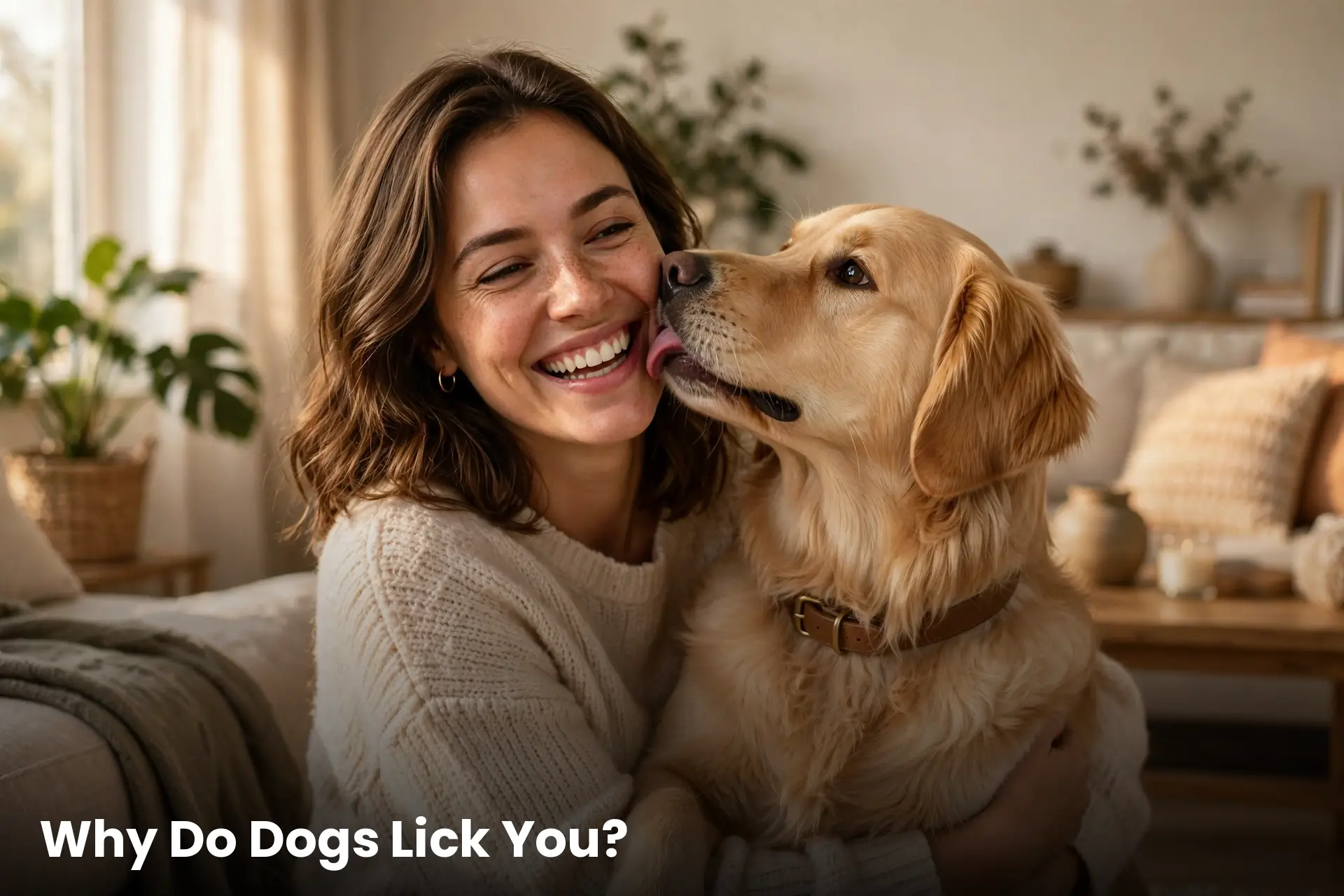
Why do dogs lick you? Dogs lick you for many reasons, not only love. A lick can mean affection, a greeting, hunger, stress, or simple curiosity about how you taste. Licking starts at birth, when a mother dog licks her newborn puppies. This guide lists the ten main reasons, explains what each spot means, and tells you when licking needs a vet.
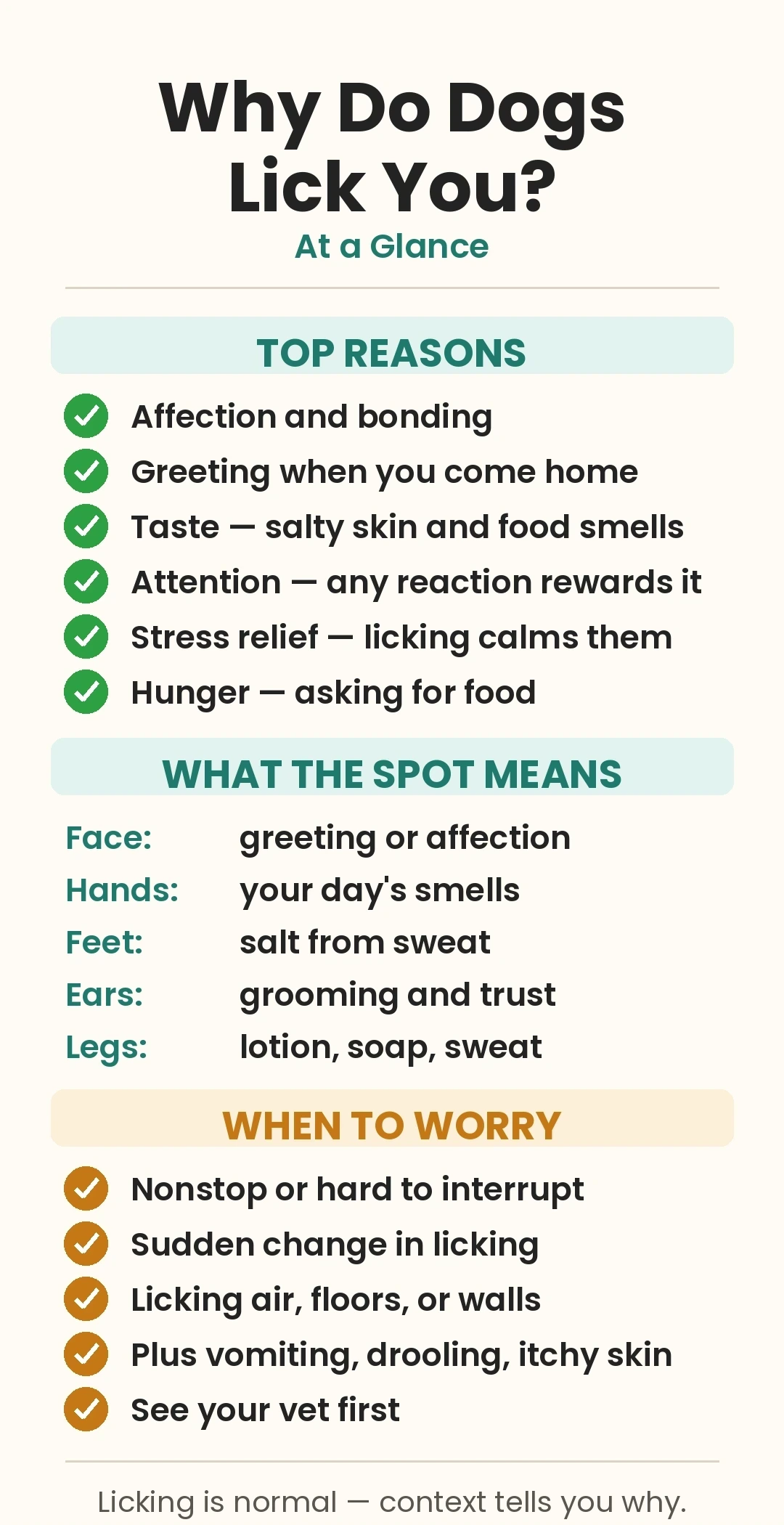
Key Takeaways — Short Answer
Why Dogs Lick in the First Place — Puppyhood and Instinct
Licking is one of the first things a dog ever learns. A mother dog licks her puppies the moment they are born. She cleans them, stimulates blood flow, and triggers urination and defecation, since newborn puppies cannot do that alone. Puppies learn fast that a tongue is a tool for care, comfort, and asking for things.
As puppies grow, they lick their mother’s face and mouth to ask for food. Wild canid puppies — wolves, coyotes, and foxes — lick their mother’s muzzle when she returns from a hunt so she regurgitates meat for them. Domestic puppies keep the same gesture. Dr. Alexandra Horowitz of the Horowitz Dog Cognition Lab at Barnard College explains that this food-seeking lick became a ritualized greeting in pet dogs. That is why your dog may rush your face the moment you walk in the door.
Puppies also lick each other for affection and comfort. As they mature, they keep licking people because people usually respond with attention or play.
The 10 Main Reasons Dogs Lick You
Dogs do not lick for one reason. Here are the ten main reasons.
1. Affection and bonding. Dogs lick and groom each other to bond, and they extend the same behavior to people.
2. Greeting. Many dogs lick when you arrive home or walk into a room — the lick works like a “hello,” a habit carried over from wild canids.
3. Communication and submission. Dogs lick other dogs’ mouths and faces to send social signals, and they use the same signals with people. A lick can say “I am not a threat” or “I respect you.”
4. Exploration. Dogs explore the world with their mouths the way people explore it with their hands. Scent and taste work together, so licking a person tells the dog where you have been.
5. Taste. Your skin tastes interesting. Sweat leaves salt behind, especially after exercise, and food residue, lotion, soap, and shampoo all add flavor.
6. Grooming. Dogs groom themselves and each other by licking, and you are not exempt. A dog may lick you to clean you.
7. Attention-seeking. A dog that learns licking brings petting, talking, food, or toys will lick more. Any response counts — even pushing the dog away or saying “stop” is attention.
8. Habit. A rewarded behavior becomes a habit. If you smile at your dog’s sleepy pre-nap kisses every night, the dog will repeat them.
9. Hunger. A lick near mealtime can be a simple request for food, the same way puppies licked their mother’s mouth to ask for a meal.
10. Stress relief and self-soothing. Dogs lick to calm themselves when they feel anxious, stressed, or overwhelmed. Licking is widely believed to release endorphins and dopamine. Wuffra notes that the AKC page states the endorphin claim without linking a study, so treat it as widely reported rather than proven.
The dominance question — a real conflict. Mary Burch, a certified applied animal behaviorist quoted by the AKC, says licking is not domination — a submissive dog licks a more dominant pack member. But Dr. Jerry Klein, the AKC’s chief veterinarian, wrote in a 2018 note that a dog might lick a baby’s face to assert dominance, and linked that reading to a bite risk. Care.com’s expert Sally Grottini adds a third position: licking strangers can be a dominance sign. Experts do not agree on this, so do not treat a lick as proof of dominance.
What a Lick Means by Body Part — Face, Hands, Feet, Ears, Legs, Lips, Nose
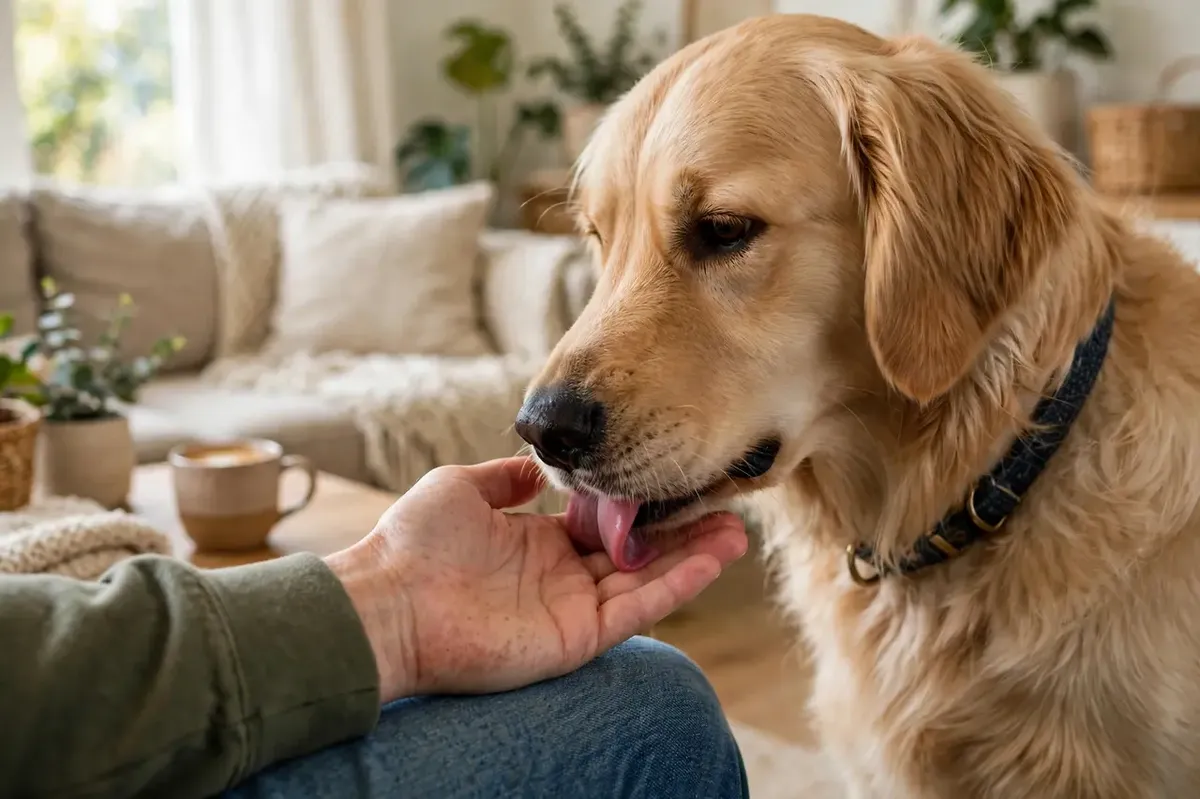
A lick on the hand often means hello — or that your hand smells interesting.
Where your dog licks you can hint at the reason, though it never proves it.
Face. Face licking is the most common target. Your face carries scents from food, other people, and everything you touched during the day. The forehead and cheeks hold eccrine sweat glands that leave a slightly salty taste, and the eyelids and nostrils hold apocrine glands with unique scent compounds. Human reactions — laughing, talking, petting — can reinforce it over time.
Hands. Your hands act like a roadmap of your day. They touched food, people, animals, and countless objects, and your dog can read that story by licking them. Adopt-a-Pet calls a finger lick a handshake.
Feet. The soles of your feet hold a high concentration of eccrine sweat glands. As sweat dries, it leaves salt and other compounds that many dogs find appealing. Sweaty feet also carry pheromones, and dogs have a Jacobson’s organ that links the nasal cavity to the roof of the mouth, so taste and smell happen together. Foot licking often becomes a game: laugh or pull your feet away, and your dog reads that as a reward.
Ears. Ear canals hold apocrine glands plus ceruminous glands that make earwax, so ears carry a strong, distinctive scent. Your dog may lick your ears from curiosity, grooming instinct, affection, or all three.
Legs. Dogs lick legs for the smells and tastes left by your routine: lotion, soap, shampoo, sweat, and salt after exercise. PetMD notes that leg licking does not mean your dog is thirsty — often the dog simply licks what it can reach.
Lips and mouth. Your lips carry traces of whatever you last ate. That is why a dog may aim straight for your mouth after a meal.
Nose. The nostrils hold apocrine glands with unique scent compounds, so the nose draws curious licks.
Licking by Time and Moment — Morning, Night, Homecoming, Shower, Meals
When the licking happens can tell you as much as where it happens.
Morning licking is often a greeting — the dog wakes up, finds you, and says hello with its tongue. Some dogs also lick first thing because they are hungry after the night.
Many owners report a nightly licking session before the dog settles down. Care.com’s expert notes that a dog may lick at the same time each day to release endorphins and dopamine and relax before sleep. Treat this as a reported pattern, not a proven rule.
The homecoming lick is a greeting ritual. Wild canids lick returning pack members, and your dog does the same when the door opens.
A dog that licks you awake is usually greeting you, asking for attention, or asking for breakfast.
Damp skin, lotion, and soap scents interest dogs, and you are often sitting still and easy to reach.
A dog that licks your face or hands after a meal wants a taste of what you ate — GoodRx puts it plainly: your dog may hope for a taste of your breakfast burrito or steak dinner.
Sweat is mostly sodium and water, so sweaty skin tastes salty. Your dog may lick you more right after a workout.
Licking When You Feel Something — Crying, Upset, Sick, Pregnant, Hurt
Dogs notice changes in your mood and body, and licking is one of their responses.
Adopt-a-Pet gives two reasons: tears are salty and taste good, and dogs read facial expressions and lick to comfort you. A study by Custance and Mayer (2012) found that dogs responded more to humans who were visibly upset. But DialaVet warns that licking when you are upset is a social or appeasing gesture, not proof that the dog understands your emotions in a human way.
Your dog may approach with licks because it senses a change in your behavior, wants reassurance, or wants to calm the situation. A relaxed body points to comfort, while a tense body points to the dog’s own unease.
Many owners report that their dog licks them more when they are ill.
Dogs instinctively lick wounds — their own and yours. The Vet Desk says it is in a dog’s nature to try to tend a cut the way it tends its own wounds. That does not make it safe. Do not let your dog lick your cuts — Section 15 explains why.
Licking During Play, Petting, and Cuddles
Licking shows up in the happiest moments too, and the meaning shifts with the activity.
Dogs lick while you pet them to give comfort back. You pet your dog to bond with it, and the dog licks you to do the same.
A dog that licks you back after a kiss may be answering the gesture, or it may be tasting your lips and the food smells on them. Dogs also lick their own lips after you kiss them.
Cuddling puts your face and hands close to the dog’s mouth, so licking comes naturally. A relaxed, slow lick during a cuddle usually means contentment.
A dog may lick you while you scratch it as a sign of pleasure, or to reach the spot you are scratching.
Laughter is a reaction, and reactions reward licking. A dog that licks you when you laugh may have learned that laughing leads to more attention.
A dog that licks you after you yell is often offering appeasement: quick licks, then moving its head away or stepping back to create space.
A lick right after you stop petting is usually a request for more — the dog learned that licking brings your hand back.
Excited dogs lick more. Play raises arousal, and licking spills out with it.
Why Dogs Lick Strangers — and Why They Lick One Person More Than Others
Dogs lick strangers for two reasons: new people smell interesting, and licking is a social signal. Here the sources conflict. Care.com’s expert Sally Grottini says licking a stranger can be a sign of dominance — watch for jumping or growling. DialaVet calls it a peaceful social signal that shows the dog is not a threat. The Vet Desk says dogs lick strangers to gauge their intentions. None is settled.
Your dog may lick you more than anyone else because it loves you most, needs something from you, or finds you the most fun to lick. The person who responds the most usually gets the most licks.
A dog that licks you but not your partner may prefer your scent, your taste, or your reactions. It may also have learned that you reward licking while your partner does not.
Labrador retrievers tend to lick their humans more than others, while more aloof breeds such as Huskies and Malamutes lick less.
Treat this as one source’s claim, not a rule.
Puppies and Senior Dogs
Puppies explore the world with their mouths. They lick their mother, their littermates, and every new person they meet. Licking is how a puppy asks for food, comfort, and attention. Puppy licking is normal and usually fades into a calmer adult pattern, though some dogs keep it for life.
A sudden increase in licking in an older dog deserves a vet visit. Adopt-a-Pet notes that compulsive disorders appear mainly in senior dogs facing cognitive decline. DialaVet adds that pain, nausea, skin disease, and cognitive changes can all change an older dog’s licking habits.
Combined Behaviors — What the Lick Plus Something Else Means
A lick rarely happens alone. The behavior paired with it changes the meaning.
A single lick followed by walking away usually means the greeting is over, or the dog asked for space and is taking it. Quick licks followed by turning the head are appeasement, not affection.
A dog that licks you and then bites, often during play, is usually overstimulated. Lick-then-bite is usually play arousal.
Humping is a separate arousal behavior, often tied to excitement, stress, or play, and it can appear alongside licking in an overexcited dog. Treat the two behaviors separately.
Whining plus licking usually means the dog wants something: attention, food, a walk, or a potty break.
A wagging tail with a loose, relaxed body usually means a friendly, happy lick. But a wagging tail alone does not prove happiness — a stiff body points to tension.
A yawn during licking can mean tiredness, or it can be a stress signal. Dogs yawn when they feel uneasy, so a lick-yawn pair in a tense situation may mean the dog wants the moment to stop.
Panting plus licking can point to stress, heat, or excitement. With restlessness or pacing, stress is the likelier read.
A lick that goes on for hours is no longer a greeting. Long, hard-to-interrupt sessions point to habit, anxiety, or a compulsive pattern.
Repeated licking of one spot on you, on the dog itself, or on an object is an obsessive pattern.
Slow, soft licks usually mean a calm, content dog.
A dog that licks with its eyes closed is usually enjoying the moment.
A dog that licks you while you sleep may be greeting you as you stir, asking for attention, or settling itself with a self-soothing lick.
How to Read the Lick — Body Language That Tells You the Mood
A lick alone tells you little. Read it with the whole dog.
Care.com’s experts list the signs that licking comes from love: a relaxed face, a loose jaw, soft eyes, and a body free of tension. DialaVet adds a wagging tail and a relaxed body.
The same experts list the opposite signs: a tense closed jaw, ears pushed backward, wide eyes with more white showing than normal, a tucked tail, and raised hackles. A dog that licks you with this body language is probably trying to calm itself.
Wuffra cites the PDSA’s body-language guide, which does not list licking you among happy signs. In the PDSA reading, a quick lick followed by turning the head means the dog is done with close quarters, and repeated lip licking or yawning means the dog is uncomfortable. Do not treat a lick alone as proof that your dog is happy — context decides.
Normal vs Too Much — How Much Licking Is Too Much, When to Worry
Normal licking is a few licks, then the dog walks away satisfied. The dog can stop when you ask, and the behavior does not take over your day.
Too much licking is nonstop, hard to interrupt, or growing over time. GoodRx draws the line plainly: if your dog licks you nonstop, there is definitely a problem.
Worry when the licking is new, has changed, or has become excessive. Adopt-a-Pet lists the same three triggers, and all three deserve a vet visit.
Book a vet check if your dog licks people, objects, or itself so often that you cannot distract it; if it started licking much more than usual, especially an older dog; if it licks the air, floors, or walls repeatedly; or if it comes with itchy skin, bad breath, vomiting, or appetite changes. If the licking takes over your life and a vet has ruled out medical causes, see a trainer or behaviorist.
When Licking Signals a Health Problem
Most licking is normal, but a change in licking can be the first sign of a health problem.
Stress and anxiety drive many excessive licking cases. The Vet Desk links compulsive licking to separation anxiety in particular. A dog that licks more during storms, visitors, car trips, or time alone may be self-soothing.
In rare cases, licking becomes a compulsive disorder. The dog repeats the behavior with no clear purpose, and other repetitive behaviors may appear alongside it, such as tail chasing, pacing, or spinning.
Adopt-a-Pet calls nausea one of the most common underlying causes of increased licking. Several gastrointestinal diseases have been linked to canine licking. A 2012 study by Bécuwe-Bonnet and colleagues found gastrointestinal disorders in dogs with excessive licking of surfaces.
Frequent lip smacking, licking, and drooling can point to dental disease and mouth pain. GoodRx names gum disease as one possible cause of obsessive licking.
Dogs that lick their feet often are trying to soothe an itch from allergies. Itchy dogs lick their paws and skin, and that licking can spill over into licking people and furniture.
A dog in pain may lick you more, especially when you touch a sore area. Some of it is comfort-seeking, and some of it is the dog telling you something hurts.
Compulsive behaviors, including licking, appear mainly in senior dogs facing cognitive decline. If an older dog develops new repetitive licking, a vet should check for cognitive changes.
Is It Safe to Let a Dog Lick You? — Germs, Face Licking, Rabies
For most healthy people, a lick on the skin is low risk — but the details matter.
Face licking — the advice ranges. VCA recommends avoiding face licks. GoodRx says healthy people will likely be fine but should steer licks away from the nose, mouth, eyes, and open wounds. GreaterGood says face licking is not generally advised. Dr. Jerry Klein, the AKC’s chief veterinarian, does not recommend it even for healthy adults. DialaVet, citing PetMD, calls it low risk for most healthy people.
Germs in dog saliva. Dogs put their noses in many unclean places, so their mouths carry germs that can harm people. Adopt-a-Pet cites a study that found household dogs are often overlooked transmitters of Salmonella — 39 percent of sampled dogs carried a gene that lets Salmonella survive in their intestines. Wuffra cites the CDC: healthy dogs can carry Campylobacter and other germs.
Babies, infants, and immunocompromised people. Do not let a dog lick a baby’s face. Klein’s 2018 note says babies and immune-suppressed adults face a higher risk of infections and parasites. Adopt-a-Pet adds that immunocompromised people should not let dogs lick them at all, and should not allow dogs to lick infants.
Rabies from a dog lick. This answer comes from WHO exposure categories and CDC guidance. The WHO categories, published in the MSF Medical Guidelines, are clear: a lick on intact skin is Category I, “no exposure,” and needs no prophylaxis. A lick on broken skin, or saliva on mucous membranes such as the eyes, nose, or mouth, is Category III, “severe exposure,” and needs prophylaxis. The CDC says the same in plain terms: wash the area with soap and water A rash or hives after a lick likely means an allergic reaction to dog saliva. and seek medical evaluation after a lick to an open wound or mucous membrane.
Rash or hives after a lick. Some people develop a rash, hives, or a bump where a dog licked them. An allergic reaction to dog saliva is the likely cause. Wash the area with soap and water, and ask a doctor if it spreads or keeps coming back.
Do Dogs’ Licks Heal Wounds? — Wound Licking, Lotion, and Skin Products
Dog saliva does have some limited antibacterial properties — a 1990 study by Hart and Powell showed antibacterial activity in saliva, which helps explain why dogs lick their own wounds. But the same saliva also carries bacteria that can cause serious infection in humans. The advice is unanimous — do not let your dog lick your wounds.
No. A dog may try to tend your cut the way it tends its own, but the infection risk outweighs the instinct. Clean the wound yourself with soap and water and cover it.
The Vet Desk mentions coconut oil and lotion only in passing, as scents that prompt licking. Keep skin products away from your dog’s mouth where you can, and ask your vet if your dog swallowed any of them.
Dogs lick their own wounds to remove dead tissue and clean dirt, and the instinct is normal. But wound licking can also cause infection and inflammation, and it can delay healing. If your dog keeps licking a wound, use a cone or a vet-approved cover.
How to Stop Your Dog From Licking You — Kind Steps
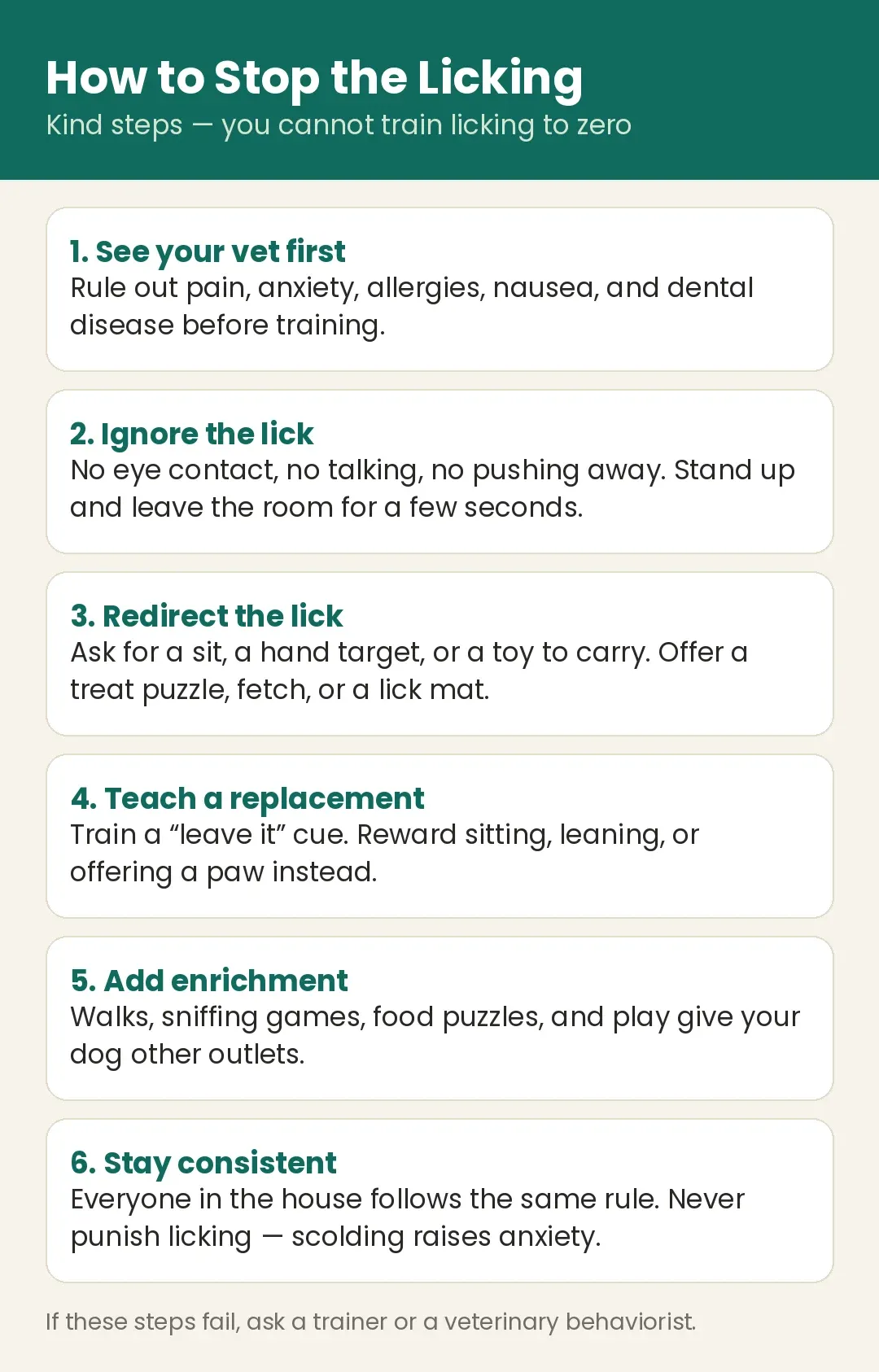
You cannot train licking to zero — it is a normal form of communication — but you can cut it back kindly.
See your vet first. Rule out medical causes before you treat licking as a training problem. A vet can check for anxiety, pain, allergies, nausea, and dental disease.
Ignore the lick. When your dog starts licking, give it nothing: no eye contact, no talking, no pushing away. Stand up and leave the room for a few seconds.
Redirect the lick. Ask for a sit, a hand target, or a toy to carry, and reward that instead. Offer a treat puzzle, play fetch, or start a short training session. A lick mat also gives a determined licker another outlet.
Teach a replacement behavior. Train a “leave it” cue so your dog can stop what it is doing and turn to you. Reward the behaviors you want — sitting, leaning, offering a paw — instead of the licking.
Add enrichment. Boredom feeds licking. Walks, sniffing games, food puzzles, and play give your dog other outlets.
Stay consistent. If you allow licking sometimes and stop it other times, your dog cannot learn the rule. Everyone in the household should follow the same rule.
Never punish licking. Scolding can raise anxiety, and anxiety can make licking worse. Praise the behavior you want rather than punishing the behavior you do not want. If these steps fail, contact a trainer or a veterinary behaviorist.
Dogs Licking Themselves, Their Paws, and Each Other
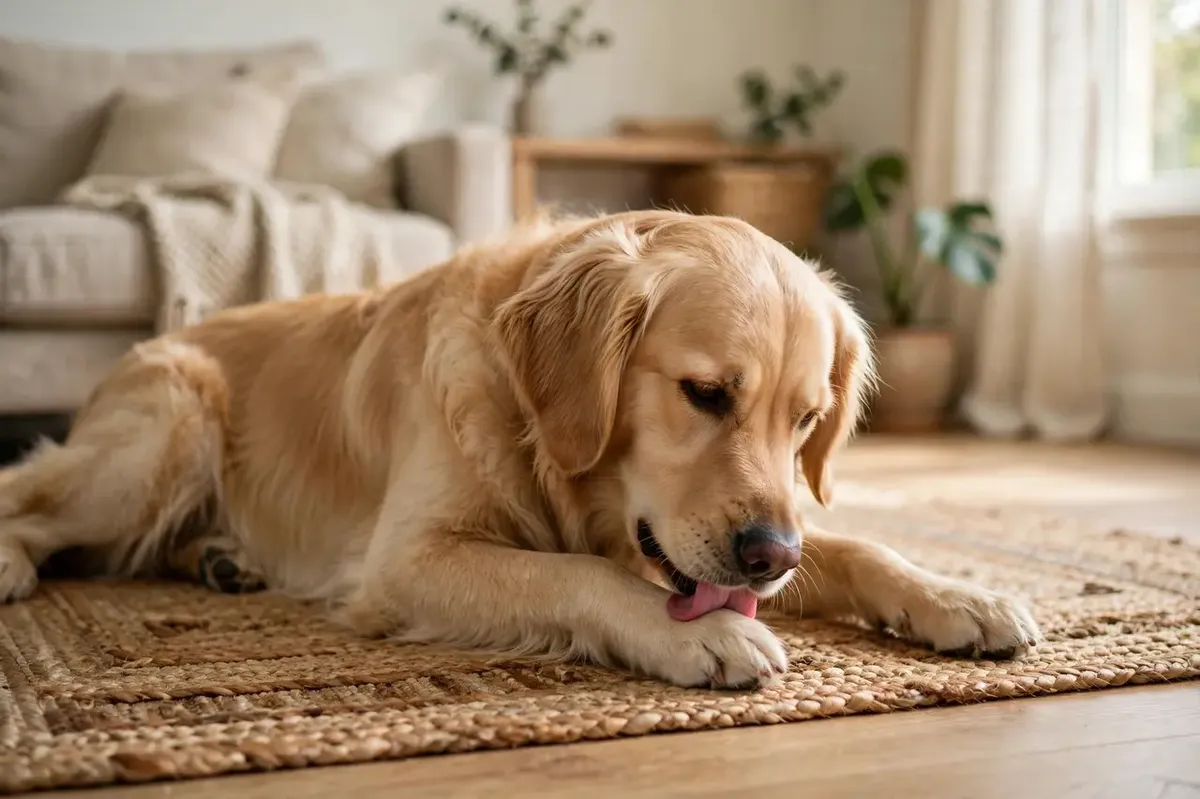
Dogs also lick their own paws — sometimes for comfort, sometimes because something itches.
Dogs lick themselves to groom, and normal self-grooming is fine. Obsessive self-licking is different: it can point to allergies, pain, anxiety, or another health problem, and it can cause sores.
A dog that licks one paw may have a cut, an abrasion, or an insect bite — Dr. Jerry Klein’s advice is to look at that paw first. A dog that licks several paws, especially with red or swollen skin between the toes, may have allergies, parasites, or contact with something caustic such as fertilizer.
Dogs lick each other to groom, bond, and send social signals. Puppies lick their mother’s muzzle, littermates lick each other for comfort, and adult dogs lick another dog’s face to show they are not a threat.