Why Do Dogs Eat Poop? Causes, Health Risks & How to Stop It (Vet Guidance)

Why do dogs eat poop? Dogs eat poop for many reasons, and vets call the habit coprophagia (pronounced kop-ruh-fey-jee-uh). Most cases come from normal dog behavior — instinct, curiosity, boredom, or habit.
Some cases point to hunger, a poor diet, or a medical problem.
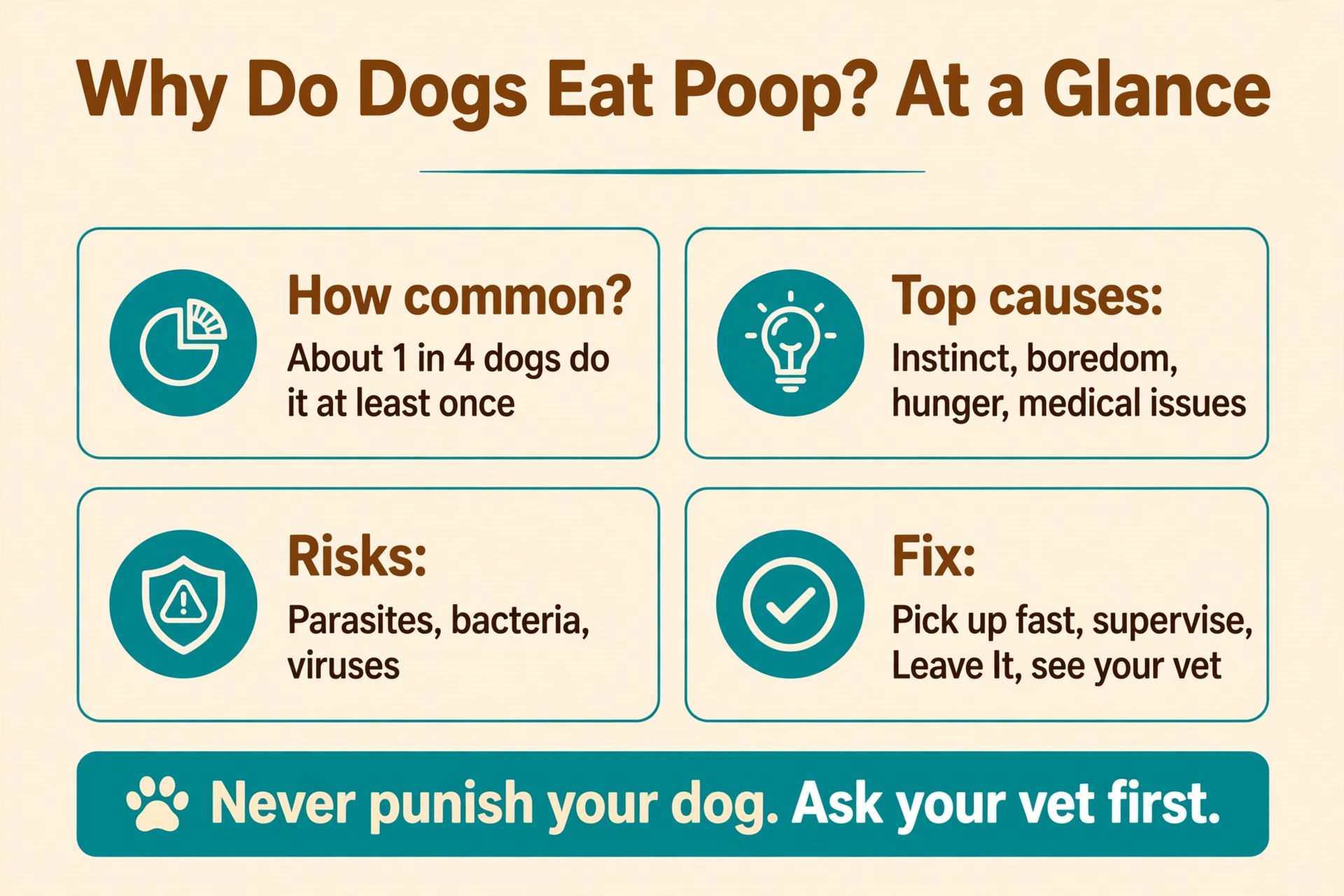
About 1 in 4 dogs eat poop at least once in their life, and about 1 in 6 do it often, according to the largest study on the topic, led by Dr. Benjamin Hart at the University of California, Davis.
This guide covers the causes, the real health risks, and how to stop it — without punishment.
Key Takeaways — Short Answer
What Is Coprophagia? The Three Types
Coprophagia means eating feces. Vets split it into three types, and the type changes both the risk and the fix.
| Type | What the dog eats | How common |
|---|---|---|
| Autocoprophagia | Its own stool | Less common — and more concerning behaviorally |
| Allocoprophagia (intraspecific) | Other dogs’ stool | The most common type |
| Inter-specific coprophagia | Other animals’ stool — cat, horse, rabbit, bird, deer, goose | Frequent, drawn by partly undigested nutrients |
The Hart study found that 85% of dogs who eat poop eat other dogs’ poop, not their own. It also found that 92% of poop eaters want fresh poop, only one to two days old. Dogs rarely eat soft, poorly formed stool or diarrhea.
They prefer firm, fresh stool — and frozen poop, which owners call a “poopsicle,” holds a special appeal.
Is It Normal for Dogs to Eat Poop?
Yes, at some life stages it is normal. Mother dogs eat their puppies’ poop for about the first three weeks after birth, and puppies often copy them. Rabbits need it for nutrients; dogs do not.
In adult dogs the habit is common but not harmless. Poop can carry parasites, bacteria, and viruses, so you should discourage it even though the behavior itself is natural. A single incident in a healthy adult dog is usually no cause for panic; a sudden habit is different and deserves a vet check.
Why Do Dogs Eat Poop? The Main Causes at a Glance
| Cause | Typical dog | First step |
|---|---|---|
| Instinct / scavenging | Any dog | Manage access — pick up fast |
| Mother-dog behavior / copying | Puppies, nursing mothers | Supervise, clean up, wait it out |
| Boredom, stress, anxiety | Under-stimulated or anxious dogs | More exercise and mental play |
| Attention-seeking | Dogs that get a big reaction | Stay calm, reward ignoring poop |
| Hunger / poor diet | Underfed dogs, poor-quality food | Vet-checked diet review |
| Medical problem | Adult dogs with sudden onset | Vet visit — fecal test and blood work |
Instinct and Evolution — Why Dogs Are Wired This Way
Dogs descend from wolves, and wolves kept their dens clean. The Hart study proposed that eating fresh stool in the resting area removed parasite eggs before they had time to mature into an infective state, which protected the pack. The authors call it a hypothesis, not a proven fact.
Dogs also evolved as scavengers, and behaviorist Steven R. Lindsay calls coprophagia a survival behavior for times when food is scarce.
Two patterns from the Hart study show how strong this wiring is. Coprophagia was more common in multi-dog households: only 20% of dogs in single-dog homes ate poop, while the figure rose to 33% in homes with three dogs.
Greedy eaters — dogs who steal food off tables — also tended to be poop eaters. In the same data, 51.1% of stool-eaters were greedy eaters, compared with 28.2% of other dogs. Female dogs were more likely to eat poop, and intact males were least likely.
Mother Dogs and Puppies — When Poop Eating Is Normal
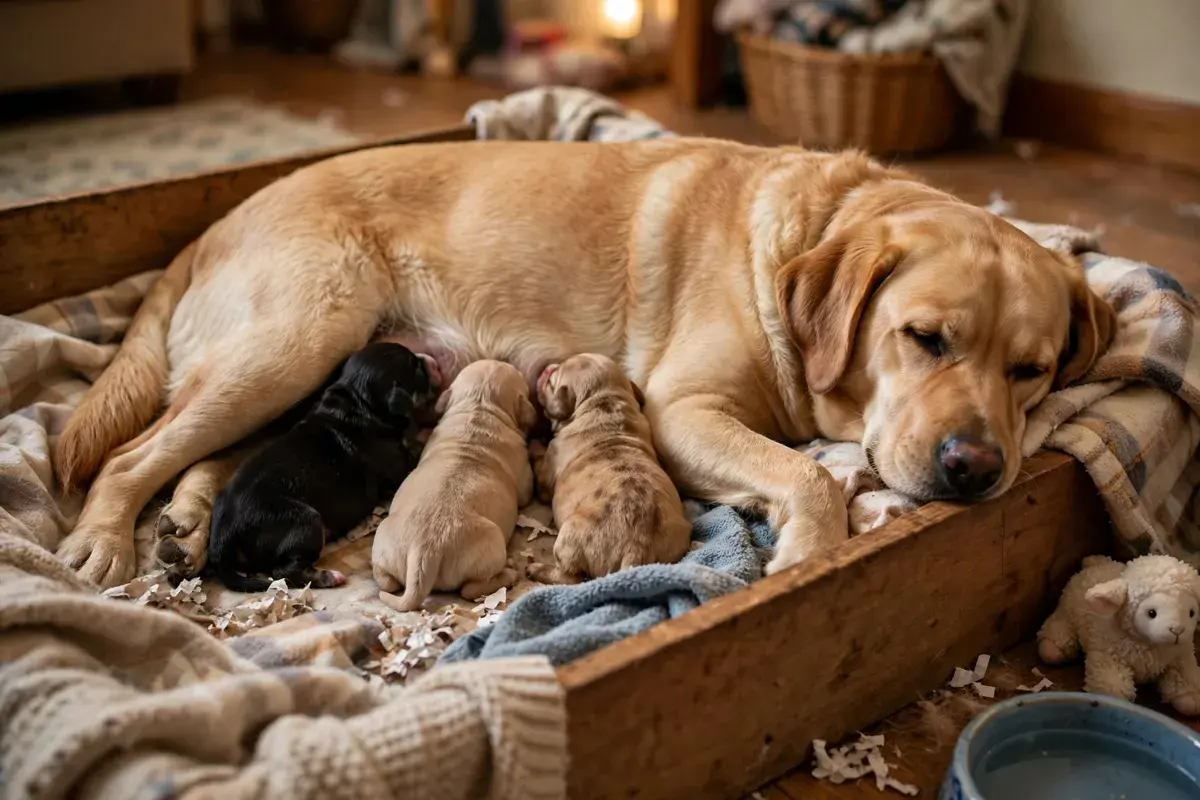
Mother dogs clean up after their puppies — for them, poop eating is normal and useful.
Mother dogs lick their puppies to trigger elimination, then eat the poop to keep the den clean and reduce predator-attracting smells. They do this for about the first three weeks.
Puppies copy what they see. They watch their mother eat poop, and they may sniff poop on her breath and confuse it with her scent. It may also help build gut bacteria in puppies.
Most puppies outgrow the habit. AKC says the behavior usually fades before the puppy is about nine months old. If it continues past six months, get the puppy checked.
Some puppies never outgrow it, and for them it becomes a hard habit to break. Use six months as the point to raise it with your vet, and nine months as the outer edge of the normal window.
Mother dogs do it for den hygiene and care, not hunger, and the habit usually stops once puppies eliminate outside their sleeping area.
Learned Behavior — Copying, Attention, and Hiding the Evidence
A puppy may copy its mother, its playmates, or another dog in the house. This trait is called allelomimetic behavior. In multi-dog homes, one dog doing it can lead others to follow.
Attention feeds the habit. If eating poop gets a strong reaction from you — even a negative one — your dog learns that poop eating reliably gets your attention. The fix is to stay calm and not overreact, then reward your dog for coming away from poop instead.
Harsh punishment creates the opposite of what you want. If you punish a dog during house training, the dog may eat its own poop to hide the evidence and avoid another punishment. That starts a vicious cycle: the dog eats the evidence, you punish more, the dog hides it faster.
VCA warns directly that rubbing a dog’s nose in its stool is an “outmoded, inhumane and useless” technique that may further encourage coprophagia. Dogs that are punished for eating poop often learn to do it only when you are gone.
Also keep feeding areas away from potty areas — dogs fed near poop may confuse the two smells. A healthy dog may also eat a sick housemate’s poop, which scientists link to pack-protection instinct.
Boredom, Stress, and Anxiety
A bored dog looks for something to do, and poop is often the most available thing in the yard. Dogs kept alone in kennels or basements, or confined to small spaces, show the habit more often.
Stress works the same way. Separation anxiety, noise anxiety, and fear all feed coprophagia. Vets call it a displacement activity — something in the mouth soothes a stressed puppy, and poop is always nearby.
Hunger sits close to boredom. Dogs may eat poop when they are not getting enough food, or when their diet lacks nutrients or calories. A poorly digestible diet leaves undigested food in the stool, which makes the stool smell like food.
Homemade diets can carry nutritional deficiencies if a boarded veterinary nutritionist does not balance them properly. If your dog seems constantly hungry, check the amount and quality of food with your vet before you assume the habit is purely behavioral.
Medical Causes — When Poop Eating Signals Illness
Most cases are behavioral, but VCA states clearly that medical problems “must first be ruled out before a purely behavioral diagnosis can be made.”
Parasites
Intestinal parasites, such as roundworms, hookworms, and whipworms, can increase appetite and drive unusual eating habits. They also cause inflammation and poor absorption, which leaves a dog hungry.
Malabsorption
Exocrine pancreatic insufficiency (EPI) means the pancreas makes too few digestive enzymes, so the dog cannot absorb nutrients. Dogs with EPI may eat stools, lose weight, pass large loose stools, and feel very hungry. EPI is most common in young German Shepherds. Chronic diarrhea, IBD, and other digestive disorders cause the same pattern.
Conditions that raise appetite
Diabetes, Cushing’s disease, and thyroid disease can make a dog ravenously hungry — vets call this polyphagia. A polyphagic dog with no food available may resort to eating poop. Medicines can do the same: steroids and some other drugs increase appetite and change behavior.
Pica
Some dogs eat non-food items because they are sick. Anemia and liver disease can cause pica — the tendency to eat rocks, plastic, clothing, dirt, and poop. If your dog eats other abnormal items alongside poop, tell your vet.
Senior-dog causes
Cognitive dysfunction can make an older dog forget how to go outside, have accidents, and eat the evidence. Arthritis can do the same through poor mobility. A sudden new habit in a senior dog can signal cognitive decline or an undiagnosed medical problem.
Vitamin deficiency — a conflict
AKC cites a 1981 study linking fecal microbes to thiamine, a B-vitamin, but the Hart study found no link between diet type and the habit. Do not assume a deficiency — ask your vet to check.
Why Dogs Eat Other Animals’ Poop — Cat, Horse, Rabbit, and More
Why do dogs eat cat poop? Cat food holds more protein than dog food, so cat feces contain undigested nutrients that dogs find hard to ignore. Cat poop also carries risks: roundworms, hookworms, Giardia, and sometimes Toxoplasma gondii from free-roaming cats.
Horse manure, rabbit droppings, deer poop, goose droppings, and goat poop hold digested vegetation and undigested grains that smell appealing — AKC singles out horse manure and goose droppings. Livestock manure can also carry dewormer or pesticide residues that can poison a dog.
If your dog targets one particular dog’s stool, get that dog checked — its food may be poorly digested, which leaves extra nutrients in its stool.
Why do dogs eat baby poop and diapers? Keep diapers out of reach, just as you would a litter box.
Why do dogs eat human poop? TopDogChoice lists human waste in its types table and notes it can signal a deficiency or a serious behavioral problem. Treat it like any sudden or intense habit: see your vet.
If your dog does either one, ask your vet rather than trusting an online guess.
Why do dogs eat poop in winter, and why do dogs eat frozen poop? Dogs love frozen poop, an especially exciting treat that you may call a poopsicle. Winter freezes stool before you can pick it up, so the temptation sits in the yard longer.
Pick up stool the same day, even in cold weather, because the habit feeds on fresh stool.
Why do some dogs eat poop and others don’t? No single answer exists. Individual temperament, habit, and opportunity matter more than breed — Medivet states there is no strong evidence that any particular breed is significantly more prone to coprophagia.
Is Eating Poop Dangerous? Health Risks for Dogs and People
A dog’s own fresh stool is unlikely to harm a healthy dog, though a dog with worms can reinfect itself. Other animals’ stool carries the bigger risk:
Watch for vomiting, diarrhea, lack of appetite, and not acting like themselves — see your vet if you notice any of those after your dog eats poop.
Your dog can also spread harmful bacteria or parasites to you through licking. Do not let a poop-eating dog lick you, wash your hands after touching their toys and dishes, and clean bowls and toys regularly. The risk matters most around children and anyone with a weakened immune system.
One myth deserves plain language. Some people claim there are no health risks and that feces is generally safe to eat from a healthy animal. That is wrong. Stool can carry parasites, bacteria, viruses, and medicines. The risk is real, and it grows with other animals’ stool.
Eating poop itself rarely kills a dog. The danger comes from what it carries — a heavy parasite load, parvovirus in an unvaccinated dog, or a toxic residue such as horse dewormer.
Many dogs eat poop and show no symptoms, but that does not make it safe — a dog can carry parasites or bacteria without looking sick and pass them to other pets and people.
When to See a Vet — Warning Signs and What the Vet Does
Book a vet visit soon if your dog:
Your vet will take a history, examine your dog, and likely recommend a fecal test for parasites, blood tests, and urine tests. A stool test is the minimum check. Bring a fresh stool sample if you can. If anxiety looks like the trigger, your vet may refer you to a certified clinical veterinary behaviorist.
Even routine poop eaters should raise the habit at the next wellness appointment — and sooner if your dog eats other animals’ poop, because periodic fecal exams matter more then.
How to Stop a Dog Eating Poop — The 4-Track Plan
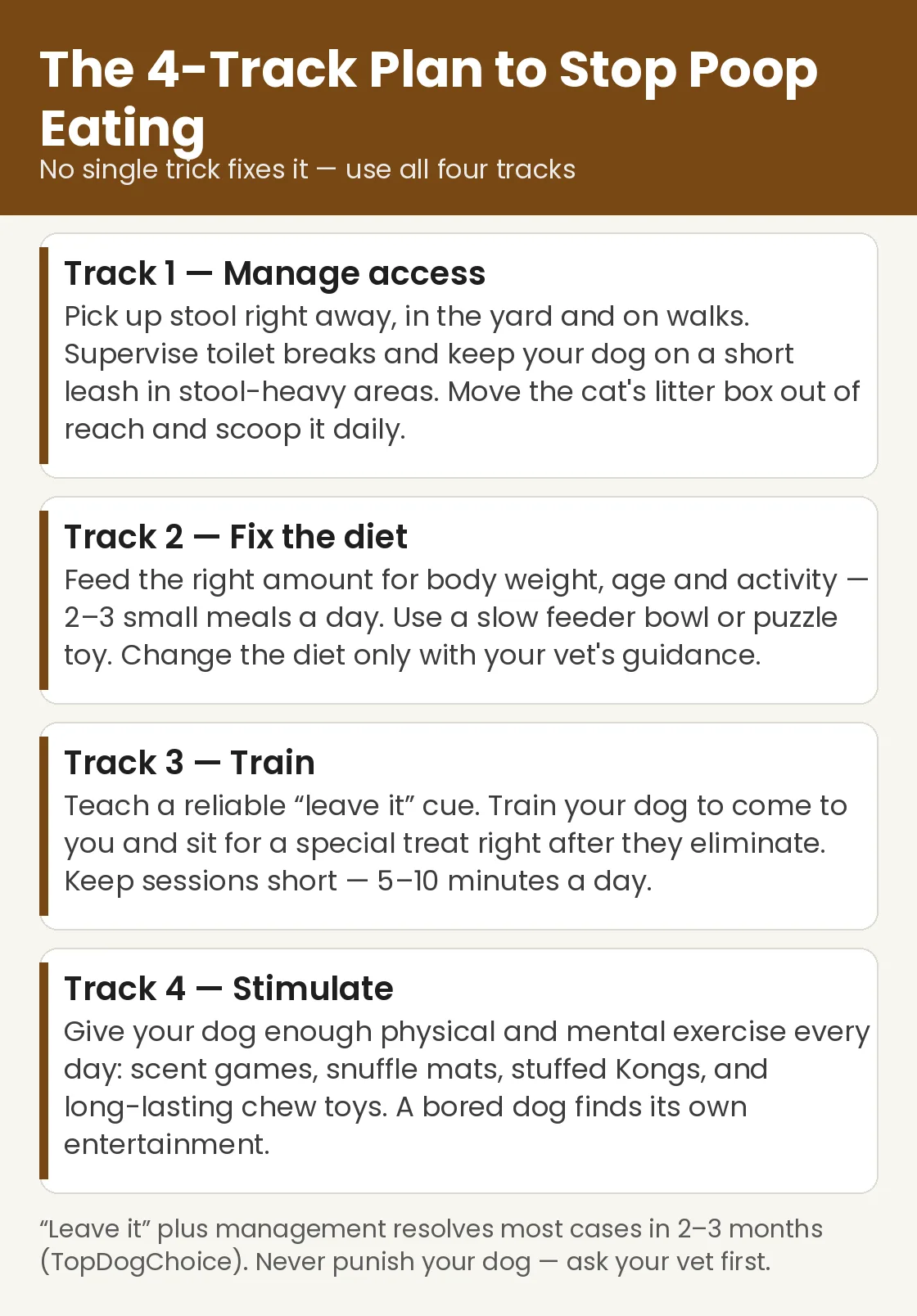
The 4-track plan to stop poop eating — manage access, fix the diet, train, and stimulate.
No single trick fixes it. Work on four tracks: manage access, fix the diet, train the dog, and add stimulation. A reliable “leave it” cue plus management resolves most cases in 2–3 months.
Track 1: Immediate management — remove the temptation
Pick up your dog’s stool right away, in the yard and on walks. Keep a diary of when your dog usually goes, so you can be ready.
Supervise toilet breaks and keep your dog on a short leash, about 4 feet, in areas thick with stool, such as dog parks and rural land with livestock. Change your walk route to one with less dog poop.
Move the cat’s litter box out of your dog’s reach, behind a baby gate or dog gate, or switch to a top-entry or self-cleaning litter box. Scoop the box daily. Secure compost and check the garden before unsupervised access.
Track 2: Diet — make the food and the stool less appealing
Check that your dog eats the right amount of food for their body weight, age, and activity level. Feed small, frequent meals from a quality brand. A regular feeding schedule of 2–3 meals a day helps a dog feel full between meals.
A more digestible diet can help. Slow your dog down at meals with a slow feeder bowl, a puzzle toy, or chew toys placed in the food dish. Fast eating leaves food poorly digested, and undigested food in stool tempts a dog to eat it.
Make any diet change with your vet’s guidance, not on your own.
Track 3: Training — teach “leave it” and reward coming away
Teach a reliable “leave it” cue. Start indoors in a calm space with food rewards, then build up to practicing outdoors near distractions.
Train your dog to come to you and sit for a special treat immediately after they eliminate — that way your dog learns to turn to you for something tasty instead of turning toward the stool on the ground.
Reward your dog for walking past poop without eating it, and use high-value treats so ignoring poop is genuinely worth it. Keep sessions short — 5–10 minutes a day beats one long session.
Track 4: Mental stimulation and exercise
Give your dog enough physical and mental exercise every day. Add scent games, such as hiding treats around the house, snuffle mats, stuffed Kongs, and long-lasting chew toys. A bored dog with nothing to do will find its own entertainment, and poop is the easiest option in the yard.
Deterrents, Supplements, and Home Remedies — What Works and What Doesn’t
Many owners hope a product will end this habit. This section looks at taste deterrents, pineapple, other home remedies, enzymes, probiotics, vitamins, and a basket muzzle, and tells you which have real support and which do not.
Commercial taste deterrents have mixed results
Deterrent treats and powders can help make poop less palatable, but results vary and you may have to try a few. In the Hart study, 11 marketed anti-poop products had owner-reported success rates of 0% to 2%.
Pineapple is popular but unproven
Pineapple tends to be the most effective food deterrent, and fresh may beat canned because it holds more bromelain. A common dose is a couple of teaspoons once a day, or 1–2 small chunks. Choose canned pineapple in 100% juice with no added sugar.
Sugar-free syrups can carry xylitol, which is toxic to dogs. Such additives have never been proven effective, and they do nothing for other animals’ stool. Ask your vet before trying it.
Other home remedies
VCA says these were published but never proven effective. Do not rely on them.
Enzyme supplements and probiotics
Enzyme supplements with papain or bromelain may improve digestion and make stool less appealing, but the effect is debated and unproven. Probiotics may support gut health, but no study shows they stop the habit. Ask your vet before adding any supplement.
Vitamin supplements
AKC notes the old thiamine theory, but the Hart study found no diet link, so a multivitamin is not a proven fix. If your vet diagnoses a real deficiency, they can prescribe supplements.
Basket muzzle
If all else fails, a basket muzzle lets your dog pant and drink while stopping them from picking up feces on walks. Keep it easy to clean, because it will get messy.
TopDogChoice calls a quarterly deworming schedule prudent if your dog eats other animals’ stool regularly, but ask your vet what fits your dog.
What Doesn’t Work — Mistakes That Make It Worse
Punishing your dog when you catch them does not work. Your dog does not connect the scolding to the act — it learns to hide and eat in secret. Rubbing your dog’s nose in the stool is aversive and traumatic, with no educational value.
Putting pepper or hot sauce on known stool sours your dog’s temperament, and sometimes the dog still likes the taste. Bitter sprays on poop often fail — your dog may even like the taste.
Your First-Week Plan — A Simple Daily Routine
Changing a habit works best with a simple daily routine. This plan walks you through your first week, step by step, with clear tasks to do each day. See your vet if the habit is new or sudden.
Day 1
Book a vet visit if the habit is new, sudden, or comes with other symptoms. Pick up every stool in the yard today. Move the litter box out of reach.
Day 2: Start a toilet diary — note the times your dog goes, so you can supervise those windows. Begin “leave it” practice indoors with treats. Day 3: Switch to a short leash on walks and change your route if it passes heavy stool areas.
Day 4
Practice recall after toileting — call your dog to you for a high-value treat the moment they finish. Reward every success. Day 5: Add one new mental game, such as a snuffle mat or a stuffed Kong.
Review your dog’s food amount and quality with your vet if you have not already. Day 6: Check the yard and garden for other animals’ droppings and block access to compost. Keep the routine steady — consistency matters more than correction. Day 7: Review the week and count successes.
If the habit persists after 3–4 months of correct work, or it comes with compulsions, anxiety, or self-injury, ask your vet for a referral to a veterinary behaviorist.